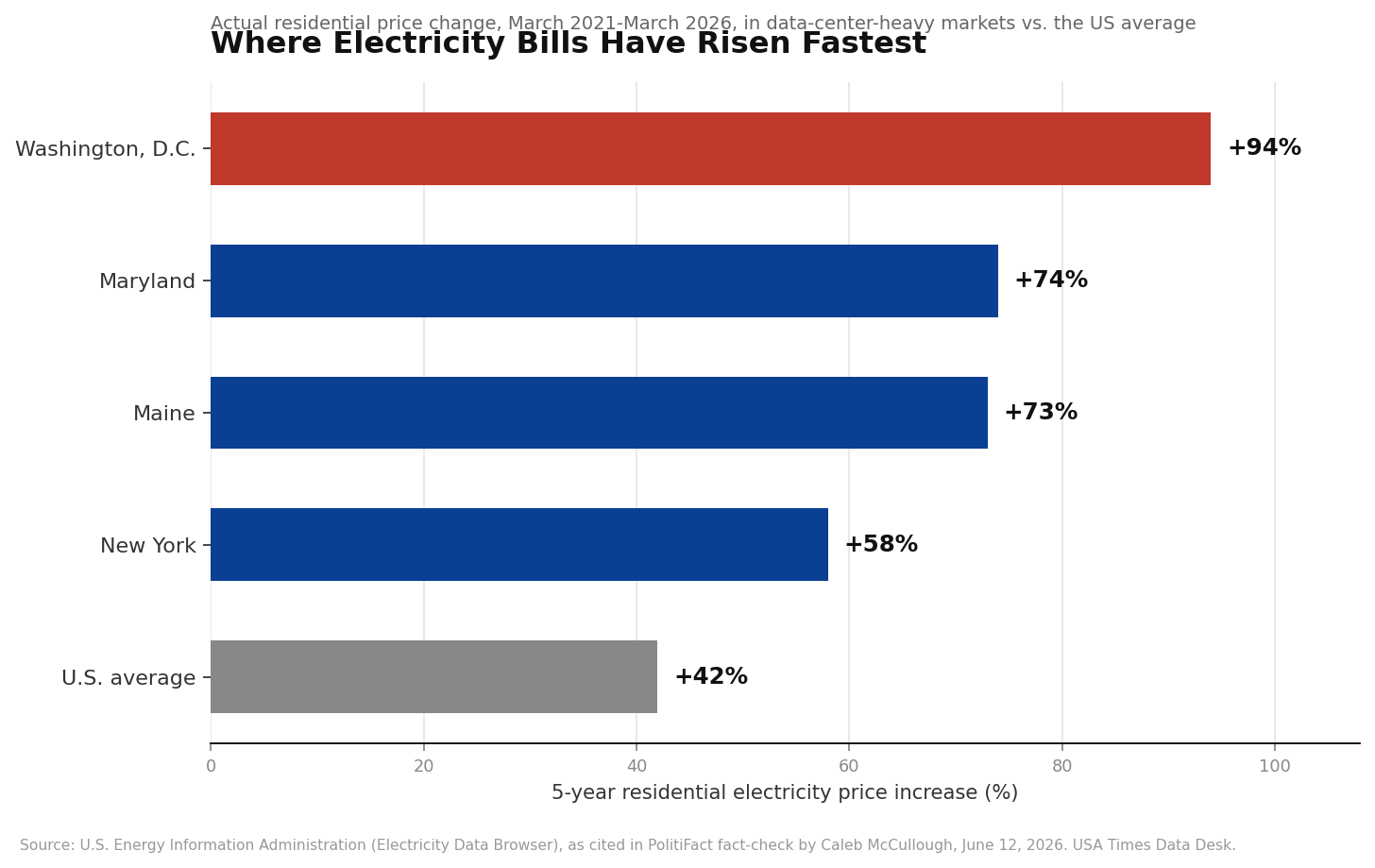
In June, Sen. Elizabeth Warren posted that residents living near large AI data centers had seen their electricity bills “go up by as much as 267%” over five years — a figure she’d also used in a formal Senate letter to data-center companies in December 2025. PolitiFact rated the claim Mostly False. Not because data centers aren’t raising electricity costs — they demonstrably are — but because the 267% figure measures something different from what a residential customer actually pays. The real numbers, once you separate wholesale market prices from what shows up on an actual bill, are still striking: residents of Washington, D.C. have seen their electricity costs rise 94% over five years, more than double the 42% national average, with Maryland (+74%), Maine (+73%), and New York (+58%) not far behind.
Wholesale vs. Residential: Two Different Numbers
Hover any bar for what it actually measures.
Batmandir · The Circle Full access to theatres, museums & exhibitions. S2 · ongoing membership, without a Founder’s seat. Explore membership →Where the 267% number actually came from
The figure traces back to a Bloomberg analysis published in September 2025, which found that wholesale electricity prices at specific grid pricing points — “nodes” — located near data centers had risen as much as 267% between April 2020 and April 2025. That’s a real, sourced number. But wholesale nodal prices aren’t the same thing as a residential electric bill. Yale School of the Environment economist Kenneth Gillingham told PolitiFact that the wholesale “supply” component Bloomberg measured typically makes up only “about 30% to 50%” of what a customer actually pays — the rest is transmission, distribution, and taxes, layered on separately by regulated utilities. And even that supply-side increase doesn’t flow through to consumers automatically: utilities generally need state regulatory approval before passing wholesale cost increases on to ratepayers, which is part of why a 267% wholesale spike near a data center doesn’t translate directly into a 267% bill increase for the household down the street.
What the actual residential numbers show
Pulling directly from the U.S. Energy Information Administration’s own data, PolitiFact found that average U.S. residential electricity costs rose 42% over the five years from March 2021 to March 2026. In the specific markets with the heaviest data-center concentration, the increase has been substantially steeper: Washington, D.C. at 94%, Maryland at 74%, Maine at 73%, and New York at 58%. None of those numbers require any wholesale-to-retail translation — they’re what residential customers in those markets actually paid, comparing the same five-year window Warren’s claim referenced. The gap between “94% in D.C.” and “267% near data centers” is the gap between a real, verified consumer impact and an overstated one; PolitiFact’s own conclusion was that Warren’s claim “has an element of truth” but “gives the wrong impression about the precise effect on consumers’ utility bills so far.”
The mechanism regulators are tracking directly
Beyond the wholesale-versus-retail distinction, PolitiFact cited PJM Interconnection’s own Independent Market Monitor — the regional grid operator covering 13 states and D.C. — which concluded in a June 2025 report that “data center load growth is the primary reason for recent and expected capacity market conditions,” and quantified it directly: data center demand added $9.3 billion, or 174%, to capacity costs for the 2025-26 delivery year compared with a scenario without that added demand. Ari Peskoe, director of Harvard Law School’s Electricity Law Initiative, put the mechanism in plainer terms: “Data centers are causing tens of billions of dollars of price increases in wholesale power markets and driving utilities to spend tens of billions of dollars on delivery infrastructure. In general, these cost increases are spread to all ratepayers by the utility” — meaning ordinary households end up subsidizing grid buildout driven by a small number of very large industrial customers, even in places without a data center nearby.
Data centers aren’t the only thing driving prices up
PolitiFact’s reporting also cited an April 2026 Lawrence Berkeley National Laboratory report on retail electricity price trends, which identified other significant drivers beyond data-center demand: rising equipment costs, an aging grid infrastructure requiring replacement, and state and federal clean-energy requirements that carry their own capital costs. That’s a meaningful caveat on the broader “AI is raising your electric bill” narrative — data centers are a real, quantified, and growing contributor, particularly in specific regional markets, but they’re layered on top of cost pressures that predate the current AI buildout and would exist even without it.
Why this fight is happening now
The dispute over how to measure data centers’ effect on electricity bills is playing out at exactly the moment the underlying buildout is accelerating fastest. Every major AI company is racing to secure gigawatts of new data center capacity to train and run increasingly large models, and that capacity has to draw power from the same regional grids serving ordinary residential customers — there’s no separate electricity supply reserved for AI infrastructure. That’s precisely the dynamic Peskoe pointed to: costs “spread to all ratepayers by the utility,” regardless of whether an individual household lives near a data center or benefits from anything the data center does. It’s also why this is likely to stay a live political fight rather than settle after one fact-check — Warren’s December 2025 letter to data-center companies was itself framed as the start of a Senate investigation, not a one-off statement, and the underlying build-out that’s driving PJM’s capacity-cost increases shows no sign of slowing in the near term.
What we did
Every figure in this article — the 267% wholesale claim and its Bloomberg origin, the 42% national and state-level residential increases from EIA data, the PJM Independent Market Monitor’s $9.3 billion/174% capacity-cost figure, and the direct quotes from Kenneth Gillingham and Ari Peskoe — comes from PolitiFact’s fact-check, published June 12, 2026 and written by Caleb McCullough, which we read in full rather than relying on a summary. PolitiFact’s own reporting draws on primary sources we did not re-verify independently ourselves — the EIA’s Electricity Data Browser, PJM’s own Independent Market Monitor report, and the original Bloomberg analysis — but we’ve attributed each specific figure to the specific source PolitiFact cited for it, rather than treating PolitiFact’s synthesis as a single undifferentiated source. We chose to build this piece around a fact-check specifically because the core news value here is the correction itself: a viral, politically significant number turns out to conflate two different measurements, and the real, verified numbers underneath it are less dramatic in one sense but more precisely tied to what consumers actually pay.