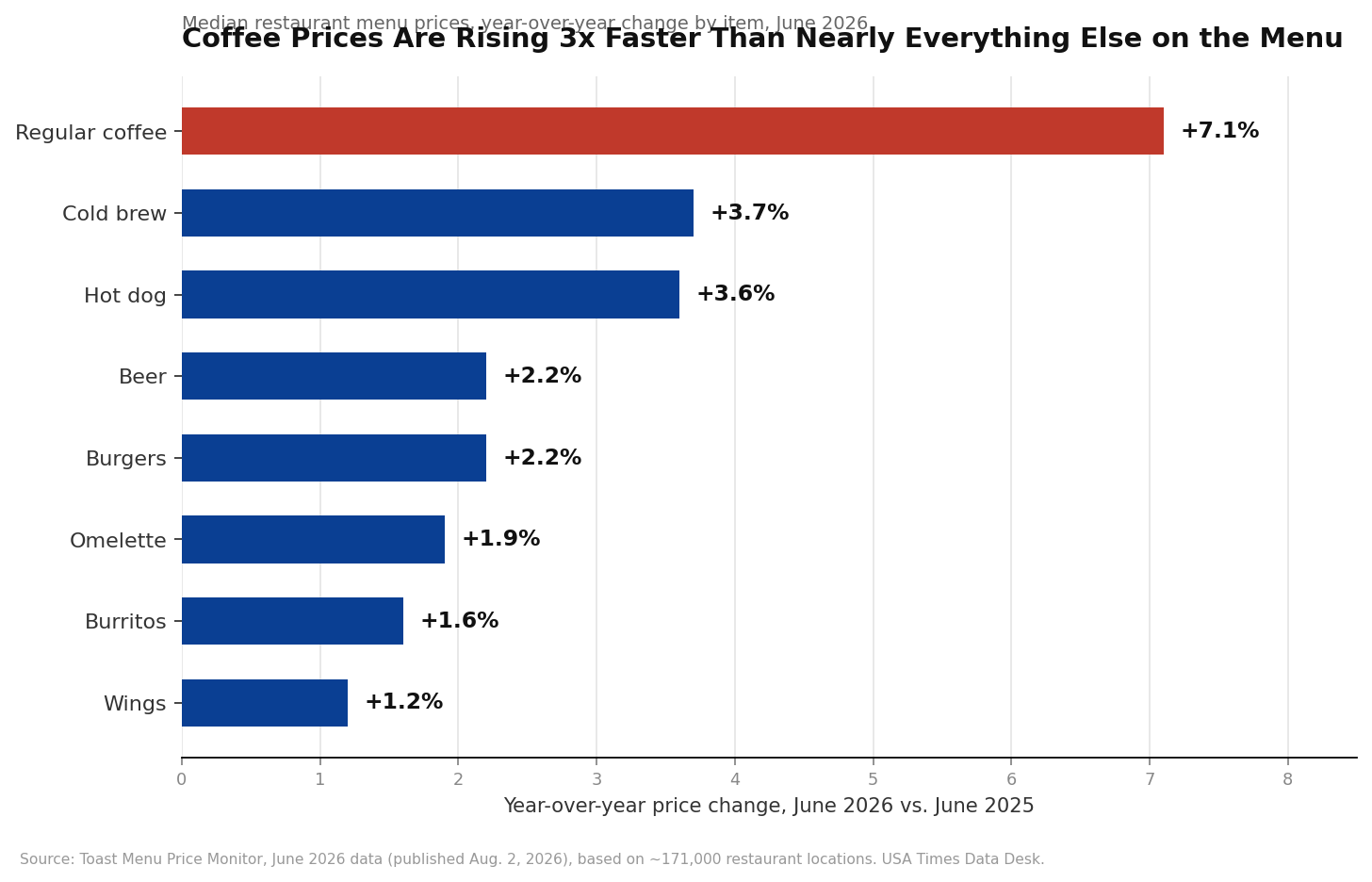
The median price of a regular hot coffee at U.S. restaurants reached $3.75 in June 2026, up 7.1% from a year earlier — more than three times the pace of nearly every other menu item Toast tracks across its network of roughly 171,000 restaurant locations. Burgers rose 2.2% over the same period, beer 2.2%, wings just 1.2%. Coffee’s outsized increase is happening at the same time the National Restaurant Association’s own 2026 State of the Industry report found that 42% of operators said their restaurant was not profitable last year — meaning the price increases restaurants are passing to customers aren’t, for a large share of operators, translating into an actual profit.
Median Menu Prices, June 2026
Hover any bar for the price and year-over-year change.
Batmandir · Founders A numbered seat at the table. S3 · The Founders Club — 161 seats per location. By invitation. Explore membership →Why coffee is the outlier
Coffee’s price trajectory has been unusually steady and steep: Toast’s month-by-month data shows the year-over-year increase climbing almost every single month, from 3.6% in June 2025 to 7.1% by June 2026, without the kind of leveling-off or reversal visible in most other menu categories. Toast attributes this specifically to upstream commodity pressure rather than restaurant-level cost control: coffee is grown almost exclusively in a narrow band of countries known as the “bean belt,” and extreme weather — both droughts and flooding — has strained production even as demand keeps growing. Notably, Toast’s own reporting flags that recent drops in global coffee futures prices, tied to favorable Brazilian crop forecasts, “likely haven’t yet reached the operator level” — meaning restaurants may still be pricing in cost increases that occurred months earlier, with any relief from recent futures declines yet to show up on menus.
Most of the rest of the menu is rising much more slowly
Outside of coffee and cold brew (up 3.7%) and hot dogs (up 3.6%, tied partly to tomato prices that Toast notes have “surged 40% in just one year”), the bulk of tracked menu items rose at rates closer to general inflation: burgers and beer both up 2.2%, omelettes up 1.9%, burritos up 1.6%, and wings up just 1.2% — the smallest increase of any item Toast tracks. Wings’ relatively muted pricing has a specific cause tied to a completely different part of the food supply chain: broiler chickens, the birds that produce wings, have been far less exposed to the avian flu outbreak that has driven egg prices sharply higher since 2024, because egg-laying hens and broiler chickens are different birds with different production cycles and different exposure to the outbreak.
The profitability picture behind these price increases
The National Restaurant Association’s 2026 State of the Restaurant Industry report, released in February 2026, projects total industry sales will reach $1.55 trillion this year, with real (inflation-adjusted) sales growth of just 1.3%. That’s a modest topline number sitting on top of a much rougher underlying picture: more than 9 in 10 operators cited food, labor, insurance, energy, and swipe fees as significant challenges, and NRA Chief Economist Dr. Chad Moutray noted that “after a year when 60 percent of operators reported softer customer traffic, there is cautious optimism for improvement” — language that frames 2026 as a recovery attempt from a genuinely difficult 2025, not confirmation that conditions have already turned around. NRA President and CEO Michelle Korsmo characterized the industry as resilient “even when faced with soft consumer spending and sustained margin pressures,” language that itself acknowledges the pressure is real and ongoing rather than resolved.
Why raising prices further isn’t a simple fix
Toast’s own separate 2026 Independent Restaurant Industry Report found that restaurants raising menu prices by more than 10% were, on balance, more likely to expect lower profits going forward — not higher ones. The likely mechanism is straightforward: aggressive price hikes tend to suppress customer traffic and order volume enough to offset the extra revenue per item, particularly at a moment when the NRA’s own data shows more than 7 in 10 consumers say they would eat out more often if they had more disposable income, implying discretionary restaurant spending is already constrained by consumer budgets rather than by menu prices being too low. That combination — cost pressure pushing operators toward price increases, and price increases beyond a certain threshold correlating with weaker rather than stronger profitability — is a large part of why NRA’s framing for 2026 leans on operational efficiency and technology investment rather than further pricing power as the industry’s likely path forward.
The workforce constraint layered on top
Restaurant and foodservice employment is projected to reach 15.8 million jobs in 2026, with the industry expected to add more than 100,000 net new positions even amid the margin pressure described above. But nearly three-quarters of operators who plan to hire say they expect difficulty finding experienced managers and chefs specifically, and the NRA’s report points to a structural, longer-term problem behind that: a shrinking population of 16-to-24-year-olds, the age cohort restaurants have traditionally relied on most heavily for entry-level staffing. The report explicitly frames “sustained workforce development and immigration reform” as necessary responses to that demographic trend — meaning the industry’s hiring plans for 2026 depend on a labor pool that NRA’s own analysis says is structurally shrinking, independent of how strong or weak consumer demand turns out to be.
What we did
The menu-price figures come directly from Toast’s “Menu Price Monitor,” specifically the June 2026 update published August 2, 2026, which aggregates transactional data from Toast’s restaurant point-of-sale network (approximately 171,000 locations as of the company’s most recent disclosed count). Toast’s own methodology notes explicitly describe this as a snapshot of all applicable Toast-platform restaurants in a given month, not a same-store-sales comparison — meaning some of the year-over-year change could reflect which restaurants were active on Toast’s platform in each period, not solely price changes at continuously-operating locations, a limitation Toast itself discloses. The industry-wide profitability, traffic, sales-growth, and workforce figures, along with both direct quotes, come from the National Restaurant Association’s February 12, 2026 press release announcing its 2026 State of the Restaurant Industry report, which we read in full. The “menu prices above 10% correlate with lower expected profits” finding is attributed to a separate Toast publication, its 2026 Independent Restaurant Industry Report, which we did not read in full ourselves — we’re citing this specific finding as reported by Toast’s own published summary of that report rather than the underlying report’s full methodology.