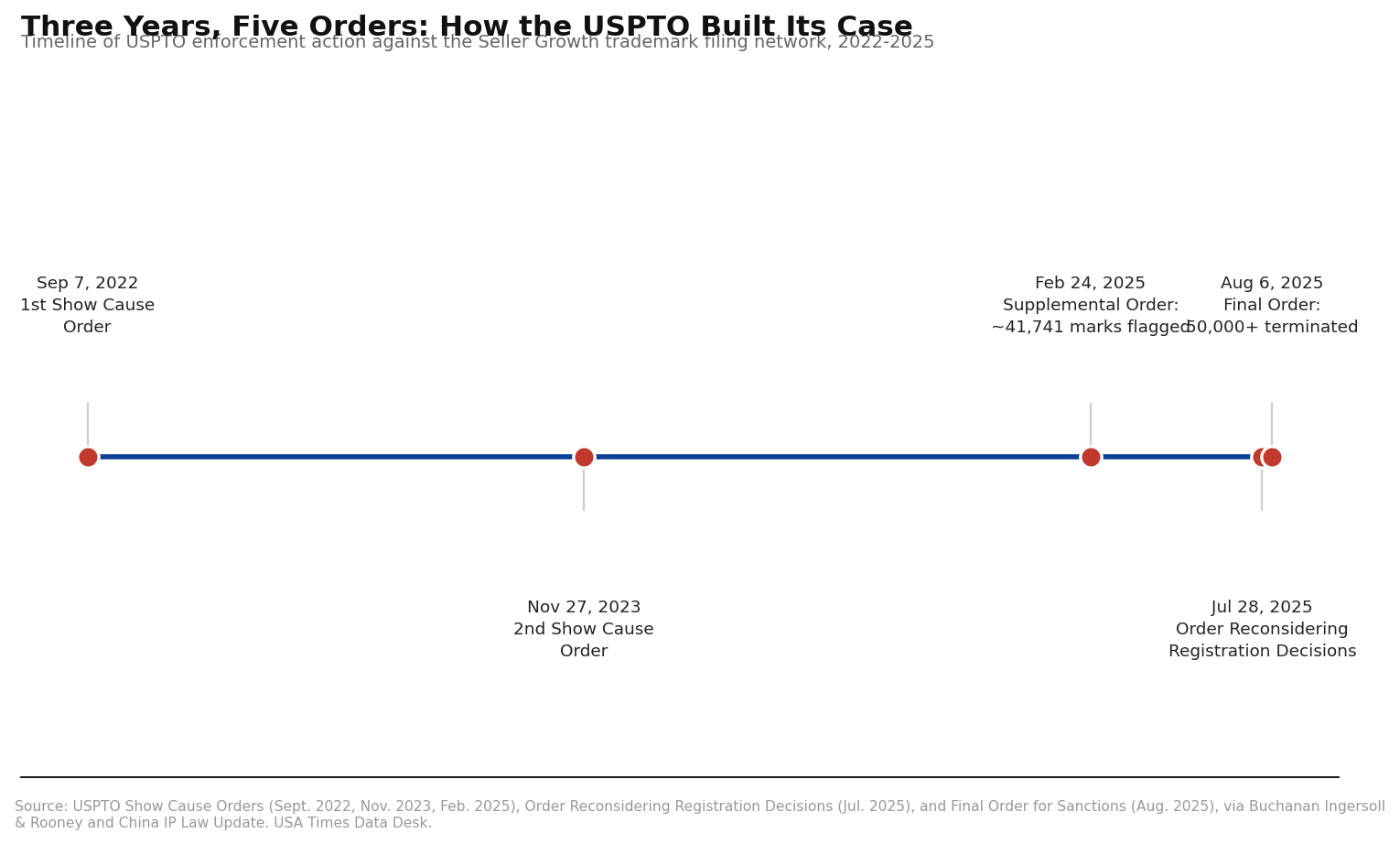
In an August 6, 2025 Final Order for Sanctions, the U.S. Patent and Trademark Office terminated more than 50,000 trademark applications and registrations linked to a single China-based filing network the agency calls “Seller Growth” — Shenzhen Chenhaiyun Tech. Co., Ltd. and its subsidiaries Shenzhen Seller Growth Network Tech. Co., Ltd., Shenzhen Qianhai Bishengdao Network Tech. Co., Ltd., and Shenzhen Qianhai Be-Victory Network Tech. Co., Ltd. Getting there took three years and five separate USPTO orders, starting with an initial Show Cause Order in September 2022 and ending with last August’s final sanctions order — a case that illustrates just how difficult it is for the agency to unwind large-scale filing fraud once it’s baked into the trademark register.
The Seller Growth Case: Order by Order
Hover any step for what the USPTO found or decided.
Batmandir · Founders A numbered seat at the table. S3 · The Founders Club — 161 seats per location. By invitation. Explore membership →How Seller Growth allegedly worked the system
USPTO rules require foreign-domiciled trademark applicants to be represented by U.S.-licensed counsel — a rule meant to ensure a qualified attorney is actually reviewing filings for accuracy before they reach an examiner. According to the USPTO’s own orders, Seller Growth circumvented that requirement three ways: contracting with U.S.-licensed attorneys in order to improperly use their licensing credentials, entering those attorneys’ electronic signatures onto submissions without proper authorization, and sharing USPTO.gov accounts across filings and communications with the agency. The USPTO also found that Seller Growth submitted false specimens of use — the photos or samples applicants must provide to prove a mark is actually being used in commerce — in at least 2,500 applications.
The same pair of shoes, ten different applicants
The fake-specimen problem isn’t unique to this one network — it’s part of a broader pattern the USPTO’s Commissioner of Trademarks has described publicly. At a Trademark Policy Advisory Council meeting, the Commissioner described examining attorneys catching fraud by literally recognizing the same product photographed for multiple, unrelated applications: “They’re filing [a use based] application and sending in a photograph of, say, some shoes with a tag on them. It looks like a great specimen until you see the same pair of shoes with the same shadow in the photograph 10 times filed by different applicants with different marks.” The USPTO has since assigned an examining attorney to work full-time on identifying these fabricated specimens and launched a pilot program letting third parties help flag suspicious filings.
A possible financial motive: provincial subsidies for foreign trademarks
One widely cited explanation for the volume of Chinese trademark filings, including allegedly fraudulent ones, is a set of Chinese provincial government subsidy programs that pay cash rewards to businesses that register trademarks abroad. Shenzhen’s program, for instance, has offered roughly RMB 5,000 (about $700-800 depending on the exchange rate) per single-country trademark registration obtained, payable within a year of the registration certificate being issued. Against a U.S. filing cost in the low hundreds of dollars, that leaves a meaningful profit margin per registration — enough, proponents of this theory argue, to make mass-filing low-quality or fabricated applications a viable income strategy for individuals in China, given that the median monthly income cited in the original reporting on these subsidies was around $1,000. We’re flagging clearly that this subsidy connection is a widely cited explanation, not something the USPTO’s Seller Growth orders themselves establish as the network’s specific motive — the agency’s orders describe the conduct and the rule violations, not why the network did it.
Scope grew as the case proceeded
The scale of the action expanded significantly between the USPTO’s February 2025 supplemental order and its final August 2025 sanctions order. The February 2025 filing identified roughly 41,741 individual trademarks tied to Seller Growth, spanning application dates from 2010 to 2023, and gave the network until late March 2025 to respond with evidence before facing cancellation. By August, after a July 2025 order reconsidering the registration decisions, the final tally of terminated applications and registrations exceeded 50,000 — meaning the case grew by roughly 8,000-9,000 additional trademarks between the supplemental order and the final sanctions order, on top of the sanctions themselves, which permanently bar Seller Growth from submitting any trademark-related documents to the USPTO on behalf of itself or anyone else going forward.
Seller Growth’s public response
Seller Growth has publicly disputed the USPTO’s characterization at earlier stages of the case. Responding to the 2022 Show Cause Order, the company described the USPTO’s review as “routine” and stated there was “no so-called sanctions by the USPTO, and the relevant rumors are all rumors,” adding that the inquiry would “not have any impact on the customers we have served and future customers.” Separately, following the February 2025 supplemental order, the Shenzhen Intellectual Property Protection Center — a local government-affiliated body — issued guidance to Chinese businesses potentially affected, advising them to verify their trademark agents’ credentials directly with the USPTO and warning that submitting false evidence of use “will constitute a false application and increase the risk of trademark rejection or revocation.” We’re including both responses because they represent the affected party’s and a related government body’s public positions, distinct from the USPTO’s own findings.
What we did
The core facts and figures in this article — the five-order timeline, the 41,741-mark February 2025 supplemental order, the 50,000+ final termination count, the false-specimen finding in at least 2,500 applications, and the specific rule-circumvention methods — come from a Buchanan Ingersoll & Rooney legal alert published August 20, 2025, and a National Law Review article by Aaron Wininger of Schwegman, Lundberg & Woessner (republished from China IP Law Update) published March 2, 2025, both of which summarize and quote directly from the USPTO’s own published orders; we read both law-firm summaries in full and cross-checked the overlapping facts (the show-cause order dates, the entity names, the 41,741 figure) between them for consistency, though we did not independently download and read the full-text USPTO order PDFs ourselves. The Commissioner of Trademarks quote about duplicate shoe-photo specimens and the Shenzhen subsidy program figures come from a Gerben IP article originally published in April 2018 and updated in August 2025 — we’re flagging that dating explicitly because the underlying subsidy-program details (the RMB 5,000 figure, the $1,000 median income reference) describe a program as reported years ago, not a current 2025-2026 subsidy rate we’ve independently verified, and we’ve worded our use of that material to reflect it’s a “widely cited explanation” rather than a confirmed current-year mechanism.