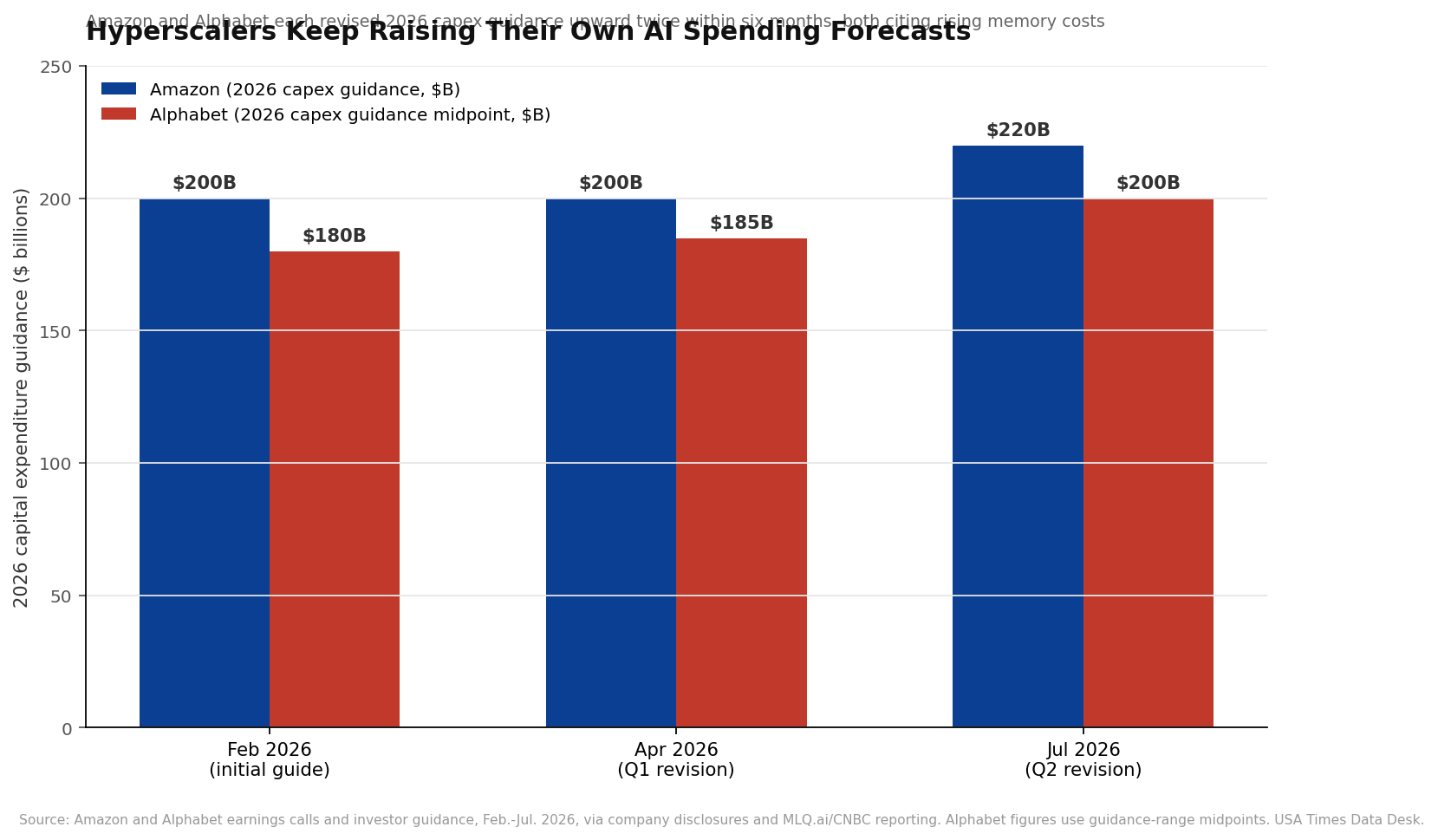
Amazon told investors on its July 30, 2026 earnings call that it now expects to spend approximately $220 billion on capital expenditures this year — up from the roughly $200 billion it had guided to back in February, and higher still than what most analysts had modeled. The company said the $20 billion increase was driven primarily by rising memory chip costs, not an expansion of its data center footprint. Even at that spending level, CEO Andy Jassy told analysts, Amazon still won’t have enough server capacity to meet customer demand: “We will still not have enough capacity to meet all the demand we have in 2026. And I believe this dynamic will also be true in 2027, too.” Amazon isn’t alone — Alphabet raised its own 2026 capital spending guidance twice in the same six-month window, for similar reasons.
Q2 2026 Snapshot: Amazon vs. Alphabet
Hover any row for context.
Batmandir · Founders A numbered seat at the table. S3 · The Founders Club — 161 seats per location. By invitation. Explore membership →Amazon
Alphabet
Why the number keeps climbing
Amazon’s guidance moved in two steps this year: an initial ~$200 billion figure given alongside Q4 2025 results in February, then a revision to approximately $220 billion announced with Q2 2026 results in late July. The company attributed the $20 billion increase specifically to higher costs for memory chips — the semiconductor components used heavily in AI server infrastructure — rather than to any change in how much physical infrastructure it plans to build. Q2 capital expenditures alone totaled $54.2 billion, a 68% year-over-year increase, giving a sense of the pace at which the company is currently deploying cash into data centers, servers, and related infrastructure.
The demand side: a backlog that keeps outrunning supply
Amazon’s spending increase is paired with genuinely fast-growing demand on the AWS cloud side. AWS revenue reached $42.2 billion in Q2 2026, up 37% year-over-year — its fastest growth rate in 18 quarters. More strikingly, AWS’s contracted backlog — signed customer commitments not yet delivered — jumped $132 billion in a single quarter to reach $496 billion, with some of that demand already extending into 2028. That backlog figure is one of the more concrete indicators available of how much AI and cloud demand companies have already locked in but that Amazon hasn’t yet built the physical capacity to serve. Jassy specifically noted AWS is on pace to double its total power capacity by the end of 2027 compared with 2025 — a proxy for how much physical buildout (data centers, power generation, transmission infrastructure) still needs to happen just to catch up to already-signed commitments.
Alphabet’s guidance moved the same way, for the same stated reason
Alphabet’s 2026 capital expenditure guidance followed a strikingly similar upward path across the same period. The company initially guided to $175 billion-$185 billion for 2026 in February, raised that range to $180 billion-$190 billion after its April Q1 report, and raised it again to $195 billion-$205 billion after its July 22 Q2 report — the same quarter Amazon made its own upward revision. Alphabet said the latest increase reflects an acceleration in how quickly it’s delivering already-planned capacity to meet demand, rather than a change in its underlying build plan. The company’s Q2 capital expenditures reached $44.9 billion, roughly double the prior year’s Q2 figure, with about 60% of that spending going toward servers and roughly 40% toward data centers themselves.
Microsoft’s number is harder to pin down, and that’s revealing on its own
Microsoft’s 2026 capital spending figure is genuinely more difficult to state as a single number, and that difficulty is itself informative about how these guidance figures work. The company has described roughly $190 billion in calendar-2026 capital expenditures, including about $25 billion attributed to higher component pricing — the same memory-cost pressure Amazon and, to a lesser extent, Alphabet cited. But Microsoft separately noted a shift in how it accounts for some leased data center capacity, from finance leases to operating leases, which by itself changes its reported capital-expenditure figure to closer to $175 billion without reflecting any change in actual physical spending. We’re flagging this distinction explicitly because it’s a reminder that these headline capex numbers aren’t perfectly comparable figure-to-figure across companies or even across a single company’s own quarters, since accounting treatment choices can move the reported number without changing what’s actually being built.
What’s actually locking in this level of spending
Behind the backlog figures are specific, large, multi-year contracts that help explain why Amazon and its peers are willing to commit this much capital years in advance. One example cited alongside Amazon’s Q2 results: Anthropic’s 10-year, $100 billion commitment to Amazon’s custom Trainium chip capacity, signed in April 2026. Amazon’s AI and custom-silicon businesses — categories that overlap, since Trainium chips power much of Amazon’s own AI infrastructure — each independently crossed a $25 billion annualized run rate in Q2, growing at triple-digit percentages year-over-year. Taken together with the broader $496 billion AWS backlog, these figures suggest the current spending surge isn’t purely speculative infrastructure-building ahead of anticipated demand — a meaningful share of it is being built against contracts that are already signed, which is part of why Jassy’s “not enough capacity” framing describes a supply constraint against real orders rather than a forecast of future ones.
What we did
Amazon’s figures — the $200 billion initial guidance, the $220 billion revision, the memory-cost attribution, the Jassy quote, the AWS revenue and backlog numbers, and the Q2 capex figure — come from an MLQ.ai news article published August 2, 2026, which itself cites and quotes Amazon’s July 30, 2026 earnings call and several outlets that covered it directly (Fortune, CNBC, Data Center Knowledge, TechTimes); we read the MLQ.ai summary in full and treated the direct Jassy quote as attributed to the earnings call rather than to MLQ.ai itself. Alphabet’s guidance figures ($175-185B initial, $180-190B April revision, $195-205B July revision) and Q2 capex figures come from a WebSearch-aggregated summary of reporting on Alphabet’s July 22, 2026 Q2 earnings call, cross-referenced against an MLQ.ai article on the same earnings call; we did not fetch Alphabet’s original earnings call transcript or press release directly. Microsoft’s figures and the finance-to-operating-lease accounting detail come from a Tom’s Hardware article published April 30, 2026 and a CNBC report on Microsoft’s Q3 FY2026 earnings — we’re noting the Microsoft figures are from an earlier point in the year than the Amazon and Alphabet figures and may not reflect subsequent revisions we did not independently check. On our chart, we used the midpoint of Alphabet’s guidance ranges (rather than the low or high end) to allow a simple bar comparison against Amazon’s single-figure guidance.