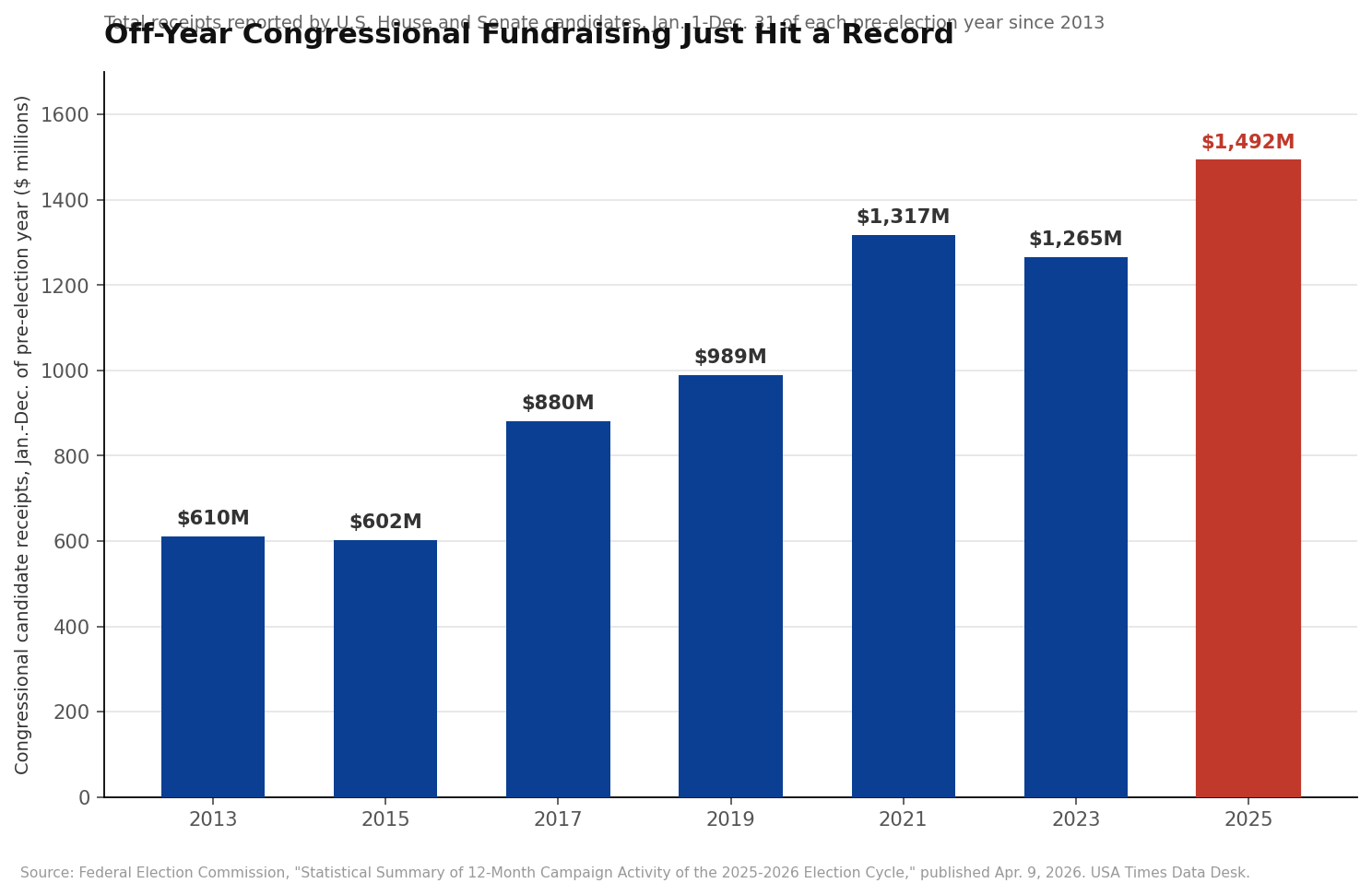
U.S. House and Senate candidates running in the 2026 midterms reported raising approximately $1.49 billion between January 1 and December 31, 2025 — the highest total ever reported by congressional candidates during the pre-election year of any cycle in Federal Election Commission records going back to 2013. That’s before a single 2026 primary or general election vote was cast. The 1,996 candidate committees that filed reports also disbursed $851.9 million over the same period, and reported combined debts of $231.8 million and combined cash-on-hand of $1.2 billion as of December 31, 2025 — meaning the money continues piling up well ahead of the actual election year.
National Party Committees, Jan.-Dec. 2025
Hover any row for context.
Batmandir · Founders A numbered seat at the table. S3 · The Founders Club — 161 seats per location. By invitation. Explore membership →Democratic
Republican
How this compares to every prior cycle
The FEC’s own comparison table, which tracks 12-month fundraising activity through December 31 of each non-election year since 2013, shows a clear long-term upward trend with 2025 as the new high point. Receipts climbed from $610.5 million in 2013 to $601.5 million in 2015 (essentially flat), then jumped to $879.9 million in 2017, $989.2 million in 2019, $1.32 billion in 2021, and $1.27 billion in 2023 — a rare dip — before reaching $1.49 billion in 2025. The number of candidates filing reports has grown alongside the money: 1,086 in 2013 versus 1,996 in 2025, nearly double, meaning some of the total increase reflects more candidates running rather than each individual candidate raising proportionally more.
Where the money split: House, Senate, and parties
Of the $1.49 billion total, House candidates accounted for the larger share: the 1,766 candidates running for the House reported combined receipts of $1 billion, disbursements of $614.1 million, debts of $198.4 million, and cash-on-hand of $870.6 million. The 230 Senate candidates reported smaller but still substantial totals — $454.1 million in receipts, $237.9 million in disbursements, $33.3 million in debts, and $345.8 million in cash-on-hand. Outside candidate committees entirely, political party committees (national, state, and local combined) reported $834.1 million in receipts and $664 million in disbursements over the same period, while 8,432 federal political action committees reported a combined $4.6 billion in receipts and $3.4 billion in disbursements — meaning PAC-level financial activity alone was roughly three times larger than what candidates themselves raised directly.
The national parties: a closer race than the candidate totals suggest
Between the two major parties’ national committees, spending was closer to even than the overall numbers might suggest. The Republican National Committee reported $172.3 million in receipts and $115.2 million in disbursements, versus the Democratic National Committee’s $145.8 million in receipts and $153.9 million in disbursements — meaning the DNC spent more than it raised over this period while the RNC did not. Combined Republican party committee totals (RNC, National Republican Senatorial Committee, National Republican Congressional Committee, and state/local committees) reached $420.4 million in receipts and $296.3 million in disbursements, versus the Democratic side’s combined $407.7 million in receipts and $362.3 million in disbursements — Republicans out-raised Democrats by a relatively narrow $12.7 million at the national-committee level, but Democratic committees spent $66 million more than Republican committees did over the same period.
PAC money dwarfs candidate fundraising
The 8,432 federal PACs that filed reports raised $4.6 billion combined in 2025 — more than three times what all congressional candidates raised directly. The largest single PAC category by receipts was “Committees with Non-Contribution Accounts,” a type of nonconnected PAC that can accept unlimited contributions for independent political activity while maintaining a separate, contribution-limited account for direct candidate donations; these committees alone reported $2.46 billion in receipts. Independent Expenditure-Only Political Committees (commonly known as super PACs, which can raise and spend unlimited amounts but cannot contribute directly to candidates) reported $1.1 billion in receipts. Of the PAC money that did flow directly to candidates, PAC contributions to federal candidates totaled $212.5 million as of December 31, 2025, split $175.2 million to House candidates and $37.3 million to Senate candidates.
A separate pool of money: “segregated” party accounts
Beyond their traditional accounts, national party committees can also raise money through “segregated party accounts” — a mechanism created by a 2014 federal spending law that lets parties collect additional funds earmarked specifically for presidential nominating conventions, national headquarters buildings, and election recounts or legal proceedings, separate from the individual contribution limits that apply to regular party fundraising. These accounts reported combined receipts of $143.5 million in 2025, and the split between parties was lopsided: Republican national committee segregated accounts brought in $91.7 million, compared to $51.9 million for the Democratic side. Recount and legal-proceedings accounts raised the most of any segregated category at $67.9 million combined, followed by headquarters accounts at $64.6 million and convention accounts at $11 million — meaning parties are currently raising more for potential legal fights than for their next nominating conventions.
Independent expenditures: still small next to the totals above
Independent expenditures — money spent by PACs or individuals advocating for or against a candidate without coordinating with that candidate’s campaign — totaled $56.4 million through December 31, 2025, a small fraction of the billions moving through candidate, party, and PAC accounts overall. Independent Expenditure-Only Political Committees (commonly called super PACs) accounted for $45.7 million of that total, with Committees with Non-Contribution Accounts adding $8.4 million and other PACs contributing $1.9 million. Individuals spent $0.4 million independently, and party committees themselves reported just $75,417 in independent expenditures. Separately, the FEC recorded only three “communication cost” filings all year — disclosures required when corporations or labor unions spend more than $2,000 communicating express political advocacy to their own members or shareholders — totaling $39,177, and no electioneering communications were reported at all during the period, a category covering certain broadcast ads referencing a candidate close to an election.
What we did
Every figure in this article comes directly from the Federal Election Commission’s own “Statistical Summary of 12-Month Campaign Activity of the 2025-2026 Election Cycle,” a press release published on FEC.gov on April 9, 2026, covering campaign finance reports filed with the Commission for activity between January 1 and December 31, 2025. We read the full press release, including its historical comparison table spanning the 2013-2025 pre-election-year cycles, and did not rely on any secondary summary or aggregator for these figures. We did not independently query the FEC’s OpenFEC API or underlying bulk campaign-finance data to verify these summary totals against individual filings; we’re relying on the FEC’s own published statistical summary, which is itself the Commission’s official aggregation of the underlying filings. One clarification worth noting: the “receipts” figures reported here represent money raised during calendar year 2025 specifically, not cumulative fundraising across the full 2025-2026 two-year election cycle, which is why the comparison table is organized by the first (non-election) year of each two-year cycle going back to 2013.