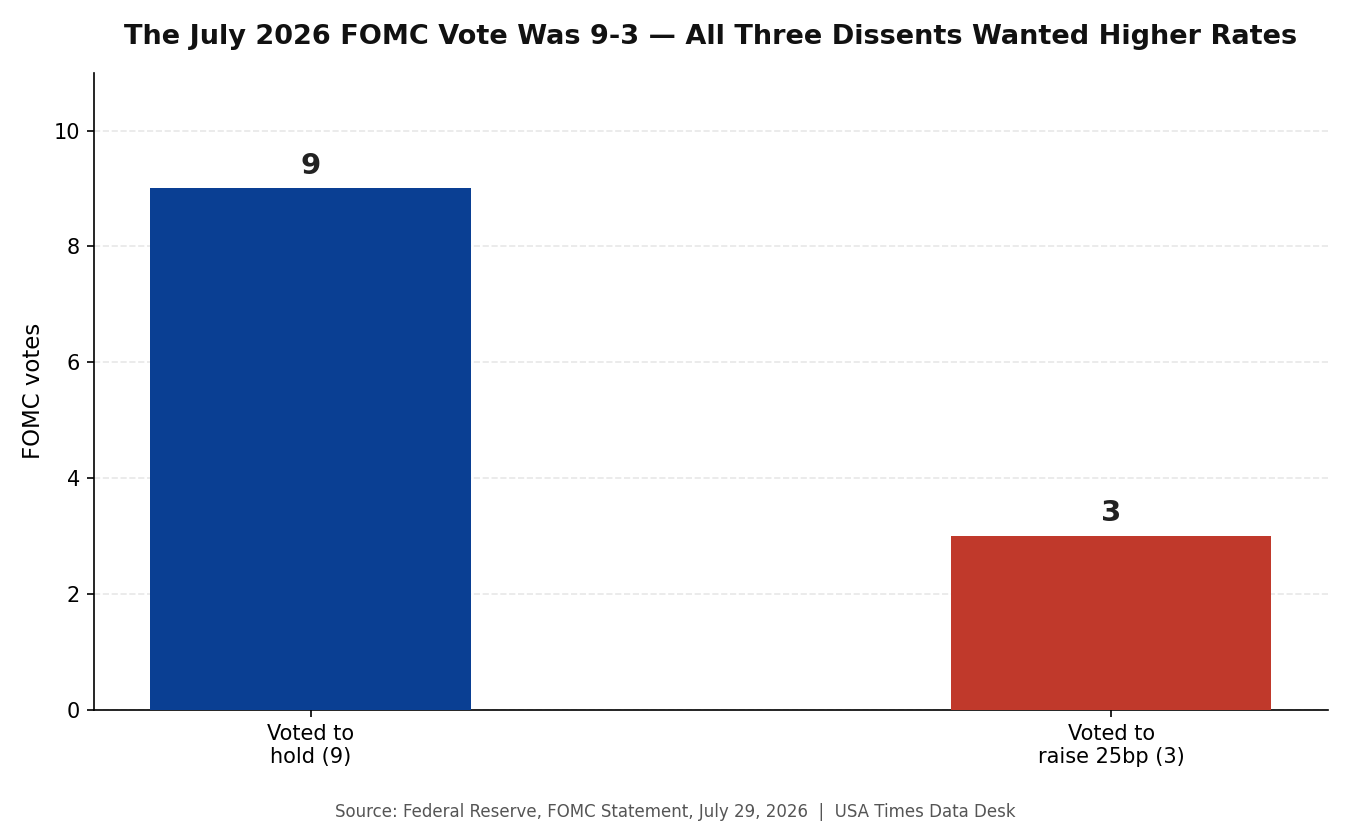
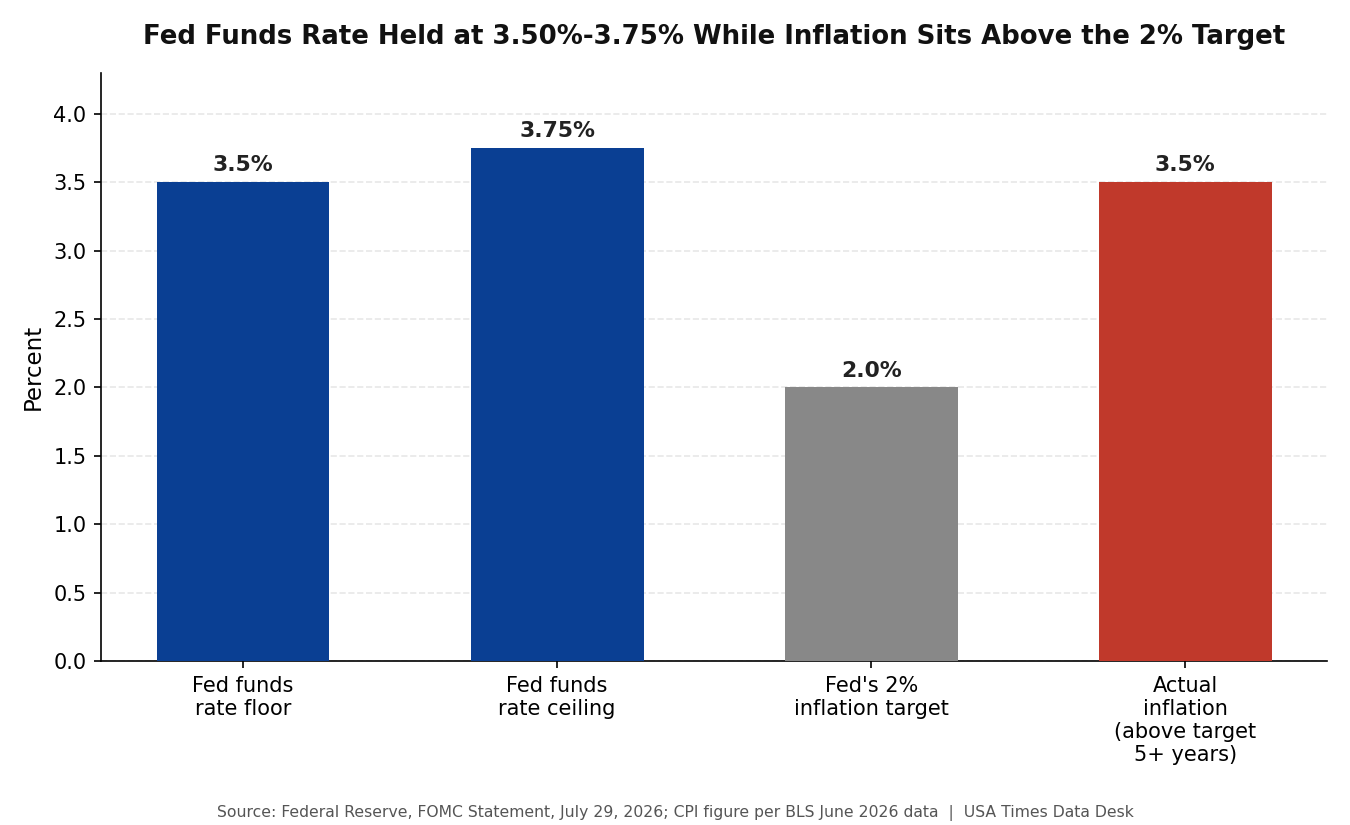
The Federal Reserve held its benchmark interest rate steady at a target range of 3.50% to 3.75% at its July 29, 2026 meeting, according to the official FOMC statement. It’s the fifth consecutive meeting the Committee has held rates unchanged. What makes this particular decision unusual isn’t the hold itself — it’s the direction of the dissent. The vote was 9-3, and all three dissenting votes, from Cleveland Fed President Beth Hammack, Minneapolis Fed President Neel Kashkari, and Dallas Fed President Lorie Logan, favored raising the rate by a quarter point, not cutting it.
That’s a meaningfully different kind of disagreement than markets are typically primed to expect. FOMC dissents in recent history have usually leaned toward wanting rates lower, sooner — officials worried about slowing growth or labor market softening. A three-vote hawkish bloc, all preferring higher rates specifically because of inflation concerns, signals a real and public split on the Committee about whether “steady” is actually the right call right now.
The statement’s own language explains the tension
The Fed’s official statement itself lays out the conflict driving the split vote. On the growth side: “Economic activity is expanding at a solid pace… Productivity growth and capital investment are strong. Job gains have kept pace with the workforce, and the unemployment rate has changed little.” On the inflation side, in the very next paragraph: “Inflation remains elevated relative to the Committee’s 2 percent goal, in part reflecting supply shocks that have driven price increases in certain sectors, including energy.” The statement adds that the Committee “will deliver price stability” — firm language, paired with a decision not to act on it this particular meeting.
Batmandir · Founders A numbered seat at the table. S3 · The Founders Club — 161 seats per location. By invitation. Explore membership →That combination — solid growth, low unemployment, and inflation still running above target — is exactly the environment in which a hawkish dissent makes the most textbook sense. When the economy shows no signs of needing support, but prices are still running hot, the standard argument for holding rates (protecting a fragile expansion) gets weaker, and the case for tightening further gets correspondingly stronger. Hammack, Kashkari, and Logan’s dissent reflects that logic directly.
The Middle East is now explicitly part of the Fed’s uncertainty language
The statement specifically attributes part of the “elevated uncertainty” facing the economy to “the conflict in the Middle East” — an unusually direct geopolitical reference for a Fed statement, which typically frames uncertainty in more abstract macroeconomic terms. That framing lines up with data USA Times’ Data Desk covered separately: June’s CPI report showed the entire monthly inflation decline traced back to a 9.7% one-month gasoline price drop tied to easing Iran-related tensions — meaning the same geopolitical volatility the Fed is flagging as a source of uncertainty has already been swinging the actual inflation data in real time, in both directions, within a matter of months.
Five years above target is the backdrop for this vote
Context matters here: inflation has now run above the Fed’s 2% target for more than five years, according to financial reporting on the meeting. A central bank holding rates steady for a fifth straight meeting while inflation remains persistently elevated is a genuinely different situation than holding steady after inflation has already cooled to target — and it’s the specific backdrop against which three regional Fed presidents concluded “steady” wasn’t good enough this time.
Market pricing ahead of the decision reflected a more dovish expectation than the hawkish dissent suggests: futures markets were pricing in two 25-basis-point rate increases, the first in September and the second in December, rather than cuts — meaning markets, like the three dissenting regional presidents, are leaning toward the Fed needing to tighten further rather than ease, even as the Committee majority opted to hold for a fifth straight meeting.
What a hold versus a hike means for borrowers
For now, the practical impact of this decision is that borrowing costs tied to the federal funds rate — credit card APRs, home equity lines of credit, and adjustable-rate products — stay where they’ve been for five straight meetings, rather than climbing further. Freddie Mac’s own May 2026 average 30-year fixed mortgage rate of 6.44% (cited in USA Times’ Data Desk’s reporting on June’s jobs data) isn’t directly set by the Fed’s overnight rate, but it moves in the same general direction over time. If the three dissenting officials’ preference had prevailed and the Committee had raised rates a quarter point, that would have been the first increase in a Fed cycle that has otherwise been either holding steady or cutting for an extended stretch — a meaningfully different signal to send into mortgage, auto loan, and credit markets than another routine hold.
Instead, borrowers get another meeting of stability, while the specifics of the vote — a 9-3 split with the minority pushing for tighter policy — signal to markets that a rate cut is not close to being on the table at the Fed’s next several meetings, barring a significant change in the inflation data between now and the Committee’s following decision.
What we did
The vote count, the target rate range, the full quoted statement language, and the names of the three dissenting officials come directly from the Federal Reserve’s official FOMC statement for July 29, 2026, read directly from federalreserve.gov. The characterization that hawkish dissents (favoring higher rates) are less common than dovish ones in recent Fed history reflects general financial-press commentary and our own framing of the unusual pattern, not a claim made by the Fed itself. The claim that inflation has run above the Fed’s 2% target for more than five years, and the market-pricing figures for anticipated September and December rate moves, come from contemporaneous financial media coverage of the meeting (CNBC’s live meeting coverage) rather than from the Fed’s own statement, which does not itself comment on market expectations or provide a multi-year inflation history in this particular release. The Freddie Mac 30-year mortgage rate figure referenced above was previously reported by USA Times’ Data Desk in a separate piece on June 2026 employment data, sourced there directly from Freddie Mac via the Bureau of Labor Statistics’ Employment Situation release; it is not part of the Fed’s own FOMC statement and is included here only as contextual background on the broader interest-rate environment.