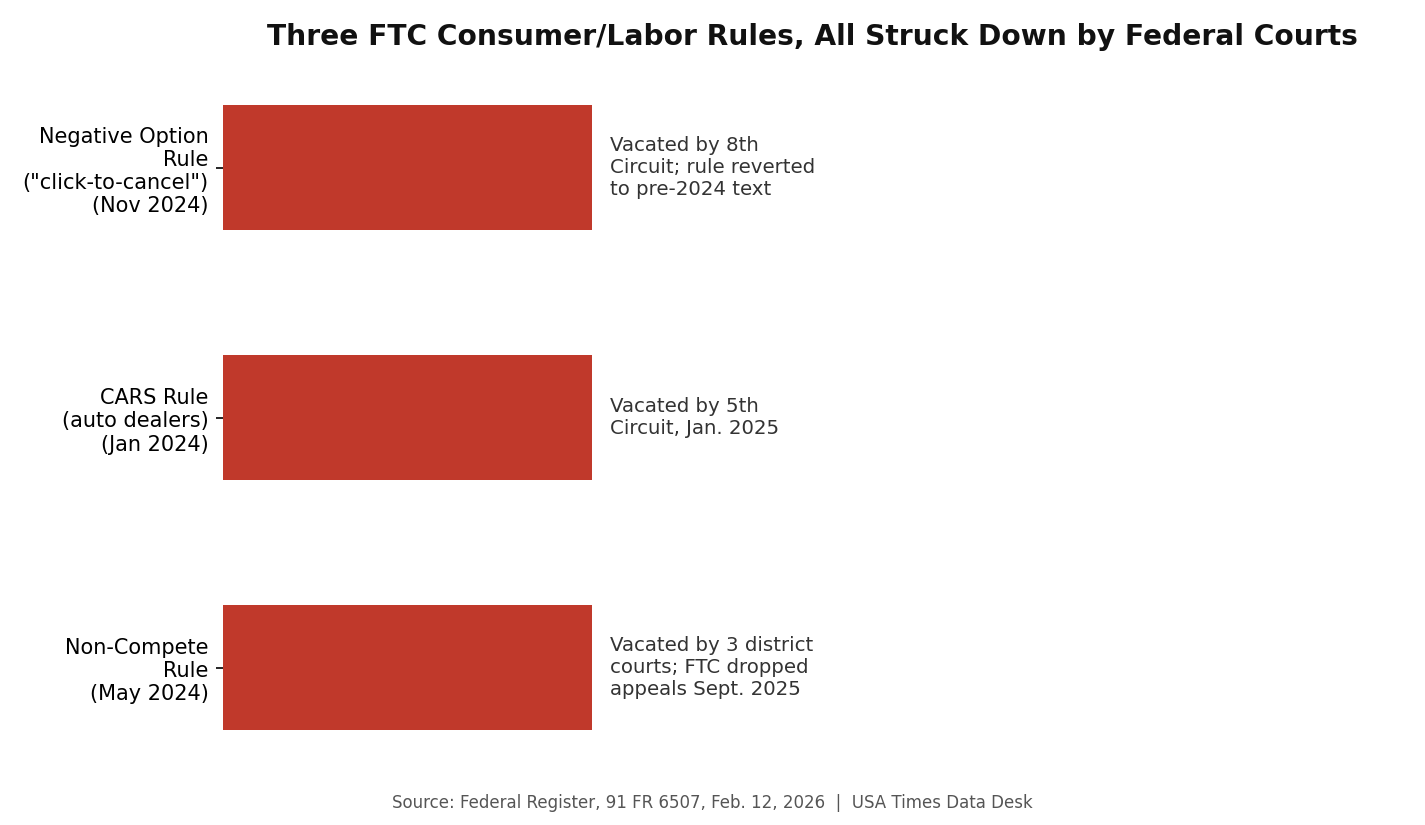
The Federal Trade Commission has formally pulled the plug on three of its own rules in a single Federal Register notice: the nationwide ban on employer non-compete agreements, the “CARS Rule” governing auto dealer advertising, and parts of the “click-to-cancel” negative option rule for subscriptions. All three were adopted under the prior Commission. All three are now gone or scaled back, not because Congress repealed them, but because federal courts said the FTC never had the authority to write them in the first place — and the current Commission voted, 3-1, to stop fighting that conclusion in court.
The most consequential of the three is the Non-Compete Rule. Adopted in April 2024, it would have banned nearly all new and existing employer non-compete clauses nationwide — one of the broadest labor-market interventions the FTC has ever attempted. It never took effect. A federal judge blocked it before its effective date, and the FTC has now formally abandoned defending it anywhere.
A Texas judge called the rule “arbitrary and capricious”
The rule’s legal collapse started in the U.S. District Court for the Northern District of Texas. In Ryan, LLC v. FTC, 746 F. Supp. 3d 369 (N.D. Tex. 2024), the court set the rule aside on a nationwide basis, ruling that the FTC lacked statutory authority under the FTC Act to issue substantive rules defining unfair methods of competition, and — separately — that the rule itself was arbitrary and capricious because the agency relied on a small number of state-level non-compete studies to justify a categorical, nationwide ban rather than a more targeted approach.
Batmandir · Founders A numbered seat at the table. S3 · The Founders Club — 161 seats per location. By invitation. Explore membership →That wasn’t the only court to weigh in, and the rulings didn’t all agree on the reasoning. A federal court in the Eastern District of Pennsylvania declined to block the rule, finding the FTC likely did have the authority to issue it. A court in the Middle District of Florida went a third way, granting an injunction but limiting it to the specific plaintiff in that case, on “major questions doctrine” grounds — the idea that an agency can’t decide an issue of major economic and political significance without clear congressional authorization. Three district courts, three different answers, is itself a signal of how genuinely unsettled the FTC’s rulemaking authority on this question was.
The Commission voted not to keep fighting for its own rule
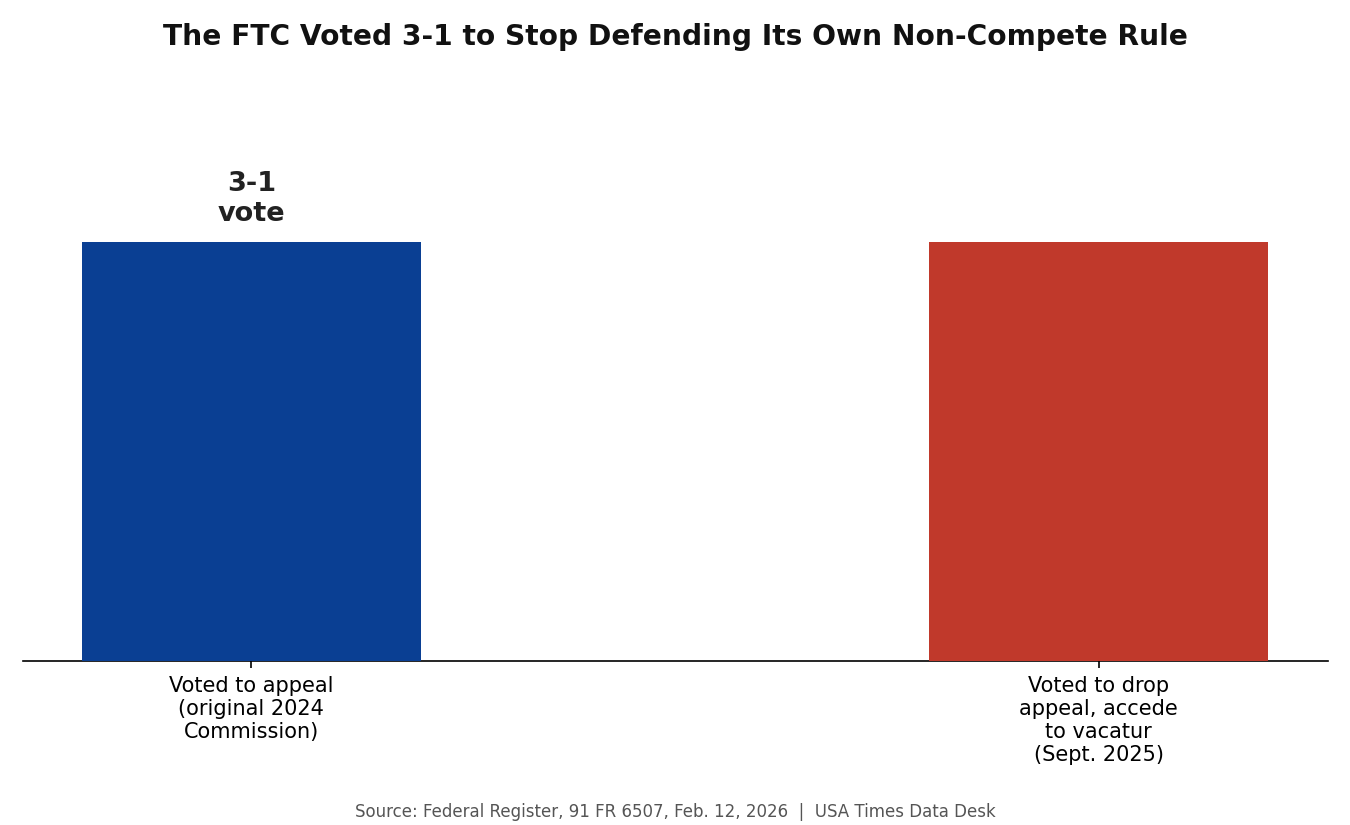
The FTC appealed the Texas ruling to the Fifth Circuit and separately appealed the narrower Florida ruling to the Eleventh Circuit. On September 5, 2025, the Commission voted 3-1 to direct FTC staff to file, in both circuits, a motion to voluntarily dismiss its own appeals and a motion asking each circuit to remand the case back to the district court with instructions to vacate the rule. In plain terms: rather than continue arguing in front of two appeals courts that it had the legal authority to ban non-competes, the Commission chose to concede the fight and formally ask the courts to erase the rule.
The Federal Register notice — signed by then-Acting FTC Secretary Joel Christie and published February 12, 2026 — is the formal administrative step confirming that outcome: removal of the Non-Compete Rule’s text from the Code of Federal Regulations, so the rulebook itself now matches what the courts already ordered. Practically, this means the pre-2024 legal landscape is back in force: non-compete enforceability is governed by state law, which varies widely — some states like California and Minnesota already ban most non-competes on their own, while most others allow them under varying standards of reasonableness.
The other two rules, in brief: auto ads and subscription cancellations
The same Federal Register document also formally withdraws the CARS Rule (Combating Auto Retail Scams), which would have imposed new disclosure and consent requirements on car dealership advertising and add-on product sales. It was vacated by the Fifth Circuit in January 2025 on procedural grounds — the court found the FTC failed to follow required rulemaking procedures, including skipping an advance notice of proposed rulemaking that the agency’s own governing statute requires for rules of this kind.
The third piece, a revision to the Negative Option Rule, is narrower than the other two. The broader 2024 “click-to-cancel” negative option rule — which would have required businesses nationwide to make canceling a subscription as easy as signing up for one — was itself vacated by the Eighth Circuit on procedural grounds in 2025, reverting the underlying negative option rule to its pre-2024 text. That federal reversal is a useful contrast to what’s happening at the local level: USA Times’ Data Desk previously covered New York City’s own click-to-cancel ordinance, a local law that took a different legal path and remains in effect for businesses operating in the city regardless of the federal rule’s fate — a reminder that state and local consumer-protection rules don’t automatically disappear when a federal counterpart gets struck down.
Why “vacated on procedural grounds” isn’t the same as “the idea was bad”
It’s worth being precise about what these rulings actually decided, because it’s not what the headlines might imply. None of the three courts ruled that non-compete bans, dealer-ad disclosure rules, or easy-cancellation requirements are bad policy. The CARS Rule and the negative option rule were vacated primarily on procedural grounds — the FTC skipped required rulemaking steps, not that the underlying consumer protections were themselves unlawful. The non-compete ruling went further, finding the FTC lacked the substantive statutory authority to issue the rule at all, regardless of process. In each case, the legal defeat was about the limits of what the FTC itself can do unilaterally through rulemaking — a separation-of-powers and administrative-law question — not a judicial verdict on whether non-competes, deceptive car ads, or hard-to-cancel subscriptions are good for consumers or workers.
That distinction matters for what happens next. Because the defeats were largely about agency authority and procedure rather than substance, all three issues remain live for Congress to legislate directly, for states to regulate on their own (as several already do for non-competes and subscription cancellation), or for a future FTC to attempt again with a narrower rule and a fuller rulemaking record. What’s dead, for now, is the specific version of each rule the prior Commission wrote — not necessarily the underlying policy goals.
What we did
All case names, court citations, vote counts, dates, and the quoted “arbitrary and capricious” language in this piece come directly from the Federal Register final rule notice (Document 2026-02866, 91 FR 6507-6510, published February 12, 2026) and the underlying district court opinion in Ryan, LLC v. FTC, 746 F. Supp. 3d 369 (N.D. Tex. 2024), both read directly from federalregister.gov and the cited case reporter. The characterization of the Eighth Circuit’s 2025 vacatur of the negative option rule and the Fifth Circuit’s 2025 vacatur of the CARS Rule reflects the procedural history described in the same Federal Register notice. The note on which states currently restrict non-competes independent of federal action (California, Minnesota, and others) is general legal background, not a claim made in the Federal Register notice itself. The link to New York City’s local click-to-cancel ordinance points to USA Times’ own prior Data Desk coverage of that separate, city-level rule, included here for contrast with the federal rule’s fate, not as part of the FTC’s own notice.