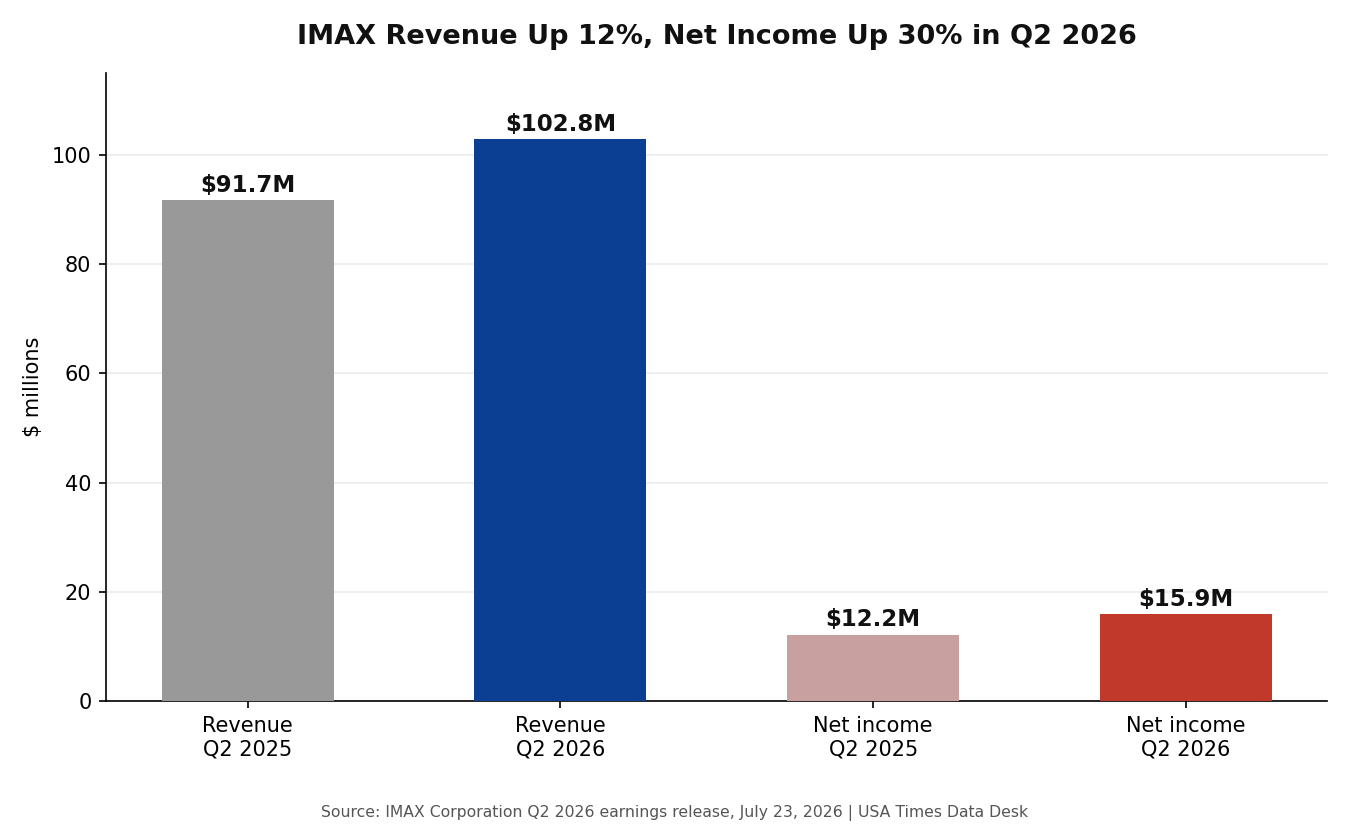
IMAX Corporation installed 38 new projection systems in the second quarter of 2026 — the company’s strongest second-quarter installation total in ten years — according to its Q2 2026 earnings release, published July 23, 2026. Revenue climbed 12% year-over-year to $102.8 million, and net income rose roughly 30% to $15.9 million. Yet the company’s installation backlog — the queue of signed contracts not yet built — still grew to 421 systems by quarter’s end, underscoring a pattern USA Times’ Data Desk covered in IMAX’s full-year 2025 numbers: the company is signing new theater deals faster than it can physically build them, even while setting installation records.
Where the growth actually came from
IMAX’s business splits into two reporting segments, and they grew at very different speeds this quarter. Technology Products and Services — the segment covering system sales, leases, rentals, and maintenance — was the clear driver: revenue rose 16% to $65 million and gross margin rose 29% to $39 million, which the company attributed to higher systems sales, rental revenue, and amendments and renewals of existing exhibitor agreements. Content Solutions — the segment covering IMAX’s film-distribution and box-office revenue-share business — grew far more modestly, with revenue up 2% to $35 million while gross margin actually fell 2% to $22 million, holding a 63% margin. In short: the quarter’s real strength was IMAX selling and servicing more hardware, not IMAX’s cut of the box office.
18 of 38 new systems were outright sales, not revenue-share deals
Of the 38 systems installed in Q2 2026, 18 were installed under sales arrangements — meaning the exhibitor bought the system outright — compared with 13 sales-arrangement installs in the same quarter a year earlier. That’s a meaningful shift in mix: a higher proportion of this quarter’s installations were straightforward equipment sales rather than the joint revenue-sharing agreements that give IMAX an ongoing cut of box office receipts from a given screen. Sales arrangements tend to generate revenue for IMAX faster (a larger payment up front, rather than a trickle of box-office share over years), which helps explain why Technology Products and Services revenue outpaced Content Solutions this quarter even as the overall network kept expanding.
Batmandir · The Circle Full access to theatres, museums & exhibitions. S2 · ongoing membership, without a Founder’s seat. Explore membership →The network crossed 1,800 commercial locations — and 1,876 systems worldwide
IMAX’s commercial network reached 1,809 locations as of June 30, 2026, up from 1,750 a year earlier — a gain driven in part by 9% growth in IMAX’s international footprint outside China, a market the company has increasingly emphasized as its growth engine relative to a more mature North American base. Counting every configuration IMAX operates — 1,809 commercial multiplexes, 10 commercial destination venues, and 57 institutional locations such as museums and science centers — the company had 1,876 total systems running in 91 countries and territories as of the same date.
A backlog that keeps growing isn’t automatically good news
A larger backlog can read as a sign of strong demand — more theater operators want IMAX systems than the company can currently install — and that’s part of the story here. But backlog growth isn’t costless. IMAX’s own disclosures note that its Greater China backlog activity in the first half of 2026 included the cancellation of backlog for 17 system locations that IMAX and its exhibition partners mutually determined were “no longer beneficial” to pursue. That’s a reminder that a signed contract sitting in backlog isn’t a guaranteed future installation — geopolitical friction, shifting real-estate plans, or a changed read on a market’s box-office potential can pull deals out of the pipeline well after they were first announced, even for a company otherwise posting record quarterly installation numbers.
Cash generation more than doubled
One figure in the release stands out even more than the headline revenue and income growth: free cash flow reached $22.99 million in Q2 2026, compared with $8.13 million in the same quarter last year — nearly triple. That jump reflects lower growth capital expenditures on joint revenue-sharing equipment ($8.7 million in Q2 2026 versus $14.7 million a year earlier) layered on top of the underlying earnings growth, meaning IMAX generated meaningfully more actual cash this quarter while spending less of its own capital building out new joint-revenue-share installations — consistent with the quarter’s tilt toward higher-margin, faster-paying sales arrangements over revenue-share deals.
Growth is increasingly coming from outside North America
The 9% year-over-year growth in IMAX’s international footprint outside China, called out specifically in the release, points to where the company sees its runway: North America’s IMAX network is comparatively mature, with most large metro markets already served by at least one screen, while large parts of Asia, Europe, and Latin America still have room for new installations. That international emphasis also shows up in the headline location count itself — 91 countries and territories is a wide geographic footprint for a premium format that, in the U.S. market specifically, is still concentrated in a relatively small number of true flagship screens. Financial media coverage of the release noted IMAX shares rose sharply — reported gains as high as 12% — in the trading session following the results, reflecting that the quarter’s revenue and installation numbers beat Wall Street’s consensus expectations.
What we did
All financial figures in this piece — revenue, net income, segment-level revenue and gross margin, installation counts, sales-arrangement breakdowns, network location totals, backlog figures, the Greater China backlog cancellation detail, and free cash flow and capital expenditure figures — come directly from IMAX Corporation’s Q2 2026 earnings release, published July 23, 2026 and read directly from businesswire.com. The characterization of IMAX’s two reporting segments (Content Solutions and Technology Products and Services) reflects the company’s own segment definitions as stated in the same release. The framing connecting this quarter’s sales-arrangement mix shift to faster revenue recognition is our own analytical inference based on how each contract type is generally understood to be structured, not a claim IMAX’s release makes explicitly. The reported stock reaction (shares up as much as 12% following the release) comes from contemporaneous financial media coverage of the earnings report, not from IMAX’s own release, which does not comment on its share price.
Related from the USA Times Data Desk
- Do Star Movies Play in IMAX? A Live Count of the Last 20 Years
- 39 Films in 1.43
- The 1% of Screens That Now Rule the Box Office: How IMAX Won the Post-Streaming Era
- Every 70mm Odyssey Show on Sale at America's Biggest IMAX Screen Is Sold Out
- Box-office coverage index · the Star Index methodology