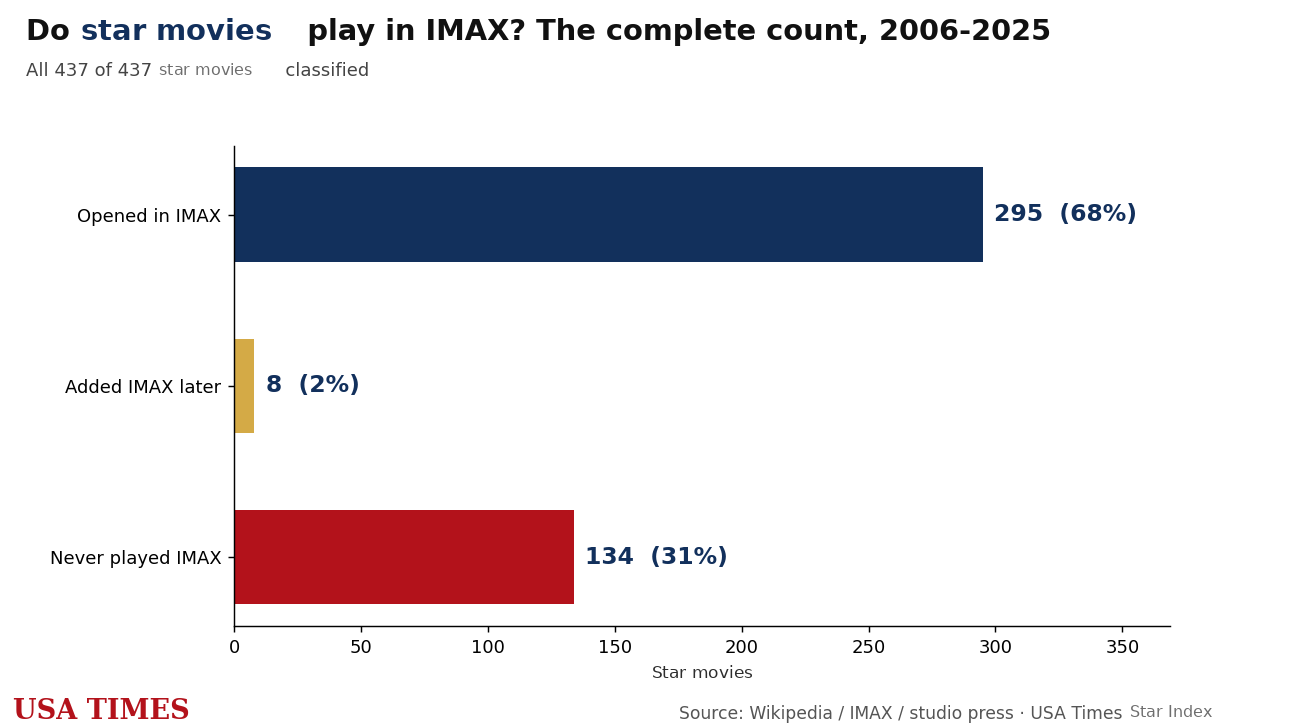
Not every big movie gets the giant screen. Some open in IMAX day-and-date; some are shut out and win it back later; some never play it at all. We set out to count, for every star movie — the films that actually took over a week at the U.S. box office — what share played IMAX, and did they open there or back into it? All 437 star movies from 2006 through 2025 are now classified. The picture that emerges: IMAX went from a niche format to close to a default, the giant screen is reserved almost automatically for the biggest titles, and the whole shift traces back to one summer.
Three ways a film meets IMAX
- Opened in IMAX — on the giant screen from its wide release. Most modern blockbusters, and every film shot with IMAX cameras (Avengers: Infinity War was the first film shot entirely with IMAX cameras, making Hollywood history at its 2018 release).
- Added IMAX later — not in IMAX at launch, but it got a run afterward. The textbook case: Barbie (2023) was locked out of IMAX by Oppenheimer’s 70mm run, then took a one-week IMAX victory lap that September.
- Never — owned a week, but never played IMAX. Mostly horror and mid-budget titles (Get Out, Annabelle: Creation).
The trend: IMAX went from niche to default
Chart the films year by year and the shift is stark. In 2006, just 1 of 13 star movies played IMAX — about 8%. By 2010 that was already up to 68%. From the mid-2010s on, most years clear 75-95%.
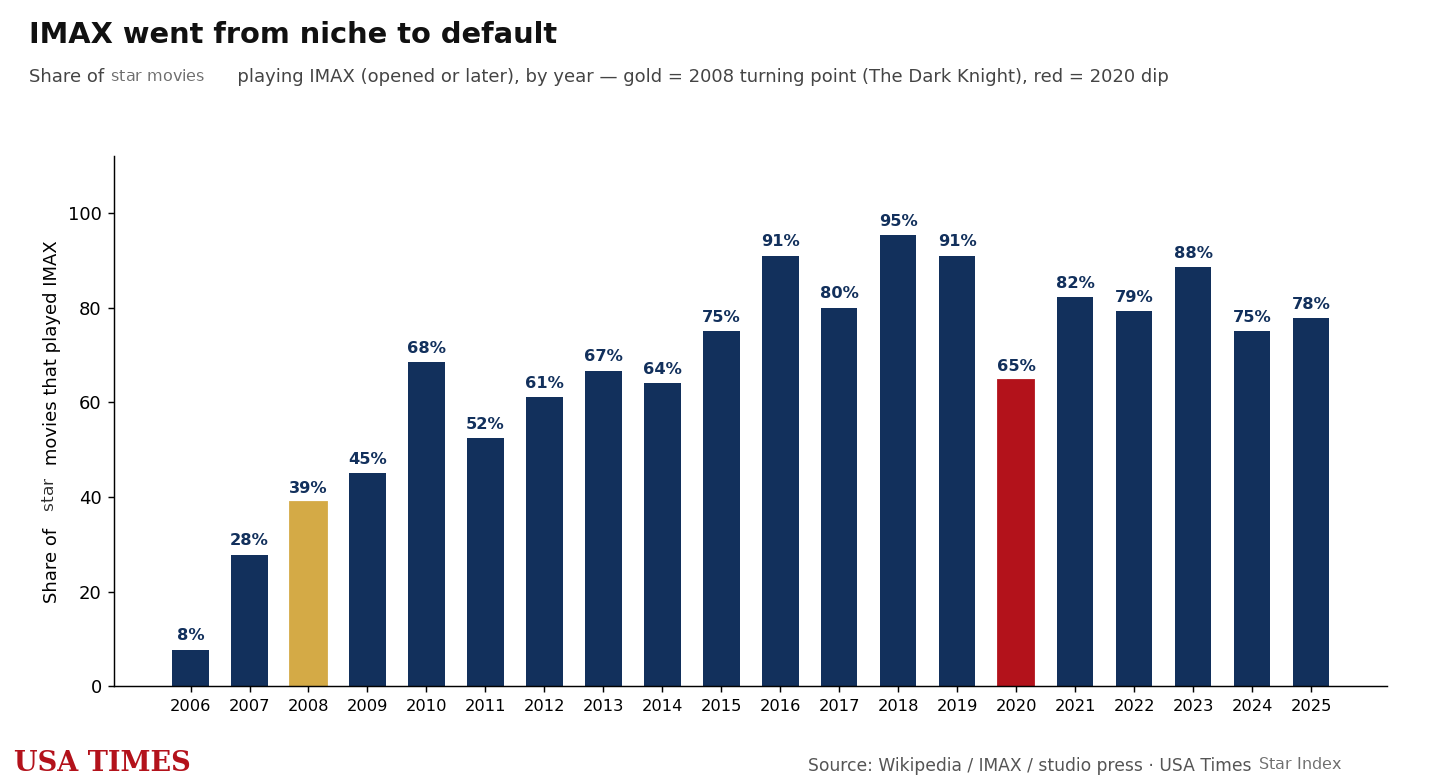
The turning point lines up with The Dark Knight in July 2008 — the first Hollywood feature to shoot with IMAX 15/70mm cameras, for roughly 28 minutes of runtime. Before that, IMAX screens mostly ran documentaries and the occasional re-release; across the whole industry, only about nine films used the format at all in 2008. Christopher Nolan’s film proved IMAX could be a mainstream storytelling tool rather than a novelty, and industry-wide adoption climbed fast — to roughly 39 films by 2012. Our own trend line tracks that same climb. The one dip in an otherwise rising line is 2020, when theater closures and a scrambled release calendar cut the number of star movies playing IMAX from 20 in 2019 to 11 — before the format snapped back the following year.
Batmandir · The Circle Full access to theatres, museums & exhibitions. S2 · ongoing membership, without a Founder’s seat. Explore membership →The bigger the movie, the more likely it’s IMAX
Break the films out by tier and the pattern sharpens further. The giant screen isn’t just a modern default — it is bought almost automatically for the biggest titles, and remains closer to a coin flip for the smaller ones.
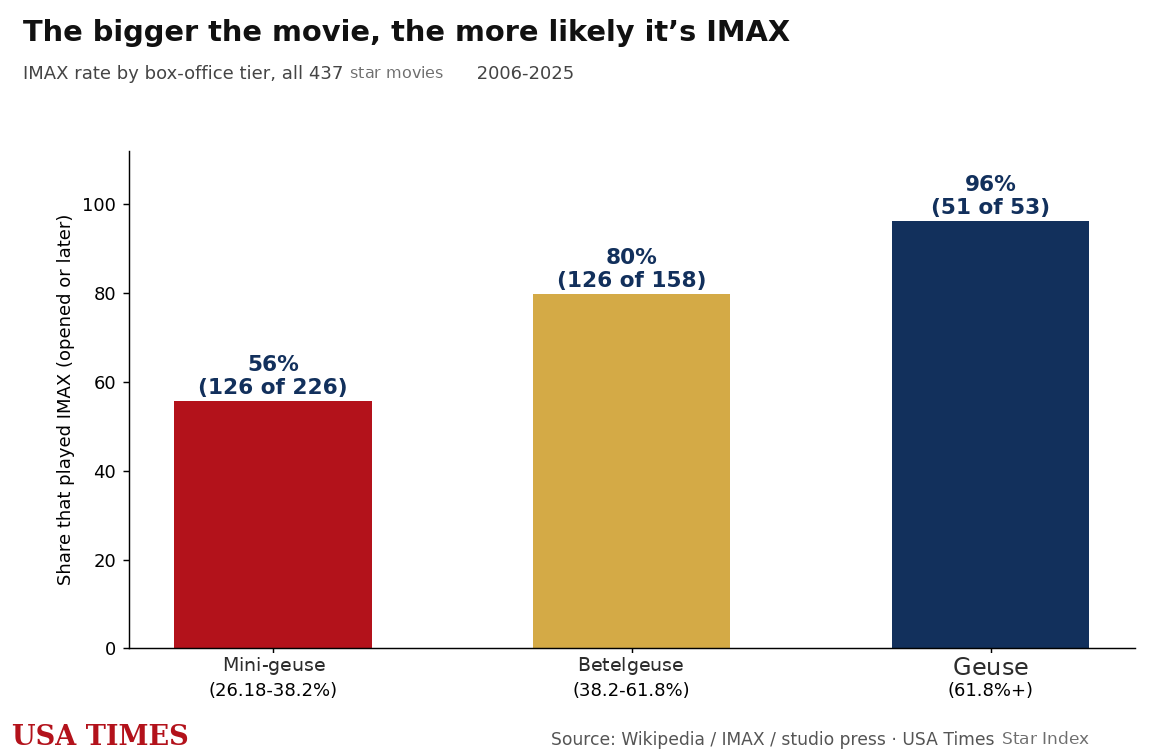
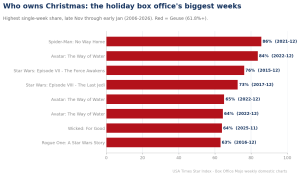
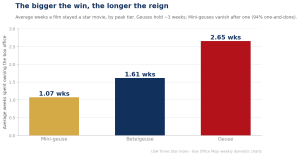
Geuse-tier films (61.8%+ of a week’s box office — think Barbie, Avengers, Star Wars) play IMAX 96% of the time: 51 of 53. Betelgeuses run 80%: 126 of 158. Plain Mini-geuses — the films that clear the bar but don’t dominate — play IMAX just over half the time, at 56%: 126 of 226. Studios appear to reserve premium-format release strategy for the titles they expect to be the biggest, which is also a bit self-fulfilling: an IMAX release itself boosts a film’s box office share.
Opening day, or a later comeback?
Of the 303 star movies that have played IMAX at all, all but 8 opened there.
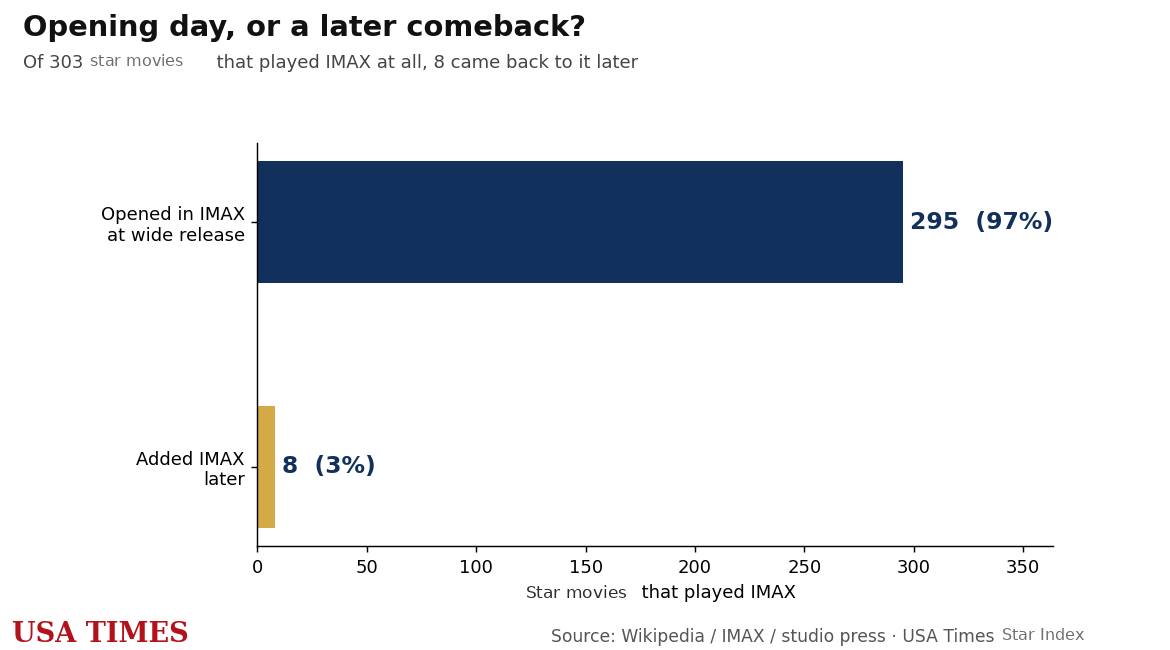
The full list of comeback films: Transformers (2007), Iron Man and The Incredible Hulk (2008), Captain America: The First Avenger (2011), World War Z (2013), Jumanji: Welcome to the Jungle (2017), Halloween (2018), and Barbie (September 2023). Notice the early cluster: in 2007, 2008 and 2011, IMAX screen counts were still small enough that even Michael Bay’s and Marvel’s biggest titles sometimes had to wait their turn. By the 2020s the format had scaled up enough that being locked out at launch — as Barbie was, by Oppenheimer — is the exception rather than the rule.
Superlatives
- First IMAX star movie: Superman Returns, June 2006 — the earliest film in our index to own a box-office week and open in IMAX the same weekend.
- Non-IMAX Geuses: only two films in 20 years have ever taken over 61.8% of a week’s box office and skipped IMAX entirely — Unhinged (2020, a pandemic-era release into a depleted marketplace) and Tom & Jerry (2021, an HBO Max day-and-date family title with no premium-format push).
The complete picture
All 437 star movies from 2006 through 2025 are now classified — no titles pending. The story holds together end to end: a near-zero starting point in 2006, a hard turn upward after The Dark Knight in 2008, a strong and consistent gradient by box-office tier, and a format that’s now the default rather than the exception for anything that dominates a week at the box office. This page will keep refreshing as new star movies join the index in future years, but the 2006–2025 analysis above is final.
Why the giant screen is scarce by design
The mechanism underneath every chart on this page is scarcity. Unlike a conventional auditorium, which can be reassigned showtime by showtime, an IMAX screen in a given market is a single slot that typically books one film at a time, often under agreements that guarantee a title the screen for a set window. That structure is what produced the Barbie/Oppenheimer standoff in 2023, and it explains why the “added IMAX later” category exists at all: a film does not back into IMAX because the studio changed its mind, but because the screen finally came free. It also explains why the tier gradient is so clean. When there is only one giant screen per market and several contenders per month, exhibitors and IMAX itself will rationally allocate it to the film with the highest expected grosses — which is, almost by definition, the film most likely to become a Geuse.
The economics: a small footprint with outsized leverage
IMAX auditoriums are a tiny fraction of North American screens, yet on a big opening weekend they routinely punch far above their weight in per-screen revenue, helped by premium ticket prices that run several dollars above a standard admission. For a studio, that makes an IMAX booking a double win: it adds high-margin gross directly, and it signals to the broader audience that a film is theatrical-scale, worth leaving the couch for. That signaling effect is the self-fulfilling loop noted above — the IMAX label boosts a film’s weekly share, and a bigger weekly share is what qualifies a film for this index in the first place. Some portion of the correlation between tier and IMAX status therefore runs in both directions, and readers should resist treating the 96% Geuse rate as purely a story about studios picking winners in advance.
What the metric does and doesn’t capture
A binary classification — played IMAX or didn’t — is deliberately blunt, and it flattens real differences. A film shot natively with IMAX cameras and held on the screen for a month sits in the same bucket as a title that got a routine two-week digital IMAX run. The count also cannot distinguish 15/70mm film presentations from the far more common digital installations, even though purists would argue they are different products. And because IMAX status is sourced from press releases and film pages rather than a single authoritative database, a handful of borderline early-era classifications rest on thinner documentation than the modern ones. None of this changes the direction of the trend, which is overwhelming, but the precise percentages in any single year should be read with a margin of error in mind.
IMAX is the flagship of a broader premium shift
The rise charted here is one visible edge of a larger change in how theatrical revenue is earned. Over the same two decades, exhibitors built out a whole ecosystem of premium large formats — Dolby Cinema, chain-branded PLF screens, 4DX and ScreenX among them — all premised on the same idea: if audiences are choosing fewer trips to the theater, each trip has to feel like an occasion, and can be priced like one. IMAX is simply the oldest and best-branded version of that bet. An interesting implication for this index is that a film’s “never played IMAX” status no longer means it skipped premium screens entirely; a mid-budget horror hit today may well have played a chain’s house-brand large format even while locked out of IMAX proper. The format count on this page is best read as a proxy for the premiumization of event cinema, not its full extent.
Where the line goes from here
With adoption already brushing against its ceiling among the biggest films, the next twenty years of this chart will be less about whether star movies play IMAX and more about which ones get to. The pipeline of films shot partly or wholly with IMAX-certified cameras keeps growing, and those titles arrive with a stronger claim on the screen than a conventional blockbuster with an aftermarket IMAX blow-up. If anything, the interesting future data point is the residual: the plain-Mini-geuse tier still plays IMAX only slightly more than half the time, which means the format has meaningful room to grow — or, alternatively, that the middle of the market will keep being served by cheaper premium formats while IMAX stays reserved for the top. Either way, this page will record the answer as new star movies join the index.
Method & sources: star-movie status from the USA Times Star Index (Box Office Mojo weekly domestic charts); IMAX status from Wikipedia film pages, IMAX Corp. releases and studio/trade reporting, classified per film. Part of the 20-year star index.
Related from the USA Times Data Desk
- 1,089 of IMAX's Screens Still Run on 2008 Technology. Only 63 Can Show the Format's Full Frame.
- The 1% of Screens That Now Rule the Box Office: How IMAX Won the Post-Streaming Era
- The IMAX Passport: 55 of the Last 58 Box-Office Geuses Opened on the Giant Screen (2006–2026)
- The 630-Pound Movie: The Absurd Logistics of Showing ‘The Odyssey’ in 70mm IMAX
- Box-office coverage index · the Star Index methodology
Sources
- Box Office Mojo — Weekend Domestic Box Office
- Box Office Mojo — Yearly Domestic Box Office
- IMAX — format & venue background (Wikipedia)
- USA Times — Star Index methodology & data sources