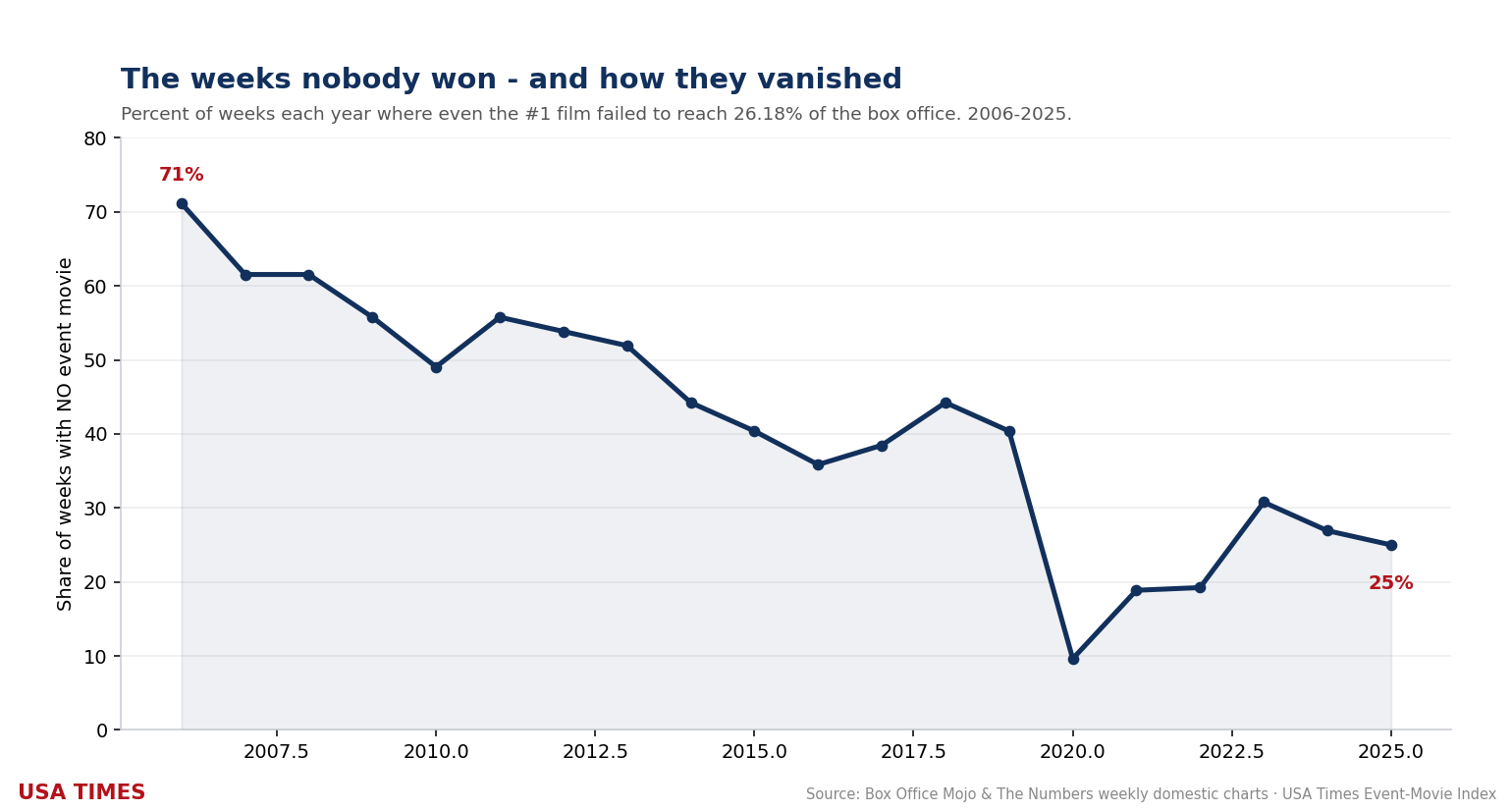
Every one of our stories so far has been about films that owned a week. This one is about the weeks that belonged to no one. By the USA Times definition, a film needs 26.18% of the entire U.S. box office to count as an event. In plenty of weeks, the top film doesn’t get there — the audience is spread so evenly across a slate of mid-size releases that nobody dominates. We call these fragmented weeks, and they are quietly disappearing.
A market that used to be shared
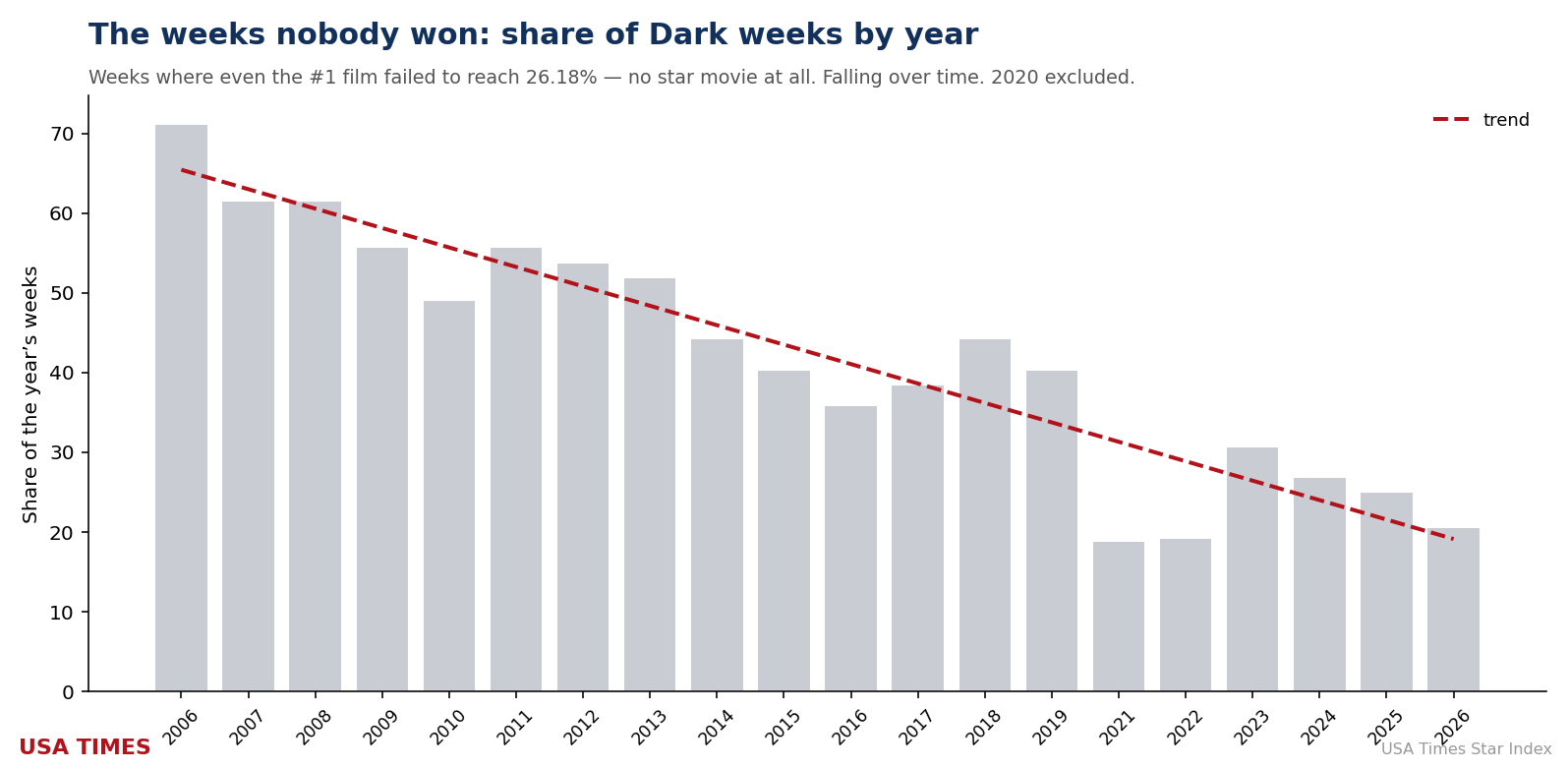
Back in the late 2000s, the box office was a genuinely shared place. In 2006, 60% of weeks had no star movie at all — the #1 film was just first among equals, with three or four other wide releases pulling real crowds at the same time. A moviegoer had options, and the money split among them.
Now almost every week has an owner
By the 2020s that had flipped. In the most recent years, only about 24% of weeks pass without a star movie — the rest belong, decisively, to a single film. The fragmented week, once the norm, has become the exception. It is the same concentration story the index keeps telling from every angle: the market didn’t get more crowded at the top, it got emptier everywhere else. Fewer films, taking bigger bites, leaving fewer and fewer weeks for everyone to share.
Batmandir · Founders A numbered seat at the table. S3 · The Founders Club — 161 seats per location. By invitation. Explore membership →What a fragmented week actually looked like
To picture a fragmented week — one in which no film reached even the 26.18% event line — imagine a typical weekend from the late 2000s. A modestly successful new release might open to eighteen or twenty percent of the market; a holdover from the week before holds another fifteen; two or three other wide releases split the rest among them, none decisively ahead. No single film owned the conversation, because no single film owned the box office. For a moviegoer, this was abundance: a genuine menu of options, several of them drawing real crowds, with the “number one movie in America” often a first-among-equals rather than a juggernaut. That texture — plural, competitive, shared — was once the default state of the American box office.
The disappearance of those weeks is therefore not a trivial statistical shift. It marks the erosion of the shared marketplace itself. As fragmented weeks became rarer, the weeks that replaced them were not more competitive — they were less so, dominated by a single film with no real challenger. The market did not consolidate into a handful of strong contenders trading blows. It consolidated into one giant and a long tail of also-rans.
Why the fragmented week is dying
The cause is the same structural story that runs through the entire index. The fragmented week depended on a steady supply of viable mid-budget wide releases — the thrillers, comedies, and dramas that once filled multiplex screens and split the audience. That category has been hollowed out, absorbed almost entirely by streaming, where a film that would once have opened on three thousand screens now debuts at home. With fewer films competing for each week, the ones that remain face less resistance, and a single title can seize a share that would have been impossible when the field was full. Fewer films, bigger bites, emptier weeks in between: it is the anatomy of concentration, viewed from below rather than above.
The seasonality of the empty week
Fragmented weeks do not fall evenly across the year. They cluster in the calendar’s dead zones — the post-holiday lull of January and February, and the late-summer trough of August and September — the stretches when studios park the films they do not expect to break out, and the market splinters among them. The gold-rush windows of summer and the winter holidays, by contrast, are where domination is manufactured, and where fragmented weeks are rarest. So the decline in shared weeks is partly a story about the tentpole windows expanding: as studios stretch “summer” earlier into spring and “holiday” earlier into November, the monopoly weeks eat into the shared ones from both ends of the calendar.
It is worth stating the limits of the measure plainly. A fragmented week is defined narrowly — the #1 film simply failed to clear 26.18% of that week’s box office — and that can happen in a genuinely healthy, plural market or in a merely weak one where nothing much opened at all. The metric captures the distribution of a week’s attention, not its total size. But across two decades, the trend is unambiguous and consistent with every other lens in the index: the shared box office, the week that belonged to no one in particular, is quietly vanishing.
What replaces a shared week
The most important thing about the vanishing fragmented week is what takes its place. If shared weeks were simply becoming competitive weeks — two or three strong films genuinely battling for the top — that would be a healthy evolution, a more exciting box office. But that is not what the data shows. The weeks that replace fragmented ones are overwhelmingly weeks of single-film domination, in which one giant takes a commanding share and no other film comes close. The market is not trading pluralism for competition; it is trading pluralism for monopoly. A moviegoer in a fragmented week had many real options; a moviegoer in the weeks that replaced it has, functionally, one. That substitution — the shared week giving way not to a fair fight but to a coronation — is the quiet heart of the concentration story, and it is why the disappearance of the weeks nobody won is worth mourning rather than shrugging off.
The vanishing of the shared week is, finally, a useful reminder that the health of a marketplace is not captured by its biggest numbers alone. Record-breaking opening weekends and billion-dollar grosses make headlines, and they are real; but they can coexist with, and even depend upon, a hollowing-out of everything beneath the very top. A box office can look robust in its peaks while growing brittle in its base. The weeks nobody won were the base — the broad, shared foundation of a plural moviegoing culture — and their slow disappearance is a structural change worth watching at least as closely as the records the giants keep setting.
Related from the USA Times Data Desk
- The 10 Most Dominant Weeks in 20 Years of American Moviegoing
- The Betelgeuse-Betelgeuse Week Has Happened Once in Twenty Years. Our Editor-in-Chief Bets December 18 Won't Be the Second.
- You Can Never Have Four: The Hidden Math That Governs the Box Office
- The Box-Office Calendar: The Months Movies Take Over, and the Dead Zones Nobody Wants
- Box-office coverage index · the Star Index methodology