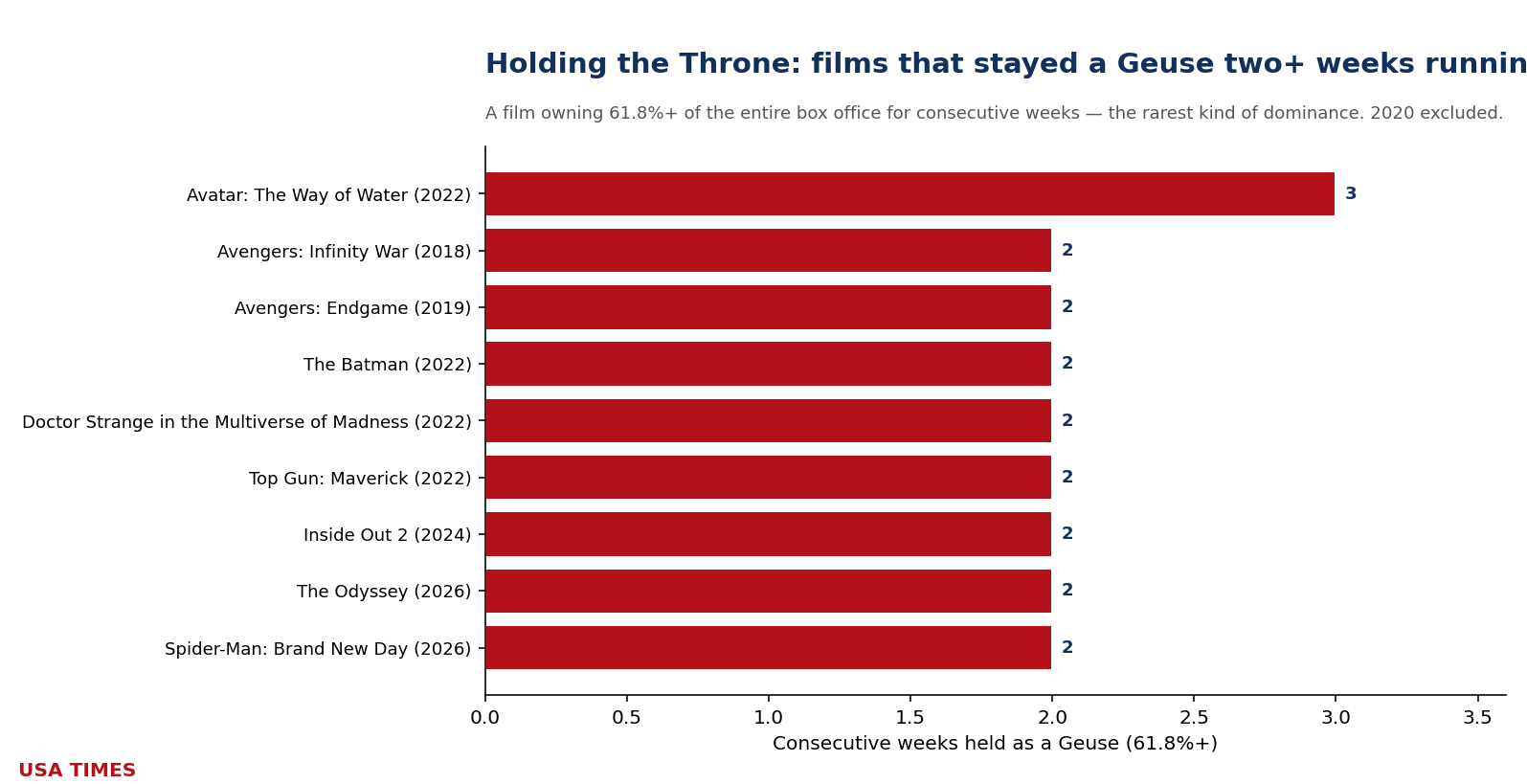
A box-office Geuse — a film taking 61.8% or more of an entire week’s U.S. box office — is rare enough. Doing it two weeks running is almost unheard of. In twenty-one years, only nine films have cleared the bar — holding the throne two consecutive weeks while grossing enough to count as an event at all. Two pandemic-era titles briefly reached the same share on near-empty theaters, but neither came close to the index’s $61.8M floor, so they don’t make the list. Two of the nine arrived in 2026.
The nine that truly held it
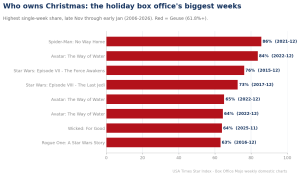
The list is almost entirely superhero and event-scale spectacle. Avatar: The Way of Water is the only film of the era to hold three straight weeks above the line. And 2026 just added two more: Spider-Man: Brand New Day (80.0% → 70.0%) and Christopher Nolan’s The Odyssey (65.1% → 61.8%). Note the counter-intuitive detail: the biggest opening doesn’t guarantee the longest hold — Top Gun: Maverick actually rose in week two.
USA Times Billion-Dollar Club: one S2 star per $1 billion in worldwide gross (floor). Two stars = crossed $2B.
| Film | Year | Weeks held | Weekly share run |
|---|---|---|---|
| Avatar: The Way of Water | 2022 | 3 | 83.7% → 65.1% → 64.4% |
| Spider-Man: Brand New Day · 2026 | 2026 | 2 | 80.0% → 70.0% |
| Avengers: Endgame | 2019 | 2 | 88.3% → 72.4% |
| Avengers: Infinity War | 2018 | 2 | 81.3% → 65.8% |
| Doctor Strange in the Multiverse of Madness | 2022 | 2 | 83.3% → 66.1% |
| The Batman | 2022 | 2 | 79.8% → 64.9% |
| Inside Out 2 | 2024 | 2 | 73.3% → 67.4% |
| Top Gun: Maverick | 2022 | 2 | 72.3% → 74.4% |
| The Odyssey · 2026 | 2026 | 2 | 65.1% → 61.8% |
The droughts, then the surge
Fifteen of the twenty-one years from 2006 to 2026 produced no sustained Geuse at all. Then 2022 produced four in a single year — Avatar, Doctor Strange, The Batman and Top Gun: Maverick — and 2026 has already produced two before the year is out. The rarest event in modern cinema is starting to cluster.
The $61.8M floor
To be counted at all, the index requires a film to gross at least $61.8M worldwide in its lifetime — 0.618 × $100M, keeping the whole system on the golden ratio. That one rule quietly disqualifies the pandemic’s strangest chapter. In 2020, with theaters shuttered and only drive-ins open, a micro-budget horror film called The Wretched sat at #1 for five weeks, its share of the near-empty market climbing to a surreal 98.8% — on a lifetime gross of roughly $250,000. A re-release, Phoenix, Oregon, did the same for two. They didn’t dominate the box office so much as outlast its collapse, and at a fraction of a percent of the floor, the index no longer counts them.
What it means
Two-week box-office domination went from impossible to recurring in the span of a few years. The absence in 2006–2017 wasn’t for lack of hits; none could hold the whole market a second week because the market was shared. What changed is concentration: a shrinking set of mega-events now command entire weeks, back to back, while everything around them is starved. The throne used to be a chair nobody could keep. Now a few franchises sit in it for a month — and 2026 is on pace to be the most crowded reign yet.
Method: weekly shares are the #1 film’s take of total U.S. box office that week (Box Office Mojo; The Numbers fallback). A sustained Geuse is the same film at 61.8%+ as the week’s #1 in 2+ consecutive weeks, across the complete 2006–2025 index plus 2026 to date.
- The IMAX PassportOf every box-office Geuse in 20 years, how many opened on a giant screen?
- One Movie, Most of the MoneyHow total box-office domination went from exception to the norm.
- The 20-Year Star IndexThe complete USA Times index of every star movie since 2006.
- The Star Movies of 2026, So FarUpdated weekly: which films are taking the whole market this year.
Why holding the throne is the rarest feat of all
Seizing the box office for a single week is difficult; holding it at Geuse level for two consecutive weeks is a different order of achievement entirely, and the tiny size of this list proves it. To repeat as a Geuse, a film must not only open enormous but out-dominate everything that arrives the following week — a test that depends on the one thing no opening-weekend marketing blitz can manufacture: genuine, self-sustaining demand. A film holds the throne only when audiences keep choosing it over every shiny new alternative, week after week, on the strength of word of mouth alone. That is why the members of this club are almost all beloved, culture-defining films rather than merely well-marketed ones.
The clustering of these sustained reigns in the most recent years is the same concentration story the index tells from every angle, viewed from its most extreme edge. In the shared, competitive box office of the late 2000s, no film could hold total domination for a second week, because the market was too plural — there was always another strong release ready to fracture the audience. Sustained Geuses became possible only as the field thinned and a shrinking set of mega-events began opening into cleared runways with no successor waiting to dethrone them. A two-week reign, once impossible, is now the ultimate signature of the winner-take-all era: not just owning a week, but owning the calendar around it.
It is worth restating the boundary the index draws here. This measures consecutive weeks at Geuse level — 61.8% or more of the entire market — not mere weeks at number one, which is a far easier bar to clear. A film can lead the box office for a month without ever repeating as a Geuse, simply by dominating a series of soft weeks. The films on this list did something harder and rarer: they held near-total command of American moviegoing across multiple weeks of real competition. That is the throne, and these are the only films that truly held it.
Related from the USA Times Data Desk
- One Movie, Most of the Money: How Total Box-Office Domination Went From Exception to Norm (2006–2026)
- The Secret in Our Stars: The Golden-Ratio Math Hidden in the USA Times Logo
- The Weeks Nobody Won: How the Shared Box Office Disappeared
- The Marathoners: The Films That Owned the Box Office the Longest
- Box-office coverage index · the Star Index methodology
Sources
- Box Office Mojo — Weekend Domestic Box Office
- Box Office Mojo — Yearly Domestic Box Office
- The Numbers — Weekly Box Office Chart
- USA Times — Star Index methodology & data sources