For full definitions, thresholds, data sources, and limitations, see our Star Index methodology.
Every year, a handful of films stop being merely popular and briefly become the event — the thing a large share of everyone who goes to the movies is doing in the same week. Until now there has been no crisp, public line between a big hit and a genuine event. USA Times is setting one.
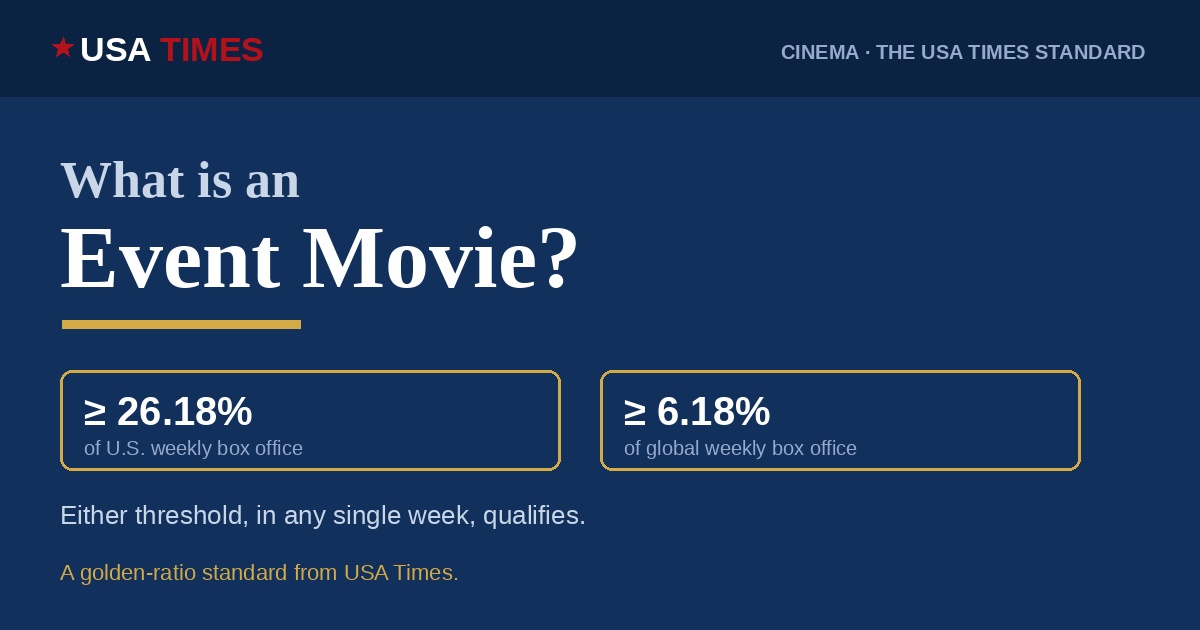
- ≥ 26.18% of the U.S. (domestic) box office that week, or
- ≥ 6.18% of the global box office that week.
The USA Times definition
A film is a star movie, by the USA Times standard, if in any single week of the year it captures either:
Batmandir · Guest Passes Step inside for a day. Guest passes from $161/day — brought in by a member. See guest passes →- ≥ 26.18% of the U.S. (domestic) box office in that week, or
- ≥ 6.18% of the global box office in that week.
Meeting either threshold qualifies. A film has to clear the bar only once — in its single best week — to earn the label for that year. It is a test of concentration, not accumulation: a star movie is one that, for at least one week, commands a defining share of the world’s moviegoing.
A hard ceiling: three in a week, never four
The 26.18% threshold carries a clean mathematical consequence. Four films each taking 26.18% of a week would require 104.72% of that week’s box office — more than exists. So on U.S. numbers, a single week can contain at most three star movies at once, and never four. A calendar year can crown many star movies, but they have to take turns: no week ever belongs to four of them. It is a small piece of arithmetic that gives the label a hard, provable edge.
A hard floor: $61.8M worldwide
Share alone can be fooled. When theaters are nearly empty — a pandemic, a strike, a freak weekend — a tiny film can post a huge percentage of almost nothing. To keep those artifacts out, a film must also clear one absolute bar: $61.8 million in worldwide lifetime gross to be counted as an event at all. The number is deliberate — it is 0.618 × $100M, the same golden ratio that sets the tiers — so the floor belongs to the system rather than sitting outside it. For Indian films we take ₹161 crore as the equivalent of that $100M reference, so the same floor applies in rupees — ₹99.5 crore in lifetime gross (0.618 × ₹161 crore). Films still in release are held as pending and measured once their gross is final. In practice the rule only ever touches 2020–2021: before the pandemic, every film that owned a week cleared the floor on its own. It is what separates genuine domination from simply outlasting a collapsed market.
Why these numbers
USA Times is built on the golden ratio (φ ≈ 1.618) — it is the geometry behind our four-star logo — so our cinema standard is drawn from it too. The domestic threshold, 26.18%, mirrors φ² (2.618), the golden ratio squared. The global threshold, 6.18%, mirrors the ratio’s fractional part, 0.618. The domestic bar sits higher because the U.S. market is smaller and more concentrated — a true event routinely takes a quarter or more of a given week — while the global bar sits lower because worldwide box office is far larger and more fragmented, so commanding even 6.18% of the entire planet’s ticket sales in one week is its own kind of rarefied air.
Why we measure by the week
We use a film’s single best week, not its lifetime gross, on purpose. A movie can pile up an enormous total slowly over months and never once dominate the conversation. Another can seize a single week so completely that it is briefly all anyone is watching. Lifetime charts reward endurance; the weekly-share test finds the films that were, however briefly, an event.
How we measure it
Qualification is assessed against weekly domestic and worldwide box-office totals as reported by standard industry trackers (for example, Box Office Mojo). “Domestic” follows industry convention — the United States and Canada — and a film’s share is its weekly gross divided by the total box office for the same week. A film needs to cross either line in just one week to make that year’s list.
For the world to use
This is a public standard. Anyone — writers, studios, researchers, other outlets — is free to use the USA Times “star movie” definition, provided it is cited as such. USA Times maintains annual star-movie ledgers: individual accounts for 2024 and 2025, a live 2026 tracker updated weekly, and a running look at whether the number of star movies per year is rising or falling. See the ledgers: the live 2026 tracker (updated weekly), 2025, 2024, and the year-by-year trend.
Methodology & scope: Thresholds are 26.18% of domestic (U.S./Canada) weekly box office or 6.18% of global weekly box office; either qualifies. Shares are computed against weekly market totals from standard industry box-office reporting. This is an editorial standard defined by USA Times and offered for public use with attribution.
Three tiers of event, set by the golden ratio
Clearing 26.18% makes a film a star movie. How far past the line it goes sets its tier — and the boundaries are drawn, like the threshold itself, from the golden ratio (φ):
| Tier | Share of the U.S. box office that week |
|---|---|
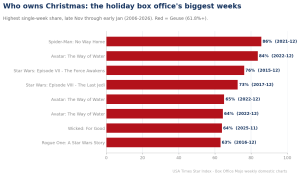
| Geuse | 61.8%+ (1/φ) — one film taking nearly two of every three tickets sold that week |
| Betelgeuse | 38.2% – 61.8% (the minor golden section to 1/φ) |
| Mini-geuse | 26.18% – 38.2% (φ² threshold to the minor section) |
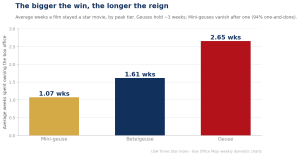
A film’s tier is set by its single best week. A separate, equally telling measure is staying power — how many weeks a film holds event status at all. The rare films that reign for weeks, and often climb through multiple tiers, are the true giants; the “one-week wonders” seize a single opening week and vanish.
Related from the USA Times Data Desk
- The Star Movies of Indian Cinema, 2025: Dhamaka, Toofan, Tsunami
- The Star Movies of 2025: Every Film That Took Over a Week at the Box Office
- Since 1940: Every Year's Biggest Indian Film — and the Budget Boom That Changed the Math
- The Star Movies of 2026, So Far (Updated Weekly)
- Box-office coverage index · the Star Index methodology
Sources
- Box Office Mojo — Weekend Domestic Box Office
- Box Office Mojo — Yearly Domestic Box Office
- The Numbers — Weekly Box Office Chart
- USA Times — Star Index methodology & data sources