For most of the last twenty years, share and scale moved together: a film that took a quarter of a box-office week was, without exception, a big movie. Then 2020 happened, and for about eighteen months the relationship broke. With theaters shuttered and only a trickle of releases, tiny films posted enormous percentages of almost nothing — and briefly looked, by the raw numbers, like the biggest movies in America.
98.8% of nothing
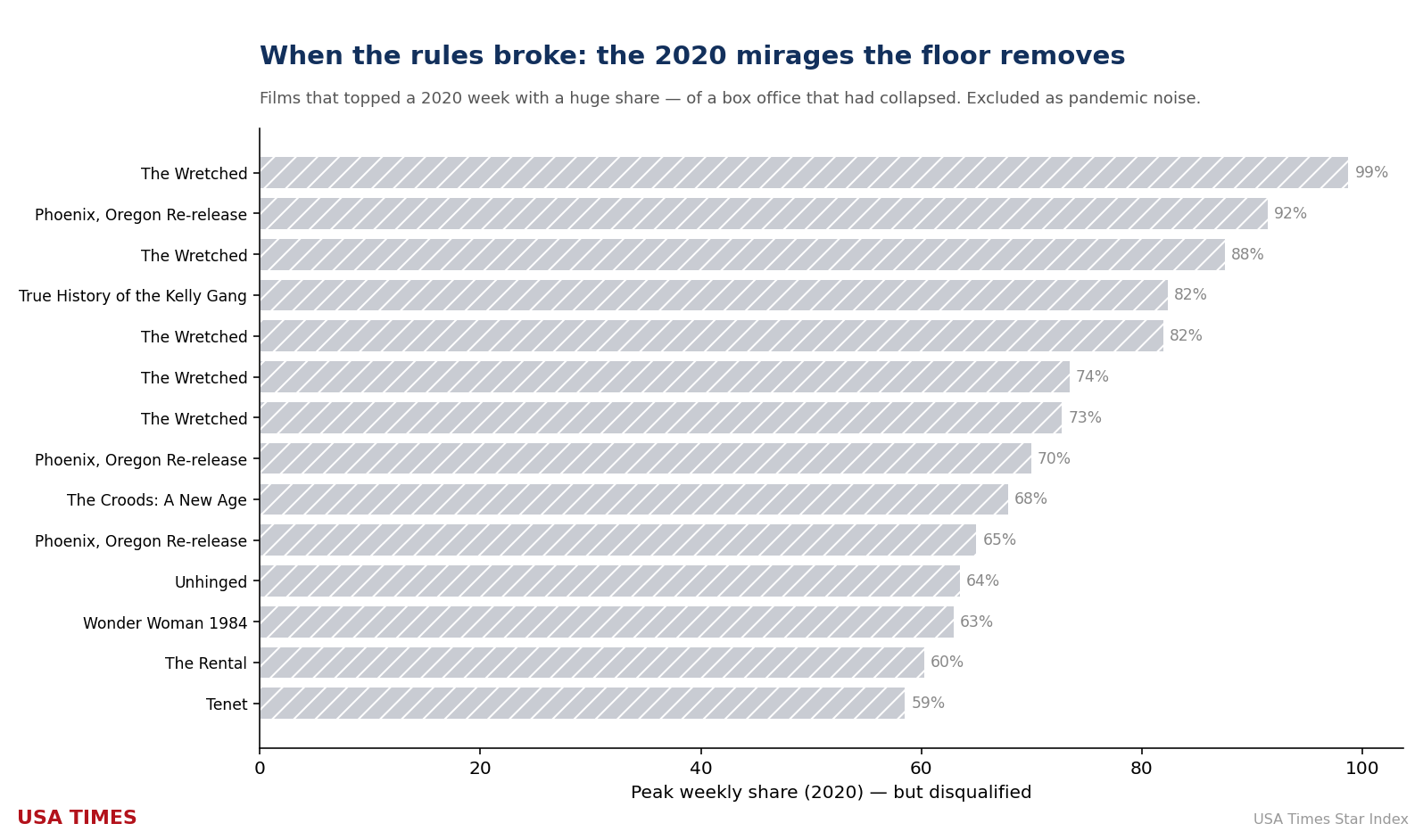
The emblem of the era is The Wretched, a micro-budget horror film that in the summer of 2020 sat at #1 for five weeks and, at its peak, took an almost unimaginable 98.8% of the entire U.S. box office. Its lifetime worldwide gross? Roughly a quarter of a million dollars. It didn’t dominate the market so much as outlast its collapse, playing to the drive-ins that were briefly the only game in town.
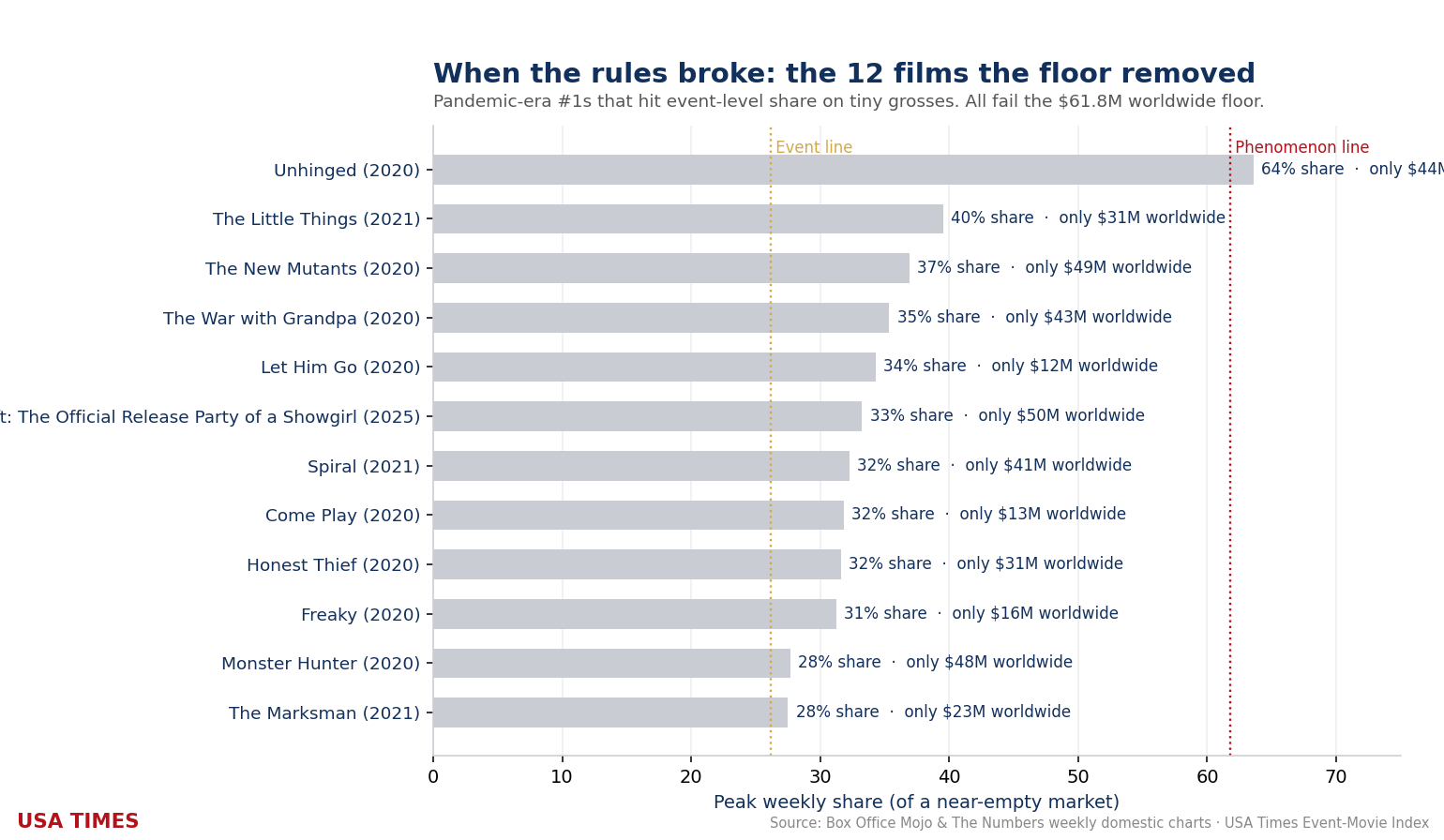
| Film | Year | Peak share | Worldwide gross |
|---|---|---|---|
| Unhinged | 2020 | 63.6% | $44M |
| The Little Things | 2021 | 39.5% | $31M |
| The New Mutants | 2020 | 36.9% | $49M |
| The War with Grandpa | 2020 | 35.4% | $43M |
| Let Him Go | 2020 | 34.3% | $12M |
| Taylor Swift: The Official Release Party of a Showgirl | 2025 | 33.2% | $50M |
| Spiral | 2021 | 32.3% | $41M |
| Come Play | 2020 | 31.9% | $13M |
| Honest Thief | 2020 | 31.6% | $31M |
| Freaky | 2020 | 31.3% | $16M |
| Monster Hunter | 2020 | 27.7% | $48M |
| The Marksman | 2021 | 27.5% | $23M |
Why we built a floor
These twelve films are the reason the USA Times Star Index now carries a hard floor: to count as an event at all, a film must gross at least $61.8 million worldwide — 0.618 × $100M, the same golden ratio that sets our tiers. It is a single rule, and it quietly removes every one of these pandemic artifacts while touching nothing before 2020. Because that is the honest lesson of the era: share can be faked by an empty room. Real domination has to be earned against a full one.
Batmandir · Founders A numbered seat at the table. S3 · The Founders Club — 161 seats per location. By invitation. Explore membership →An empty theater is a distorting mirror
The pandemic did not just shrink the box office; it warped the very meaning of a market share. Share is a ratio — a film’s gross divided by the whole week’s gross — and when the denominator collapses to almost nothing, the ratio stops measuring what it was designed to measure. A film taking 98% of a week in the summer of 2020 was not dominating American moviegoing in any meaningful sense; it was simply the last title standing in a market that had all but ceased to exist. The percentage was real, but it described the emptiness of the room more than the pull of the film. This is the deep lesson of the pandemic era for any index built on share: a percentage is only as meaningful as the total it is a percentage of.
That distortion is why these months required a structural fix rather than a footnote. An asterisk would have acknowledged the problem while leaving the bad data in the record; the floor rule removes it cleanly. By requiring a film to gross at least $61.8 million worldwide before it can count as an event at all, the index quietly disqualifies every pandemic artifact — films whose enormous shares rode on near-zero totals — without any special pleading. The rule is blind to the pandemic; it simply asks whether a film drew a real audience, and the pandemic-era phantoms cannot answer yes.
What the broken months actually teach
It would be easy to treat 2020 and 2021 as a curiosity to be excluded and forgotten, but the broken months carry a genuine analytical lesson that outlasts the emergency. They demonstrate, in the starkest possible terms, that domination and scale are separate properties that usually travel together and can, under stress, come completely apart. In normal times, a film that takes a huge share of a week is also a big film, because the week itself is large; the two facts reinforce each other so reliably that we forget they are distinct. The pandemic pried them apart and showed the seam. A tiny film can post a giant share; a giant film can post a modest share against fierce competition. Any honest measure of the box office has to hold both facts at once, and the pandemic is what forced the index to build that distinction into its foundations.
The floor as a permanent safeguard
The $61.8 million floor was born of the pandemic but it is not limited to it. It stands as a permanent safeguard against any future distortion of the same kind — a strike that empties theaters, a freak weekend, a natural disaster that shutters a region’s cinemas. Whenever the denominator collapses and share becomes unreliable, the floor quietly catches the artifacts before they can pollute the record. That the rule only ever activates on 2020–2021 films in twenty years of data is itself a validation: before the pandemic, every film that owned a week cleared the floor on its own, effortlessly, because a real week of American moviegoing is simply too large for a genuine nobody to dominate. The floor does nothing in normal times and everything in broken ones, which is exactly what a good safeguard should do.
In the end, the broken months are a story about honesty in measurement. It would have been easy, and even flattering to the drama of the era, to leave the 98% shares in the record and marvel at them — to let a micro-budget horror film sit atop the all-time domination charts on the strength of an empty market. The harder and more truthful choice was to build a rule that quietly excludes them, and to explain plainly why. An index earns trust not by having impressive numbers but by having defensible ones, and the pandemic forced the USA Times Star Index to decide, permanently, which kind it wanted to be.
Related from the USA Times Data Desk
- NYC Rat Complaints Just Fell Below Pre-Pandemic Levels for the First Time Since the 2021 Surge
- You Can Never Have Four: The Hidden Math That Governs the Box Office
- The 38.2% Club: The ‘Betelgeuses’ That Run the Box Office
- Box Office Tracker: "Minions & Monsters" mantém o 1º lugar e "Michael" ultrapassa US$ 371 mi sem alarde
- Box-office coverage index · the Star Index methodology