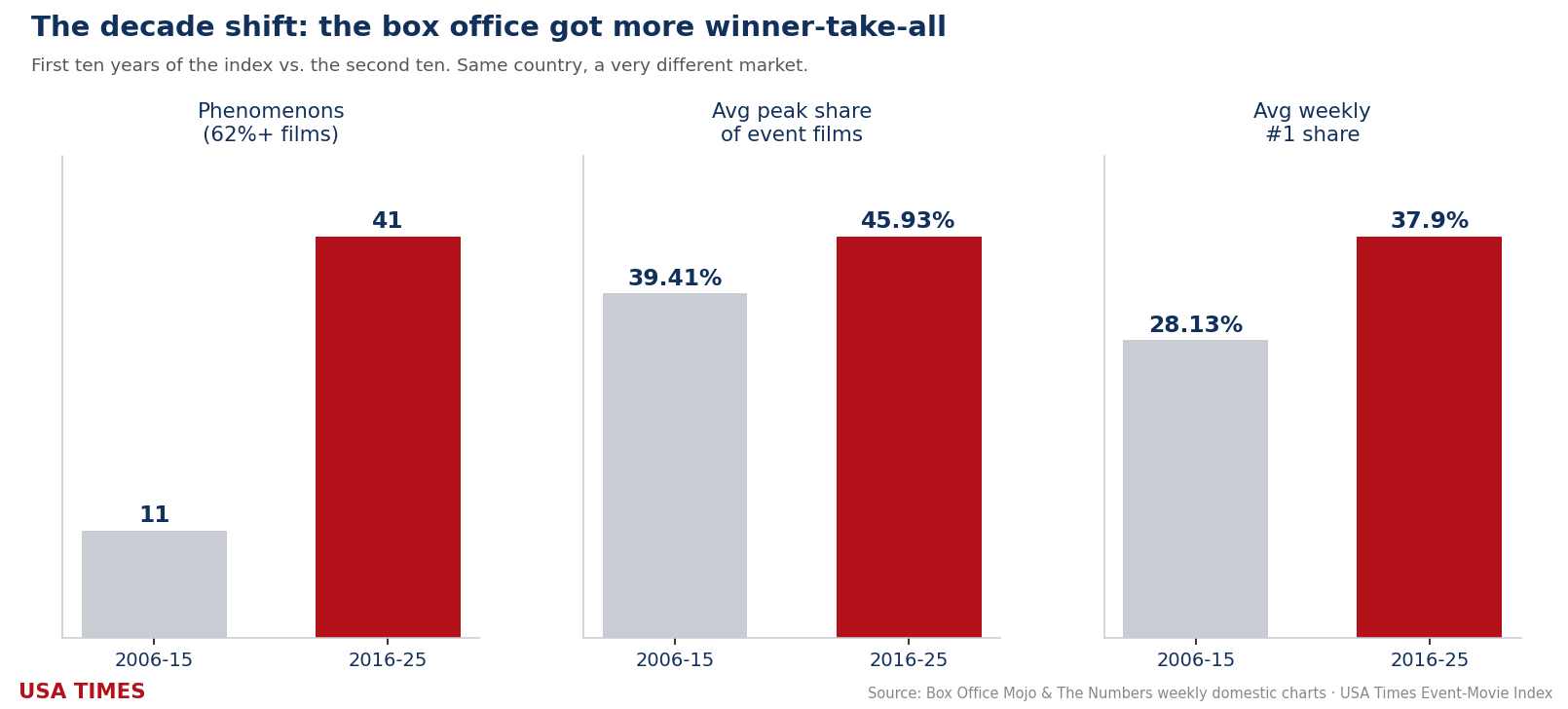
Twenty years is long enough to split in half and compare. Take the first decade of the USA Times Star Index, 2006 through 2015, and set it beside the second, 2016 through 2025. The number of films that own a week barely changes. Almost everything about how completely they own it does.
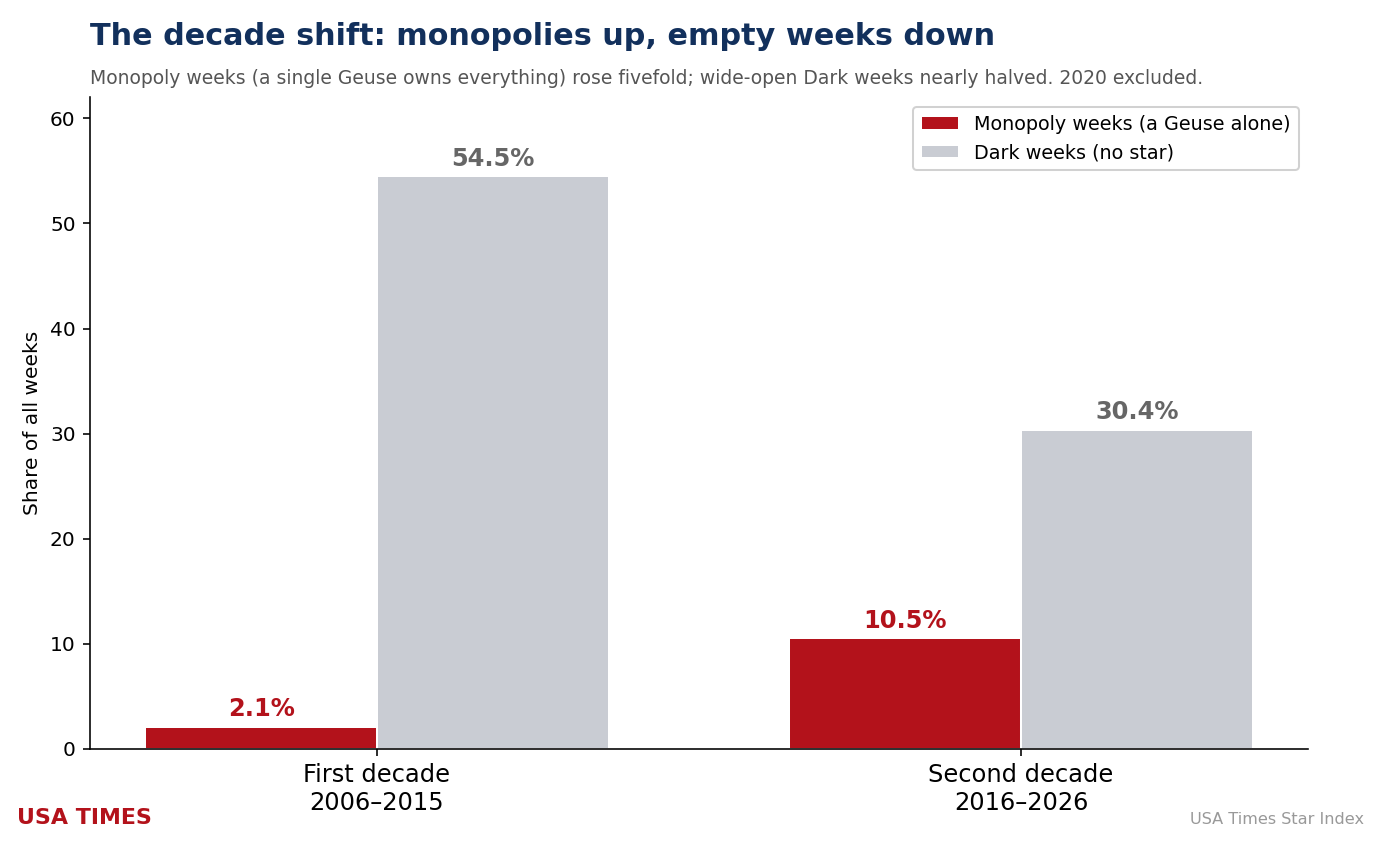
Geuses went from rare to routine
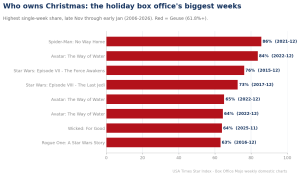
The headline number is Geuses — films that take 62% or more of an entire box-office week. In the first decade there were 11 of them. In the second, 41 — nearly four times as many. What was once a lightning strike, a handful of times a decade, is now an almost monthly event.
Every dominant film got more dominant
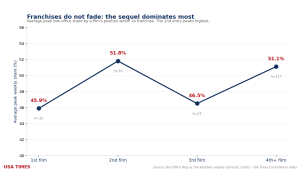
The average star movie’s peak share climbed from 39.4% to 45.9%, and the average weekly #1 film’s share of the whole market rose from 28.1% to 37.9%. Every measure points the same way: the top of the box office got heavier. When a film wins now, it wins by more.
Batmandir · The Circle Full access to theatres, museums & exhibitions. S2 · ongoing membership, without a Founder’s seat. Explore membership →None of this is because Americans go to the movies more — if anything, they go less. It is because the business reorganized itself around a smaller number of enormous bets. Franchises consolidated, mid-budget films migrated to streaming, and the screens that remained were increasingly handed to whichever giant was opening that week. The theater didn’t get bigger. The winners did.
What actually changed between the decades
The temptation is to read a chart like this as a story about movies getting bigger, but that framing misses the mechanism. The films at the top of the box office did not, on the whole, sell dramatically more tickets in the second decade than the first. What changed is the competition around them. In the mid-2000s, a strong opener landed into a crowded marketplace — a healthy slate of mid-budget dramas, comedies, and genre pictures all drawing real audiences the same weekend. That competition capped how large any single film’s share could grow. As the mid-budget film migrated to streaming and studios concentrated their spending on a shrinking set of franchise tentpoles, the marketplace thinned out. The same-sized blockbuster now opens into a near-empty field, and so it commands a far larger slice of a smaller pie.
This is the crucial and counter-intuitive point: concentration at the top is the mirror image of collapse in the middle. Every percentage point the biggest films gained in share was a percentage point surrendered by the films that used to fill the weeks around them — films that, increasingly, are no longer made for theaters at all. The winner-take-all box office is not primarily a triumph of the winners. It is a consequence of everyone else leaving the field.
The role of the pandemic, and why it is not the whole story
Any honest accounting of the shift has to reckon with 2020 and 2021, which distorted the theatrical market more violently than any event in a century. It would be easy to attribute the entire concentration trend to the pandemic — to argue that theaters simply have not recovered, and that once they do, the shared marketplace of the 2000s will return. But the data resists that comfort. The drift toward concentration was clearly underway before 2020, visible year over year through the 2010s, and it has continued after theaters reopened. The pandemic accelerated an existing trajectory; it did not create it. The structural forces — streaming, franchise consolidation, the economics of the mid-budget film — predate the shutdown and outlasted it.
Why it matters beyond the numbers
A more concentrated box office is not merely an academic curiosity; it reshapes what kinds of films get made and seen. When a handful of mega-events reliably capture the overwhelming majority of theatrical revenue, studios rationally pour their resources into more of the same, and the films that do not fit the tentpole mold — the original drama, the modest comedy, the star vehicle for adults — lose their theatrical rationale. The concentration measured here is, in that sense, both a symptom and a cause: a symptom of choices already made, and a cause of the narrowing still to come. The number of star movies each year barely moves, as our headline index has long noted. What moves, decisively, is how much of the market those few films command — and that shift is the quiet story of modern moviegoing.
A final caveat keeps the comparison fair. “Domination” measures share within a week, not total gross or artistic merit, and the two decades are not perfectly like-for-like: release calendars shifted, the number of wide releases fell, and the international market grew. But every reasonable adjustment points the same direction. The concentration is real, it is large, and it is ongoing.
The view from the ticket buyer
Step out of the aggregate for a moment and consider what the shift feels like from a single seat in a single theater. Two decades ago, a moviegoer choosing a Friday night out faced a genuine menu: several films opening wide, several more holding over, each with a real audience and a real cultural presence. Today that same moviegoer increasingly faces a binary — the one enormous event everyone is seeing, or a thin scattering of smaller titles that will be gone from theaters in a fortnight. The concentration measured in these charts is, at ground level, a narrowing of choice: more of the biggest thing, less of everything else. That is not a value judgment about the biggest films, many of which are excellent. It is a description of a marketplace that increasingly offers one dominant option at a time, and it is the lived texture of the numbers this analysis has traced across twenty years.
None of this means the decade shift is irreversible, or that a healthier balance could not return if the economics of mid-budget theatrical filmmaking somehow revived. But nothing in the current structure of the business points that way, and the trend has now held for long enough, through enough different conditions — boom years and bust years, pandemic and recovery — that it is best understood not as a phase but as the defining feature of the modern box office. The winner takes more than ever, and the field it wins from grows thinner every year.
Related from the USA Times Data Desk
- The Rider Sees $350. Drivers Say They Get $47. Inside Lyft’s Vanishing Fare.
- The Weeks Nobody Won: How the Shared Box Office Disappeared
- Every 70mm Odyssey Show on Sale at America's Biggest IMAX Screen Is Sold Out
- The Star Movies of 2025: Every Film That Took Over a Week at the Box Office
- Box-office coverage index · the Star Index methodology