When a director like Christopher Nolan shoots a film in true IMAX, he is composing for a frame that almost no one in the world will ever see in full. The format is called 1.43:1 — nearly square, taller than any other shape in commercial cinema — and the number of screens on Earth that can show it is not in the thousands, or even the hundreds. It is 63. That is the entire planet’s capacity for the tallest image the movies have ever produced.
What the number actually means
Of those 63 screens, 55 are flat auditoriums running either genuine 70mm IMAX film or IMAX-certified laser at the full 1.43:1 ratio, and 8 are the domed OMNIMAX theatres that survive mostly in science museums. For the purest version — real celluloid, the 70mm strip run sideways through the projector so each frame is enormous — the count is smaller still: roughly 25 theatres in the United States, about 34 across North America. When a film like this year’s The Odyssey is released “in IMAX 70mm,” the participating-theatre list runs to around 41 locations worldwide. There are more Michelin three-star restaurants than there are screens that can show a movie at its full height. We keep a running census of every one of them in our true 1.43 theatre directory; the striking thing is how short the list stays.
Why taller is the whole point
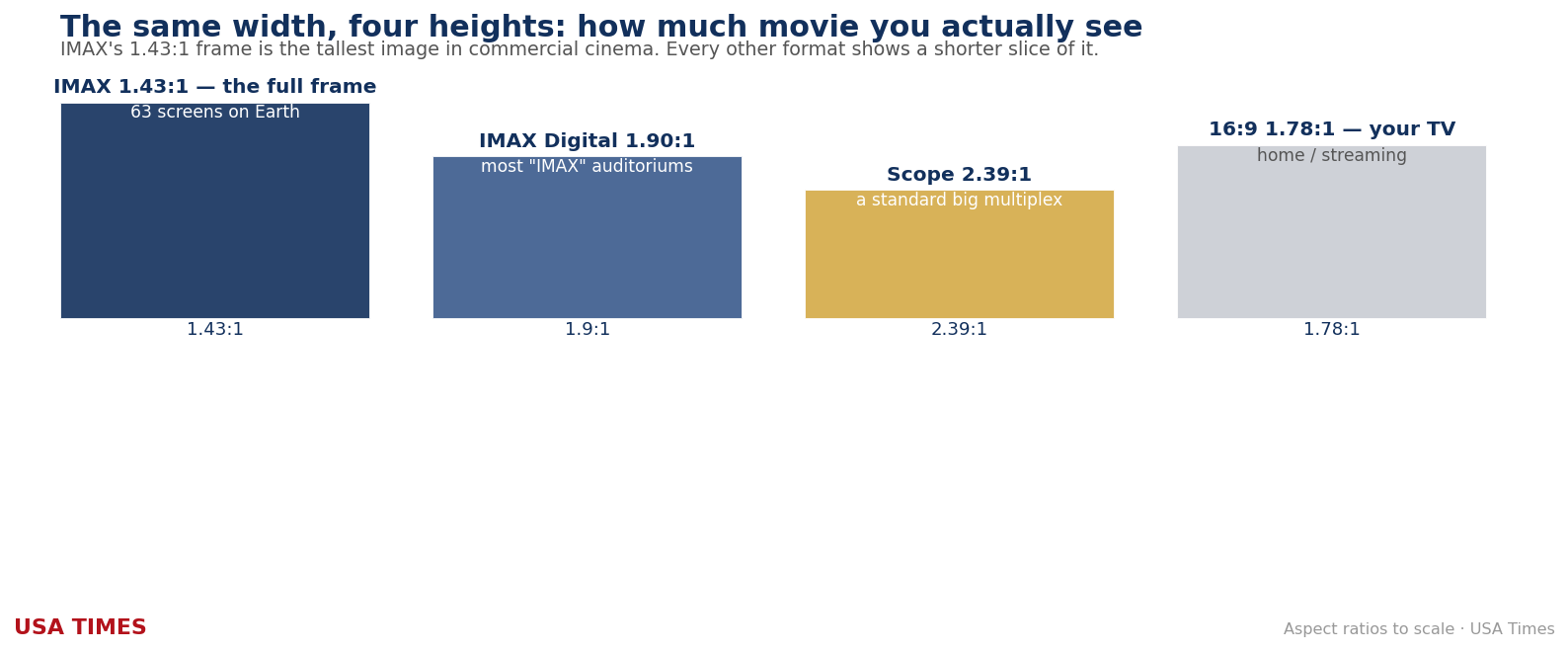
Most conversations about premium cinema fixate on width, but the magic of true IMAX is height. A conventional widescreen “scope” image is 2.39:1 — a long, letterboxed ribbon. The 1.90:1 ratio used by the digital IMAX auditoriums in most malls is closer to a rectangle. The 1.43:1 frame is dramatically taller than both, which is why a shot of a rocket on the launchpad, or a face filling the screen, or a canyon seen from its rim, feels less like watching a picture and more like standing inside one. The image extends above and below your natural line of sight; your peripheral vision runs out before the frame does. That is a sensation no television, however large, can reproduce, because the effect is not about resolution — it is about the image being physically bigger than you.
Batmandir · Guest Passes Step inside for a day. Guest passes from $161/day — brought in by a member. See guest passes →The frame you take home is a crop
Here is the quiet irony of the format. When a film shot in 1.43:1 arrives on streaming or 4K disc, it is almost always cropped to fit a 16:9 television — and often the studio delivers a version that alternates between the taller IMAX ratio and a standard widescreen shape, expanding and shrinking scene by scene. Watch at home and you are, in a real sense, seeing a different edit: the same footage, but with the top and bottom of the director’s composition shaved away, the very dimension the format existed to capture. The 63 screens are not a luxury upsell on the “normal” movie. They are the only places the movie exists at full size. Everywhere else is the abridgment.
Scarcity is becoming the selling point
For a century, the film industry chased ubiquity: more prints, more screens, more territories, the same movie everywhere at once. The 1.43 format inverts that logic. Its value comes precisely from how few places can deliver it — from the fact that seeing The Odyssey or Oppenheimer in true 70mm requires knowing which of two dozen theatres in the country is equipped, buying a ticket weeks ahead, and often traveling to get there. Filmgoers now plan trips around a screen the way music fans plan them around a venue. The experience is not reproducible on demand, and that irreproducibility has quietly become one of the last things theatrical cinema can offer that the living room cannot.
It is also why the next frontier for the format may not be bigger public palaces but smaller private ones — rooms built to the 1.43 standard and held for a handful of viewers who want the full frame without the logistics of a sold-out opening night. A screen that shows films the way they were shot, on a calendar you actually control, is a strange kind of luxury: not more content, but the correct shape of it. In an era when every film is available everywhere in a slightly diminished form, the rarest thing you can buy is the whole picture.
How to actually see one
If you want to see a film at full height, three rules help. First, confirm the format, not just the brand: an auditorium labeled “IMAX” is usually the 1.90:1 digital kind, not the 1.43:1 film kind, and only the latter shows the tallest frame. Second, book early — true 70mm engagements are short and sell out, because supply is measured in dozens of rooms, not thousands. Third, sit closer than instinct tells you; the format rewards letting the image overwhelm your field of view rather than framing it politely from the back row. Do all three and you will see something most moviegoers, even devoted ones, never do: the movie exactly as the director drew it, top to bottom, with nothing cropped away.
The machinery behind the frame
Part of why the format stays rare is that it is gloriously impractical. A 70mm IMAX print is not a slim reel in a canister; a single feature can weigh hundreds of pounds and arrive on a platter the size of a dinner table, threaded through a projector that is itself a piece of precision heavy machinery. The film runs horizontally, each frame fifteen perforations wide, which is why the image is so large and why the equipment to move it is so demanding. Shipping one of these prints across the country is closer to freight logistics than to dropping a hard drive in the mail — a physical object that has to be trucked, handled, and threaded by trained projectionists. We’ve written before about the sheer weight and logistics of showing a film this way; the short version is that every screening is a small act of engineering.
That difficulty is not a bug the industry is racing to fix. It is the reason the format means anything. A movie you can stream in one tap is abundant by design; a movie that requires a specific room, a specific machine, a heavy reel of celluloid, and a specific night is scarce by nature — and scarcity, in the end, is what turns watching a film into going to see one. The 63 screens are not the past clinging on. They are a bet that in a world of infinite, slightly-cropped copies, the whole picture — at full height, in a room built for it — is worth leaving the house for.