Read in: English · Español · Русский · 中文 · Português
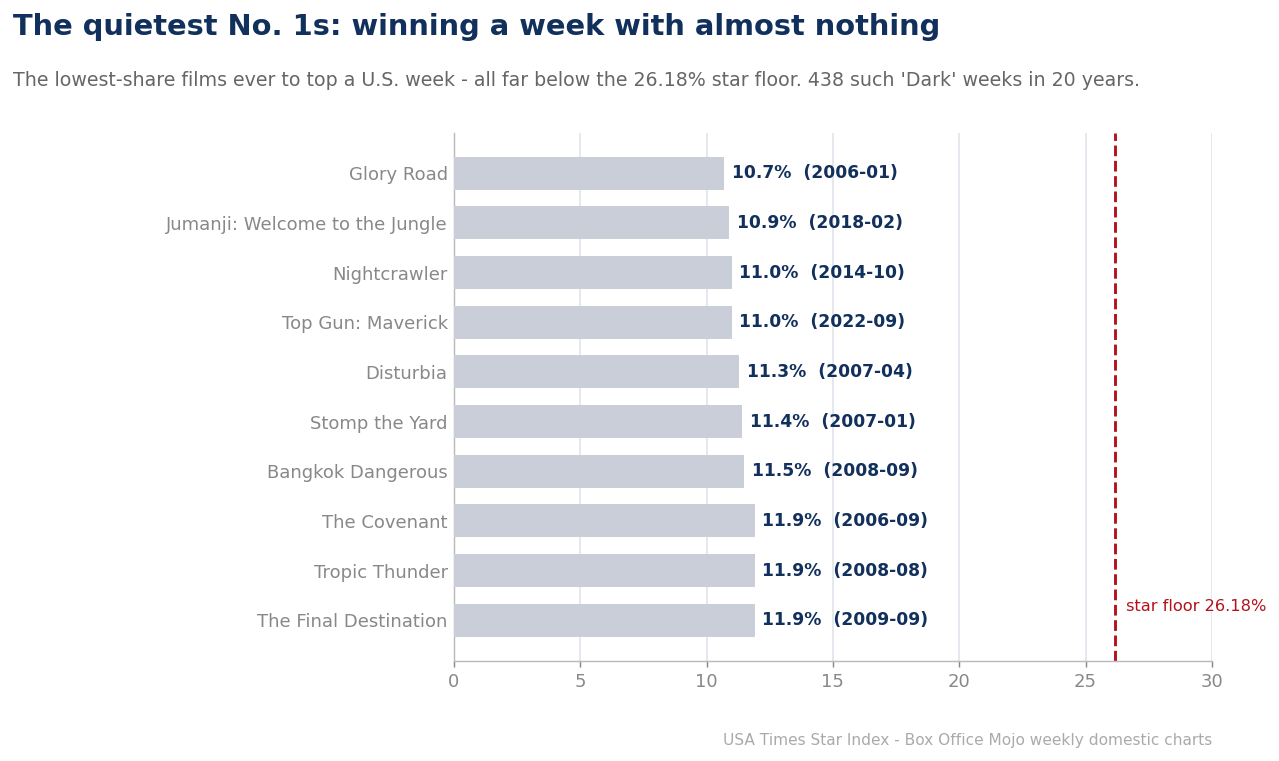
Not every week at the box office has a champion worth the name. On the quietest weeks in the last twenty years, the No. 1 film in America took barely a tenth of the market — a “win” so faint it would be a footnote in July. The lowest-share chart-topper on record is Glory Road, which led the week of January 13, 2006, with just 10.7% of the total U.S. box office. It is the emptiest crown in the Star Index.
The gallery of faint crowns
The quietest No. 1s cluster in the box office’s dead zones: mid-January, early February, and the late-August lull, when studios park their weakest wide releases and audiences stay home. Glory Road (10.7%), Stomp the Yard (11.4%), Disturbia (11.3%) and Nightcrawler (11.0%) all topped their weeks with shares that wouldn’t crack the top three in a busy summer frame. None of them is a flop — several were solid earners — but each won a week simply because no one bigger showed up.
Batmandir · The Circle Full access to theatres, museums & exhibitions. S2 · ongoing membership, without a Founder’s seat. Explore membership →There is a wrinkle worth noting: some of these faint No. 1 weeks belong to genuinely huge films in the twilight of their runs. Top Gun: Maverick appears on the list at 11.0% for the week of September 2, 2022 — not because it was weak, but because it was still leading the box office months after opening, in a market so soft that even its long-faded weekly gross was enough to top the chart. The same faint-crown week can therefore mean opposite things: a weak film in a weak week, or a giant that outlasted everything around it.
| Film | Week | Share |
|---|---|---|
| Glory Road | Jan 2006 | 10.7% |
| Jumanji: Welcome to the Jungle | Feb 2018 | 10.9% |
| Nightcrawler | Oct 2014 | 11.0% |
| Top Gun: Maverick (holdover) | Sep 2022 | 11.0% |
| Disturbia | Apr 2007 | 11.3% |
| Stomp the Yard | Jan 2007 | 11.4% |
Why the ‘Dark’ week exists
These faint crowns are the extreme edge of a much larger category: the 438 “Dark” weeks — 43% of the last twenty years — in which the No. 1 film failed to clear the 26.18% star-movie floor at all. A Dark week isn’t empty of movies; it is empty of dominators. Three or four mid-sized films split the audience, none breaks away, and the “winner” leads by default. The quietest No. 1s are simply the darkest of these Dark weeks, the ones where the leader barely registered.
For the industry, these weeks are a paradox. They look like failure — no film captured the culture — yet they are also the most winnable weeks on the calendar. A modest release dropped into mid-January can lead the entire U.S. box office with a share that would be invisible against a giant, and reap the “number one movie in America” headline that follows. The savviest counter-programmers live in exactly these weeks, trading raw scale for the outsized publicity of a cheap crown.
The quiet weeks are getting rarer at the very bottom
One subtle shift over the twenty years: the very faintest crowns are concentrated in the late-2000s and early-2010s, when a deeper bench of small wide releases meant more genuinely leaderless weeks. As the mid-budget release migrated to streaming, the calendar polarized — more overwhelming giants at the top and more truly empty weeks in between — but the specific phenomenon of a 10%-share No. 1 has become slightly less common, because when a soft week arrives now, it is more often a fading giant like Maverick holding on than a small new film scraping to the top. The quietest crowns, like everything else in the modern box office, increasingly belong to the biggest films.
The economics of a cheap crown
Winning a Dark week is worth more than the faint share suggests, which is why distributors chase it. The phrase “number one movie in America” carries the same marketing weight whether a film earned it with 65% of a booming summer week or 11% of a dead January one — and the second is far cheaper to buy. A modest genre film that would be invisible against a tentpole can lead a quiet week outright, bank the headline, and use it to sell tickets and, later, home viewing. The quietest crowns are, in a sense, the best value in the business: maximum publicity for minimum scale.
Horror studios have turned this into a discipline. A large share of the faint-crown weeks belong to inexpensive thrillers and horror titles opened deliberately into the calendar’s empty stretches, where a $10–20 million film can top the chart and launch a franchise. Disturbia, Stomp the Yard, and countless January releases followed exactly this playbook. The Dark week isn’t a failure of the market so much as a feature of it — an open lane for anyone willing to skip the crowded months.
What a faint crown says about the year
The frequency of very-low-share No. 1s is also a barometer of the health of the theatrical calendar. A year with many faint crowns is a year with long fallow stretches and few mid-sized films strong enough to command a week. As the mid-budget release has thinned, those stretches have, if anything, grown — which is why the quietest weeks increasingly feature a fading giant holding on rather than a fresh small film breaking through. Either way, the faint crown is a signal: it marks the weeks when the box office briefly runs on fumes, waiting for the next real star to arrive.
What we did: We ranked every weekly chart by the No. 1 film’s share of that week’s total domestic box office and pulled the lowest-share leaders, then counted all weeks whose leader fell below the 26.18% star floor. Weekly share is each film’s gross as a percentage of that week’s total U.S. domestic box office, from Box Office Mojo’s weekly charts, 2006–2026. We exclude 2020 as a pandemic anomaly.
Related from the USA Times Data Desk
- Most Weeks, Nobody’s a Star
- The Box-Office Calendar: The Months Movies Take Over
- The Star Index methodology
Sources
- Box Office Mojo — weekly and weekend box office grosses
- The Numbers — historical domestic box office records
- USA Times — Star Index methodology (how our tiers and box-office share are computed)