Read in: English · Español · Русский · 中文 · Português
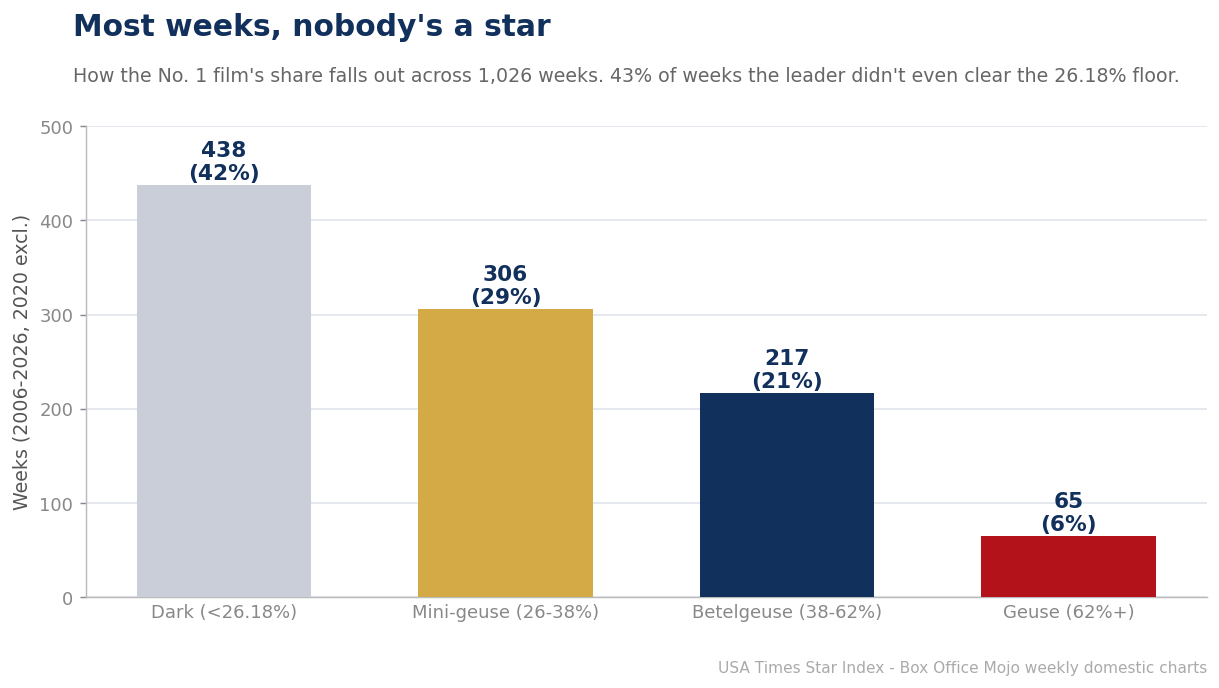
For all the talk of blockbusters, the typical week at the U.S. box office has no star at all. Across 1,026 weeks in the USA Times Star Index, the No. 1 film failed to clear the 26.18% qualification floor — our threshold for a genuine “star movie” — in 438 of them, or 43%. Nearly half the time, the biggest film in America simply wasn’t big enough to own its week.
The shape of an ordinary week
The median weekly winner takes just 28.7% of the market — barely into star territory. Break the twenty years into tiers and the pyramid is steep: 438 “Dark” weeks with no star, 306 weeks won by a Mini-geuse, 217 by a Betelgeuse, and just 65 weeks — 6% — crowned by a Geuse. The rare, market-swallowing phenomenon that dominates the cultural conversation is, statistically, a once-every-few-months event.
Batmandir · Founders A numbered seat at the table. S3 · The Founders Club — 161 seats per location. By invitation. Explore membership →Why the ‘Dark’ weeks matter
Those 438 starless weeks are the connective tissue of the movie year: the stretches between tentpoles when three or four mid-sized films split the audience and no single title breaks away. They are where counter-programming lives, where a modest release can win a weekend outright, and where the box office looks less like a monopoly and more like a fair fight. They are also, increasingly, where most of the calendar lives — a reminder that the highlight reel of 80%-share phenomena is the exception, not the norm. The everyday box office is a crowd, not a coronation.
A market of crowds, punctuated by kings
The 43% “Dark” figure reframes how to think about the movie year. For nearly half of it, there is no dominant film — just three or four mid-sized releases splitting the audience, none strong enough to clear the star-movie line. These are the weeks that rarely make headlines precisely because nothing ran away with them, yet they are the statistical center of gravity of the entire box office.
| What owned the week | Weeks | Share of 20 years |
|---|---|---|
| Nothing (Dark, <26.18%) | 438 | 43% |
| A Mini-geuse (26.18-38.2%) | 306 | 30% |
| A Betelgeuse (38.2-61.8%) | 217 | 21% |
| A Geuse (61.8%+) | 65 | 6% |
The 6% that define the era
At the other extreme, the 65 Geuse weeks — a mere 6% of the calendar — are the ones everyone remembers: the opening of an Avengers, an Avatar, a Barbie. Culturally they dominate the story of the movies; statistically they are rare punctuation. This is the gap between perception and data. The blockbuster era is real, but it is built on a small number of enormous weeks scattered across a calendar that is, most of the time, an ordinary and competitive marketplace.
Why the floor is set where it is
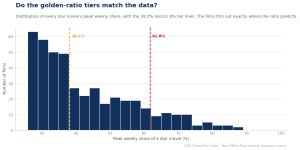
Some readers ask why 26.18% is the dividing line for a “star movie” at all. The threshold is the golden-ratio floor the Star Index uses throughout (0.2618, the square of 1/φ), chosen because it cleanly separates films that meaningfully own a week from those that merely happen to lead a fragmented one. The distribution here is a validation of that choice: a large mass of weeks sits below it — the genuinely leaderless weeks — while the weeks above it correspond to films audiences actually treated as events. The line isn’t arbitrary; it falls in a real valley in the data.
Have Dark weeks grown or shrunk?
The 43% figure is an average across twenty years, but it is not static. In the mid-2000s, a deeper bench of mid-budget releases meant more weeks had a genuine leader that cleared the star line. As the mid-budget film eroded and the market concentrated around a smaller number of giants, the calendar polarized: more blowout weeks at the top and, paradoxically, more leaderless Dark weeks in between, as the stretches without a tentpole were left to a scrum of smaller titles. The distribution has hollowed out in the middle — fewer of the solid, unspectacular hits that used to lead an ordinary week.
What fills a leaderless week
Dark weeks are not empty of movies; they are empty of dominators. They are typically split among horror titles, faith-based releases, mid-budget comedies and dramas, and holdovers from the last tentpole — none strong enough to clear a quarter of the market alone. These are the weeks where an inexpensive film can “win” the weekend with a share that would be an afterthought in July, which is exactly why savvy distributors target them. A modest opener that would vanish against a giant can lead a Dark week outright and reap the headline that comes with it.
The perception gap
The gap between the 6% of weeks crowned by a Geuse and the 43% with no star at all is, ultimately, a media-attention story. Coverage clusters around the enormous weeks because they are events; the leaderless majority of the calendar goes largely unremarked. But for anyone actually making release decisions, the Dark weeks are the opportunity — the open water between the giants where a well-placed small film can still make a mark. Understanding how often those weeks occur is the difference between a release strategy built on hope and one built on the shape of the real market.
The genre map of a leaderless week
Dig into what actually leads a Dark week and a clear cast of characters emerges. Horror is the most frequent Dark-week winner — a genre built to open modestly, play cheaply, and win a quiet weekend without ever threatening the star line. Faith-based releases, mid-budget comedies, and adult dramas fill out the rest, along with the fading holdovers of the last tentpole. These are films for which leading a Dark week is a genuine success, not a disappointment: they were never built to take a quarter of the market, only to win the room when no giant is present.
Streaming absorbed the missing middle
The most important structural reason Dark weeks persist — and have arguably grown — is that the mid-budget theatrical film has migrated to streaming. The $30–60 million adult drama or comedy that once opened wide and led an ordinary week now premieres on a service instead. That exodus hollowed out the middle of the theatrical calendar: the weeks between tentpoles used to have a real leader clearing the star floor, and increasingly they don’t, because the films that would have led them aren’t in theaters at all. The 43% Dark figure is, in part, a measure of what streaming took.
The opportunity hiding in the gaps
For a nimble distributor, though, the Dark weeks are not a problem — they are the whole opportunity. A modest film that would be invisible against a July giant can lead a February or September week outright and claim the “number one at the box office” headline that drives its marketing. The savviest small-and-mid-budget releases are timed precisely into these gaps. Understanding that 43% of the calendar is up for grabs is the difference between fighting the giants and simply going where they aren’t.
What we did: We classified every week’s No. 1 film by its share into four bands using the Star Index golden-ratio thresholds (26.18%, 38.2%, 61.8%) and counted the weeks in each. Weekly share is each film’s gross as a percentage of that week’s total U.S. domestic box office, from Box Office Mojo’s weekly charts, 2006–2026. We exclude 2020, whose pandemic-shrunken weeks distort shares below the Star Index qualification floor.
Related from the USA Times Data Desk
- The Perpetual Runner-Up: Twenty Years of No. 2
- What Is a Star Movie? The USA Times Definition
- The Star Index methodology
Sources
- Box Office Mojo — weekly and weekend box office grosses
- The Numbers — historical domestic box office records
- USA Times — Star Index methodology (how our tiers and box-office share are computed)