Read in: English · Español · Русский · 中文 · Português
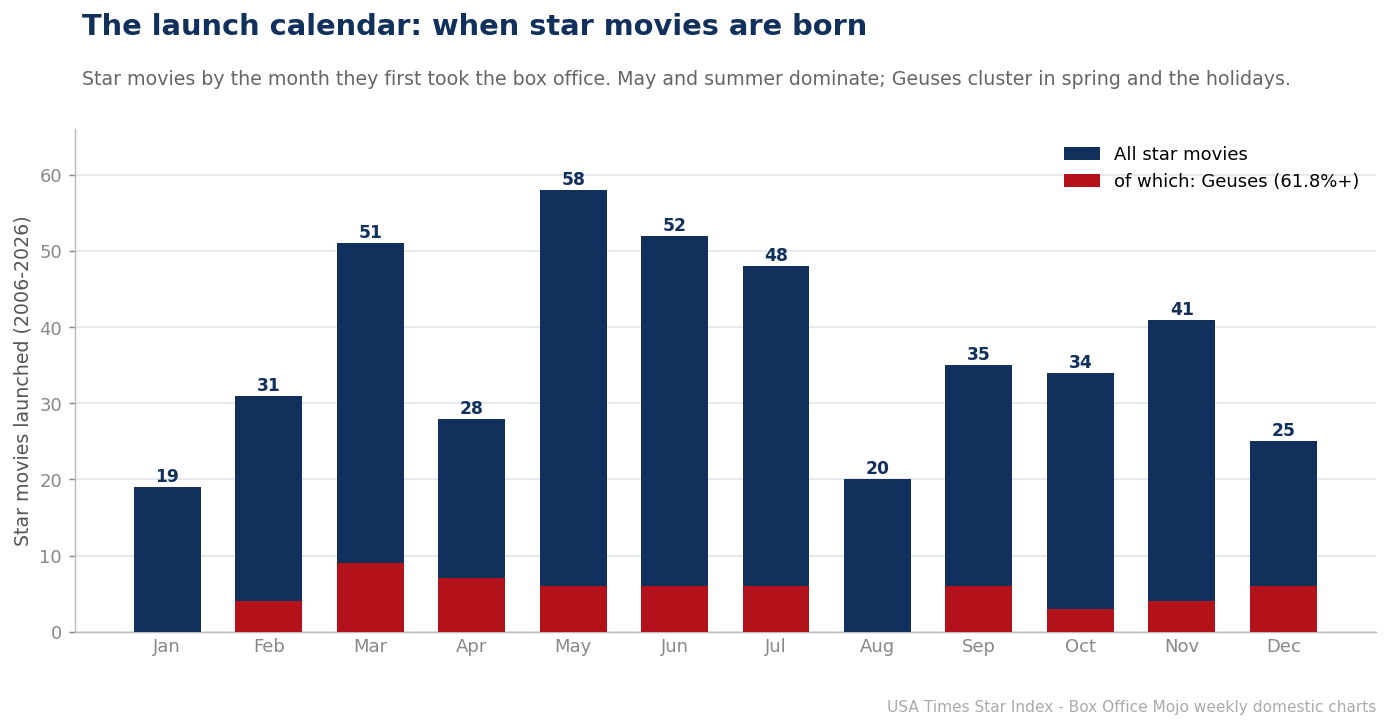
Star movies are not born evenly across the year. Map every week-owning film in the Star Index to the month it first took the box office and a clear seasonal skeleton emerges: a towering peak in May (58 star movies in twenty years), a strong summer shoulder through June and July, a secondary spring bump in March, and deep troughs in January and August — the months when almost nothing large is born.
Summer is where stars are made
May alone accounts for more star-movie launches than any other month, and May through July together produce roughly a third of all the star movies of the last two decades. This is the tentpole corridor by design: studios reserve their surest blockbusters for the weeks when school is out and the audience is largest. March has quietly become a second launch window — 51 star movies — as studios learned that a strong spring opening faces less competition than the summer scrum. The message for release strategy is unchanged after twenty years: if you have a giant, you open it when the crowd is already there.
Batmandir · Founders A numbered seat at the table. S3 · The Founders Club — 161 seats per location. By invitation. Explore membership →But Geuses keep their own calendar
Split out the rarest tier — the Geuses, films that took 61.8%+ of a week — and the map shifts. Geuses cluster not just in summer but in March (9 of them, the single highest month) and across the December holidays, with a notable dead spot in January and August where no Geuse has ever been born. The reason is competitive space: a film reaches Geuse share by dominating a week almost completely, which is easiest when it opens huge into a market with no rival giant. March and the pre-Christmas weeks offer exactly that — a massive opening with clear air around it — whereas the summer’s crowded slate can cap even a huge film’s share as other tentpoles siphon off the audience.
| Month | Star movies born | of which Geuses |
|---|---|---|
| May | 58 | 6 |
| June | 52 | 6 |
| March | 51 | 9 |
| July | 48 | 6 |
| November | 41 | 4 |
| January | 19 | 0 |
| August | 20 | 0 |
The empty months
January and August are the box office’s nurseries for nothing. Between them they account for fewer star-movie launches than May does alone, and neither has ever produced a Geuse. These are the dumping grounds — the weeks after the holidays and the end-of-summer lull, when studios clear out films they don’t expect to dominate. It is the flip side of the tentpole strategy: concentrating the giants into a few prime windows necessarily leaves long stretches of the calendar barren. A film released in January isn’t just facing a soft audience; it is being told, by its own studio’s scheduling, that it was never expected to be a star.
What the map means for moviegoers
For audiences, the launch calendar is a rough guide to when the year’s essential films actually arrive: a wave in spring, a flood in summer, a holiday spike, and long quiet stretches in between. It also explains the increasingly lumpy rhythm of moviegoing — a few unmissable months bracketed by weeks with little that demands a trip to the theater. The stars, it turns out, are born on a schedule, and that schedule has barely moved in twenty years.
Why March became a launch window
The rise of March as a star-movie nursery — 51 launches, and the single richest month for Geuses — is one of the clearest strategic shifts of the past two decades. For years March was an afterthought, but studios discovered that a major film opening in early spring faces a fraction of the competition it would meet in summer, giving it room to post an enormous share and hold for multiple weeks. The Super Mario Bros. Movie, Godzilla vs. Kong, and a string of other spring giants proved that you don’t need June to make a phenomenon — you need open air, and March has plenty of it.
The summer paradox
Summer produces the most star movies but proportionally fewer Geuses than its raw volume would predict, and the reason is crowding. When three or four tentpoles open within weeks of each other, they cannibalize one another’s share — each is big, but none can take 60%+ of a week because the others are siphoning off the audience. The result is a summer full of Betelgeuses rather than Geuses. It is the same dynamic we’ve documented in the “most contested months” analysis from the opposite direction: the fullest months produce the most hits but the fewest total-domination weeks, because the giants get in each other’s way.
What the empty months cost
January and August’s barrenness is a self-inflicted feature of the tentpole strategy. By concentrating the surest bets into a few prime windows, studios necessarily strand the rest of the calendar — and those empty months represent real, foregone theatrical demand. There is a live debate in the industry about whether a more even distribution of major releases across the year would grow the overall market by giving audiences a reason to go more often, rather than in a few frantic bursts. The launch calendar, unchanged for twenty years, suggests studios have so far decided the concentrated approach is worth the empty stretches — but the barren nurseries of January and August are the price they pay for it.
What we did: We mapped each qualifying star movie’s first week atop the chart to a calendar month and counted launches per month, then repeated the count restricted to Geuse-tier films. Weekly share is each film’s gross as a percentage of that week’s total U.S. domestic box office, from Box Office Mojo’s weekly charts, 2006–2026. We exclude 2020 as a pandemic anomaly.
Related from the USA Times Data Desk
- The Box-Office Calendar: The Months Movies Take Over
- The Box Office’s Most Contested Months
- Box-office coverage index