PAULIE GEE’S SLICE SHOP (Greenpoint, 110 Franklin Street, Brooklyn) — Italian / Pizza. Case study #32. Prices compared between Paulie Gee’s Slice Shop’s own online-ordering menu and the same shop’s Uber Eats storefront, both for the 110 Franklin Street location, captured the same day.
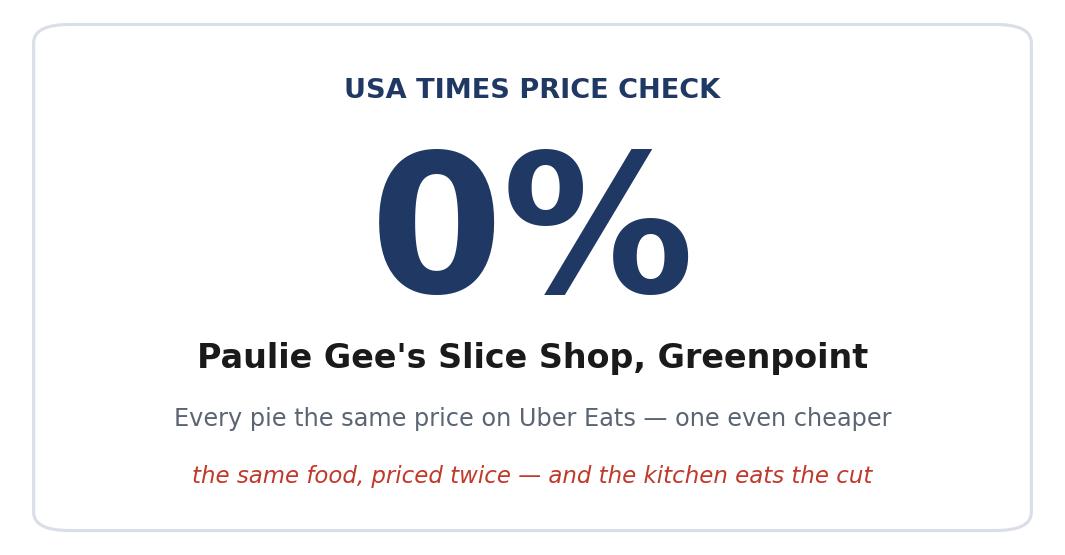
Order Paulie Gee’s 20-inch cheese pie — the plainest whole pie this Greenpoint slice shop makes — directly from the shop’s own online-ordering site for pickup and it is $29.75. Order the same pie, from the same ovens, delivered on Uber Eats and it is… $29.75. The $42 Hellboy Squared Sicilian is $42.00 either way; the Vodka Sauce pie is $35.00 either way; the vegan Freddy Prince, the priciest pie on the board, is $43.75 either way. We priced 14 of Paulie Gee’s whole pies side by side, round and Sicilian, meat and vegan, and every one carried the same price on Uber Eats as ordering direct — with a single exception that cuts the wrong way for the “delivery costs more” story: the sausage pie is $35.00 direct and $33.00 on Uber, two dollars cheaper on the app. The average markup was zero.
Paulie Gee’s does not raise its menu for the delivery customer. The food price is set once, and here it lands on Uber Eats at the shop’s own direct-order price to the dollar — and, on one pie, a couple of dollars below it. Which means, as the numbers below show, that the shop is the one absorbing the platform’s commission.
The markup
Across the 14 matched pies the delivery markup was effectively 0% — a median of zero, a mean a hair below zero, and a range from −6% (the sausage pie, cheaper on Uber) to 0%. A basket of all 14 pies costs $519 ordering direct and essentially the same $517 to have delivered on Uber Eats. There is no gentle treatment for the cheap pies and no steeper one for the expensive ones: a $29.75 cheese pie, a $35 vodka-sauce pie, a $42 Hellboy Squared and a $43.75 vegan Freddy Prince are all listed at the shop’s own price on the app. This is the same pattern this series has found at Table 87, Emily, Motorino, Boqueria and Van Leeuwen — a flat, honest transfer of the menu to the app with nothing added on the food.
What the shop nets
Here is why a 0% markup is the whole story. When a customer orders delivery through Uber Eats, the platform keeps a commission on the sale. To come out level with a walk-in, a shop would need to mark its delivery menu up by about +42.9% at a 30% commission — or about +17.6% even at New York’s capped 15%. Paulie Gee’s marks up nothing. So the math runs entirely against the shop: apply a 30% commission to the $517 delivery basket and Paulie Gee’s keeps about $362 — roughly $157 less than the $519 the same pies bring in ordering direct. Even at New York’s capped 15% rate it nets about $439, still about $80 less than direct. On all 14 of the 14 pies — every one, the sausage pie included, even though it sells for less on Uber — the shop nets less selling through Uber than selling the same pie through its own channel. This is the pattern this series calls absorbing (Type B): the customer pays the shop’s own price, and the shop quietly eats the commission out of its own margin.
Why it still lands on Uber
Paulie Gee’s sets its own menu prices; Uber does not. But Uber sets the commission, and a shop that chooses not to pass it on is choosing to absorb it. Many restaurants in this series lift their delivery menus to recover the platform’s cut, in whole or in part; Paulie Gee’s has declined to, holding its Uber prices at its own direct-order prices to the dollar — and shading one pie lower. That protects the delivery customer and squeezes the kitchen. It does not make the fees disappear: on top of these identical menu prices, Uber still charges the delivery customer a delivery fee, a service fee and tax at checkout — none of which appear in the figures above, because they require a logged-in order to see. Uber also reports to merchants a “Menu Markup” metric measuring the gap between a restaurant’s own prices and its in-app prices; at Paulie Gee’s that gap is zero, which means the commission comes almost entirely out of the shop.
The New York context
New York City caps the core commission a delivery app can charge a restaurant at 15% for delivery, plus 5% for other listing and marketing services and 3% for card processing — limits the City Council first made permanent in 2021. A 2025 amendment, signed into law after the platforms sued and settled, now lets restaurants opt to pay an additional up to 20% for “enhanced services” such as wider delivery zones and top-of-search placement, which can push the total a restaurant chooses to pay toward roughly 43% — the same figure a shop would need to mark up its menu just to break even. Paulie Gee’s marks up none of it. One place New York’s cap does reach the customer is on the rival app: DoorDash layers a consumer “NYC Regulatory Response Fee” onto its checkouts, a surcharge it added to offset the commission cap — a mechanism worth flagging wherever it appears, though it is DoorDash’s and is charged at checkout rather than in the menu prices matched here. The Mayor’s Department of Consumer and Worker Protection continues to review delivery-app fees.
| Item | Order-direct (pickup) price | Uber Eats | Markup | Shop nets @30% (vs direct) |
|---|---|---|---|---|
| Pies | ||||
| Hellboy Squared Pie (Sicilian) | $42.00 | $42.00 | 0% | $29.40 (-12.60) |
| Freddy Pepperoni Square (Sicilian) | $40.25 | $40.25 | 0% | $28.17 (-12.08) |
| Hellboy Pie (20″) | $38.50 | $38.50 | 0% | $26.95 (-11.55) |
| Freddy Prinze Square Pie (Sicilian) | $38.50 | $38.50 | 0% | $26.95 (-11.55) |
| Daniela Spinachi (20″) | $36.75 | $36.75 | 0% | $25.72 (-11.03) |
| Pepperoni Pie (20″) | $35.00 | $35.00 | 0% | $24.50 (-10.50) |
| Sausage Pie (20″) | $35.00 | $33.00 | -6% | $23.10 (-11.90) |
| Vodka Sauce Pie (20″) | $35.00 | $35.00 | 0% | $24.50 (-10.50) |
| The Mootz Pie (20″) | $33.00 | $33.00 | 0% | $23.10 (-9.90) |
| Cheese Pie (20″) | $29.75 | $29.75 | 0% | $20.82 (-8.93) |
| Vegan Pies | ||||
| Vegan Freddy Prince w/ Vegan Sausage (Sicilian) | $43.75 | $43.75 | 0% | $30.62 (-13.13) |
| Vegan Vidalia Square (Sicilian) | $40.25 | $40.25 | 0% | $28.17 (-12.08) |
| Vegan Pepperoni Pie (20″) | $38.00 | $38.00 | 0% | $26.60 (-11.40) |
| Vegan Cheese Pie (20″) | $33.00 | $33.00 | 0% | $23.10 (-9.90) |
| All 14 matched pies (basket) | $518.75 | $516.75 | -0% | $361.72 (-157.03) |
By the numbers
- Pies matched: 14 (same description and portion, same 110 Franklin St location; the shop’s by-the-slice items, add-on toppings, drinks, canned beer and any item we could not confirm to the dollar on both platforms were excluded)
- Delivery markup: mean 0%, median 0%, range −6% to 0% — every pie priced at the direct-order price on Uber, one (the sausage) $2 cheaper on the app
- Basket: $519 ordering direct, $517 delivered on Uber Eats (essentially identical)
- Break-even markup at a 30% commission: +42.9% — Paulie Gee’s 0% is a long way below it
- What the shop nets: about $362 on the basket at a 30% commission (~$157 less than direct); about $439 even at New York’s capped 15% (~$80 less)
- Pies on which the shop nets less than ordering direct: 14 of 14 at a 30% commission; 14 of 14 at New York’s capped 15%
- Story type: B (absorbing) — the customer pays the shop’s own price; the shop absorbs the platform’s commission
Method
On 16 July 2026, USA Times captured Paulie Gee’s Slice Shop’s own prices from its first-party online-ordering site (order.online, the DoorDash-powered Storefront linked directly from pauliegee.com), set to Pickup from 110 Franklin Street — the price a customer pays ordering directly from the shop, on a channel that carries no marketplace commission markup and shows the same food prices in pickup and delivery modes; we treated that as the direct/counter price. The same day, we captured Uber Eats list prices for the same 110 Franklin Street store from the rendered storefront and matched them item by item against that menu; every one of the 14 matched pies was priced identically except the sausage pie, which was $2 lower on Uber. We matched only whole pies with the same description and portion (round 20-inch and Sicilian square pies are treated as the distinct items they are), used list prices rather than promotional prices, and excluded by-the-slice items, configurable add-on toppings, drinks, canned beer and any item we could not confirm to the dollar on both platforms. Because a logged-in checkout is required to see them, this automated audit did not capture the delivery fee, service fee, any New York regulatory fee, tax or tip a customer pays on top; the Uber figures reported are the storefront’s list prices for the food. The “shop nets” figures are an analytical estimate that applies a 30% (and, separately, New York’s capped 15%) commission to the Uber Eats price; they are our interpretation of the economics, not figures disclosed by Uber, and the true commission tier for this store is a private contract term that is not public. Prices can change and can vary by address; figures reflect the moment of capture.
Right of reply
USA Times contacted Paulie Gee’s Slice Shop and Uber for comment and will update this report with any response. Paulie Gee’s was told plainly that it is not the target of this story — and was asked the one question that decides it: after Uber’s commission, does it net more, less or the same as ordering direct, and is holding its Uber prices at its own direct-order prices (one pie lower) a deliberate choice. Uber was asked about its commission tiers in New York and whether it tracks the gap between a restaurant’s own prices and its in-app prices (the metric it reports to merchants as “Menu Markup”).
Sources
- Paulie Gee’s Slice Shop direct-order (pickup) prices — Paulie Gee’s Slice Shop online-ordering site, Pickup from 110 Franklin St, captured 16 July 2026.
- Paulie Gee’s Slice Shop Uber Eats list prices — Paulie Gee’s Slice Shop (110 Franklin St) on Uber Eats, captured 16 July 2026.
- NYC delivery fee caps and the 2025 amendment — NYC Department of Consumer and Worker Protection, delivery fee caps, reviewed July 2026.
This report is part of a USA Times series auditing food-delivery pricing. Prices were collected by USA Times on the date noted, compared item by item against the restaurant’s own current menu, and reviewed by an editor before publication.