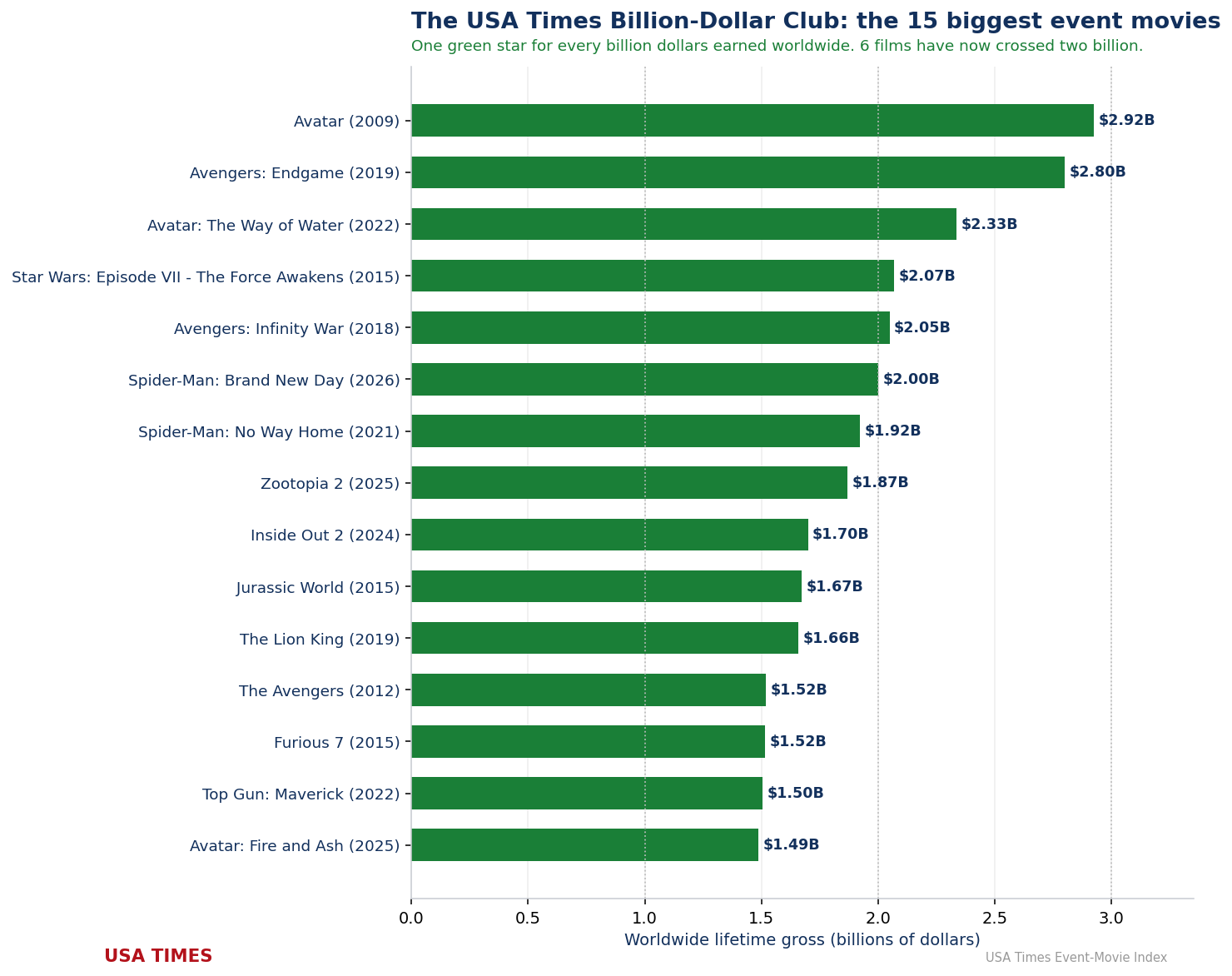
The USA Times Billion-Dollar Club is our simplest badge and our most demanding one. A film earns a green ⭐ star for every full $1 billion it grosses worldwide — one star at a billion, two at two billion, and so on. No rounding up: a film has to actually cross the line. Across twenty years of star movies, 55 films have made the cut.
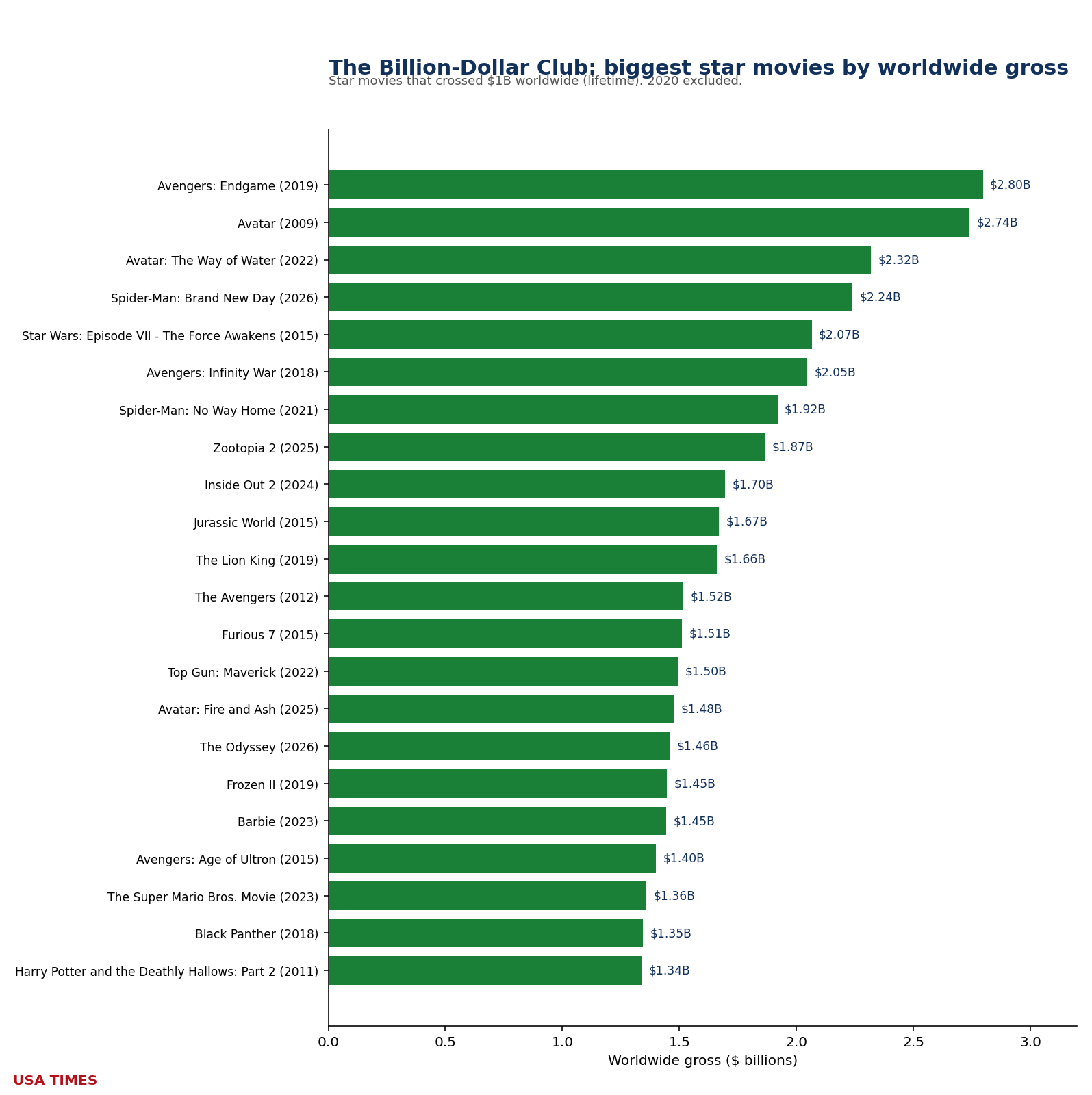
The two-star club
Only six films in history have earned a second star — the rarefied group that crossed $2 billion worldwide.
| # | Film | Year | Worldwide gross |
|---|---|---|---|
| 1 | Avatar | 2009 | $2.924B |
| 2 | Avengers: Endgame | 2019 | $2.797B |
| 3 | Avatar: The Way of Water | 2022 | $2.334B |
| 4 | Star Wars: Episode VII – The Force Awakens | 2015 | $2.068B |
| 5 | Avengers: Infinity War | 2018 | $2.048B |
| 6 | Spider-Man: Brand New Day | 2026 | $2.000B |
The heartbreak of one star
The cruelest number in the club belongs to Spider-Man: No Way Home, which grossed roughly $1.92 billion — a colossal figure that still falls just short of a second star. Under our floor rule it wears one, not two. That is the point of the badge: it rewards crossing the line, not coming close to it. Somewhere out there, a future release will become the sixth two-star film.
Batmandir · Founders A numbered seat at the table. S3 · The Founders Club — 161 seats per location. By invitation. Explore membership →A club that barely existed twenty years ago
What makes the Billion-Dollar Club worth tracking is how young it is. For most of cinema history, a billion dollars worldwide was not a high bar — it was an impossible one. Only a handful of films had ever approached it before the late 2000s, and each was a generational event. The threshold began to fall regularly only as the global box office expanded, international markets like China matured, and 3D and premium-format surcharges inflated ticket prices. The club, in other words, is largely a creation of the last fifteen years, and its swelling membership is as much a story about the globalization and financialization of moviegoing as it is about any individual film’s popularity.
That context matters because it tempers the awe. A billion dollars in 2010 and a billion in 2026 are not the same achievement: ticket-price inflation alone means a modern billion represents fewer actual admissions than an older one. The club counts nominal dollars, unadjusted, because that is how the industry itself keeps score and how records are broken in the headlines — but a careful reader should hold the nominal figures loosely. Crossing $1 billion is a genuine milestone; it is not proof that a film sold more tickets than every pre-club blockbuster that never reached the number.
Why the second star is so much rarer than the first
The steep drop-off between one star and two — dozens of films at a billion, only a small group at two — is not an accident of our threshold. It reflects a real cliff in the economics of blockbusters. Reaching $1 billion requires a film to be a global event; reaching $2 billion requires it to be a global geuse, the kind of cultural moment that pulls in casual and repeat viewers alike and holds screens for months. The gap between those two states is enormous, and most films that clear the first bar exhaust their audience well before the second. The five two-star films are not merely twice as big as the one-star films; they occupy a different tier of cultural penetration entirely.
This is why the near-misses are so poignant, and why our floor rule is deliberately unforgiving. A film that grosses $1.9 billion is, by any reasonable measure, one of the most successful pieces of entertainment ever made — and it still wears a single star, because the badge rewards crossing the line, not approaching it. That strictness is the point. A club that rounded up would be a club that meant nothing; the whole value of the marker is that every star represents a full billion actually earned, a line genuinely crossed.
How to read the badge across our coverage
The green stars appear throughout the USA Times Star Index — beside film names in our charts, our tables, and our weekly tracker — and they are meant to be read at a glance: one star, one billion; two stars, two billion. Because the club is scored on worldwide lifetime gross, a film’s star count can change over time, and occasionally does: a title still in release sits without a star until its receipts are final, then earns one (or two) the moment it crosses. That living quality is intentional. The club is not a historical monument but a running scoreboard, updated as the global box office writes its next chapter.
Domination and dollars are not the same thing
It is worth drawing a sharp line between this club and the rest of the USA Times Star Index, because they measure genuinely different things and a film can excel at one while failing the other. The index proper measures domination — how completely a film owned a given week of the American box office, expressed as its share of the whole market. The Billion-Dollar Club measures scale — the total worldwide money a film ultimately accumulated over its entire run, at home and abroad. A film can dominate a quiet American week without ever sniffing a billion dollars globally, and a film can grind its way past a billion on the strength of international markets while never once seizing a dominant share of a single U.S. week. The two lenses catch different giants.
That distinction explains some of the club’s stranger entries and omissions. Certain films that loom large in the American imagination fall short of the club because their success was disproportionately domestic; others that barely registered as cultural events in the United States sit comfortably inside it, carried by enormous grosses in China, Japan, or the wider international market. Animation, in particular, and long-tail family films tend to over-index in the club relative to their domination scores, because they earn steadily over months and travel unusually well across borders — the opposite profile of a superhero tentpole that detonates on opening weekend and fades. Read together, the two metrics give a fuller portrait than either alone: one tells you which films owned the moment, the other which films owned the world.
For the collector, the completist, and the box-office obsessive, that is the real pleasure of the club — not the raw size of the numbers, but what the pattern of membership reveals about how modern blockbusters actually make their money. The green stars are a shorthand for a film’s global reach, and reading them alongside its domination tier is one of the most compact ways to understand what kind of hit a film really was.
Related from the USA Times Data Desk
- The Weeks Nobody Won: How the Shared Box Office Disappeared
- The Betelgeuse-Betelgeuse Week Has Happened Once in Twenty Years. Our Editor-in-Chief Bets December 18 Won't Be the Second.
- The Second-Weekend Cliff: Does the Box Office Fall by the Golden Ratio?
- One-Week Wonders: The Box Office’s Shooting Stars
- Box-office coverage index · the Star Index methodology
Sources
- Box Office Mojo — Weekend Domestic Box Office
- Box Office Mojo — Yearly Domestic Box Office
- The Numbers — Weekly Box Office Chart
- USA Times — Star Index methodology & data sources