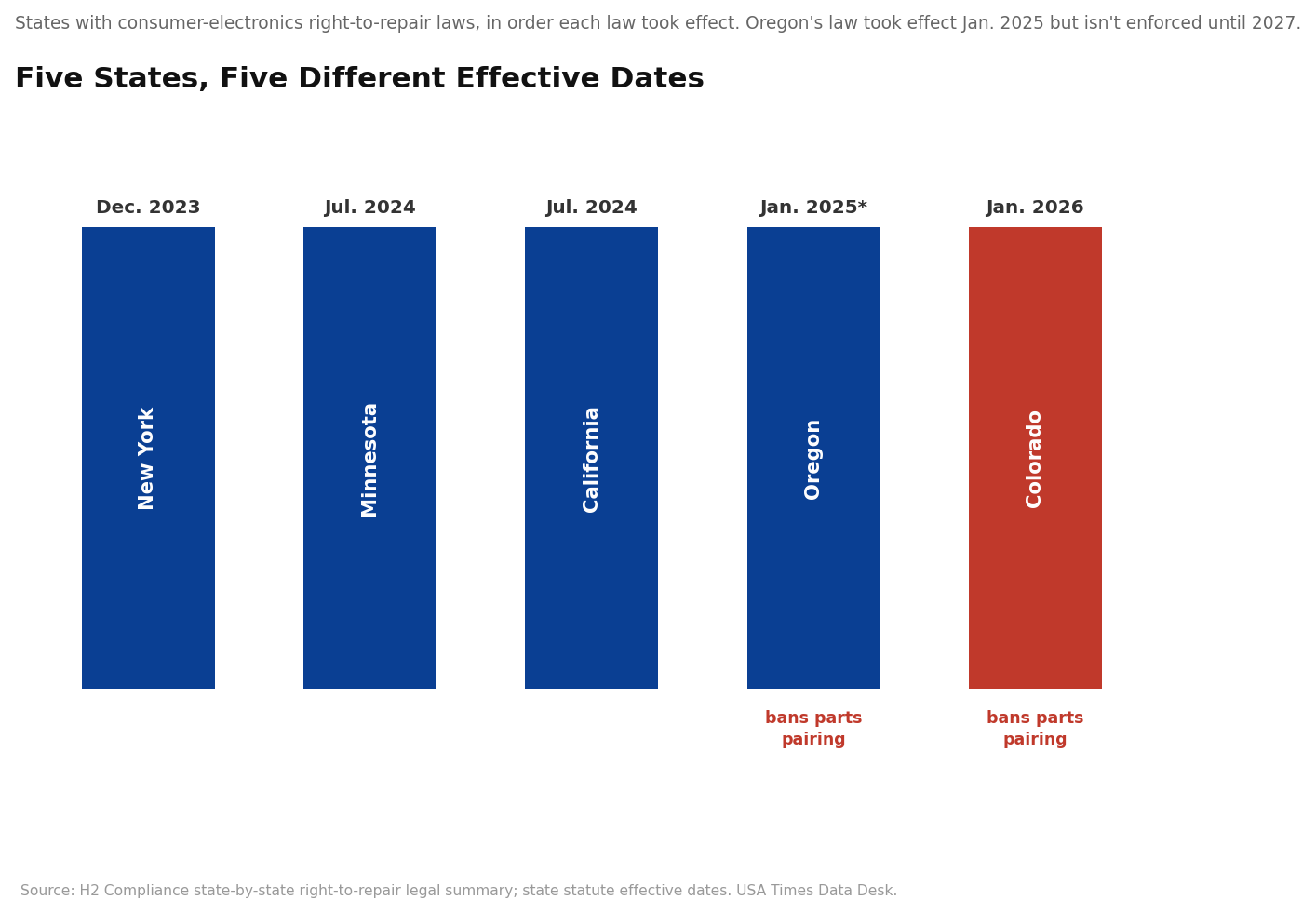
On January 1, 2026, Colorado became the fifth state with a consumer-electronics right-to-repair law on the books — and only the second, after Oregon, to specifically ban “parts pairing,” the practice of using software to lock replacement parts to a single device so that repairs made with non-manufacturer components trigger reduced functionality or persistent warning messages. Only five states have consumer-electronics right-to-repair laws at all: New York, Minnesota, California, Oregon, and now Colorado, each with a different effective date, a different set of covered products, and different exclusions — meaning what a manufacturer legally owes a customer trying to fix their own phone or laptop currently depends heavily on which state that customer lives in.
State-by-State: What Each Law Covers
Hover any state for coverage details and exclusions.
Batmandir · Founders A numbered seat at the table. S3 · The Founders Club — 161 seats per location. By invitation. Explore membership →What “right to repair” actually requires
At their core, these laws require manufacturers to make documentation, diagnostic tools, and replacement parts available to consumers and independent repair shops on “fair and reasonable terms” — the same access, in principle, that a manufacturer’s own authorized repair network gets. Before these laws existed, a consumer needing a cracked-screen or battery replacement was often functionally limited to the manufacturer or an authorized repair partner, since the parts and diagnostic software needed to complete many repairs weren’t sold to independent shops or the public at all. New York was the first state to extend this kind of law specifically to digital electronics, when its Digital Fair Repair law took effect December 28, 2023.
Five laws, five different rulebooks
None of the five state laws are identical, and the differences matter for anyone trying to understand what’s actually required where they live. New York’s law covers digital electronic equipment worth over $10 (adjusted annually for inflation) sold in the state after July 1, 2023, but exempts common household appliances like toasters and microwaves, along with e-bikes, medical devices, and security systems. Minnesota’s Digital Fair Repair Act, effective July 1, 2024, requires manufacturers to make parts, tools, and documentation available within 60 days of a product’s first sale in the state. California’s law, also effective July 1, 2024, sets tiered support windows — three years for products priced $50-$99.99, seven years for products over $100 — and applies only to products manufactured after July 1, 2021. All three exclude video game consoles and medical devices from coverage.
The parts-pairing fight is the newest front
Colorado’s Consumer Right to Repair Digital Electronic Equipment Act, effective January 1, 2026, covers electronics manufactured and first sold or used in the state on or after July 1, 2021, and — like Oregon’s law — specifically restricts parts pairing when the practice would prevent repairs, reduce a product’s functionality or performance, or trigger misleading warnings. Oregon was first to enact this specific restriction; its ban on parts pairing applies to covered devices manufactured after January 1, 2025, though the broader Oregon law technically took effect that same date but isn’t enforced until 2027, giving manufacturers and repair shops a multi-year runway to adjust before violations carry consequences. Parts pairing has become the central battleground in right-to-repair advocacy because, unlike simply refusing to sell parts, it lets a manufacturer sell a part to anyone while still degrading the repaired device’s functionality unless the repair is registered through the manufacturer’s own system — a workaround that repair advocates argue defeats the purpose of parts availability requirements passed in earlier state laws.
What’s specifically excluded, and why it matters
Every one of the five state laws carves out video game consoles and medical devices from coverage, and most also exclude agricultural equipment (which is regulated separately in several states) and dedicated security or emergency-communication devices. Colorado additionally routes powered wheelchairs to a separate law, the Consumer Wheelchair Repair Bill of Rights Act, which took effect January 1, 2023 — meaning wheelchair users in Colorado had a right-to-repair protection three years before smartphone and laptop owners in the same state did. These exclusions aren’t uniform across states: Oregon excludes electric toothbrushes and solar panels specifically, categories the other four states’ laws don’t separately address at all, illustrating how much these laws have been shaped state-by-state through individual legislative negotiation rather than following a shared federal template.
No federal law, and most state attempts have failed
There is currently no federal right-to-repair law covering consumer electronics in the United States. Since 2012, seven states have passed some form of right-to-repair legislation covering at least one product category — including Massachusetts’s motor-vehicle right-to-repair law and Colorado’s separate power-wheelchair and agricultural-equipment laws — but only five states have laws specifically covering general consumer electronics like phones and laptops. The gap between introduction and passage is wide: in 2024 alone, 30 different states introduced some form of right-to-repair legislation, and none of those 2024 bills became law, underscoring how much industry opposition and legislative negotiation typically stands between a bill’s introduction and an enacted statute in this area.
It started with cars, not phones
The right-to-repair movement’s first legislative win in the U.S. had nothing to do with consumer electronics. Massachusetts passed a motor-vehicle right-to-repair law more than a decade before any state extended similar protections to phones and laptops, requiring automakers to give independent mechanics the same diagnostic access dealerships had. That gap between the 2012 automotive law and New York’s first consumer-electronics law in late 2023 reflects how differently the two industries were positioned to resist: the auto-repair fight was largely settled by the mid-2010s, while electronics manufacturers had another decade to lobby against extending similar rules to phones, laptops, and tablets. Colorado’s own history follows a similar sequence within a single state — its powered-wheelchair repair law took effect in 2023, three full years before its general consumer-electronics law, and its right-to-repair protections for agricultural equipment are governed separately still.
What we did
All state-by-state legal details in this article — effective dates, covered product definitions, price thresholds, exclusions, and the parts-pairing provisions specifically — come from a state-by-state right-to-repair legal summary published by H2 Compliance, an environmental and product-compliance consulting firm, dated January 27, 2025. We read the full summary and did not independently verify the underlying state statute text ourselves; H2 Compliance is a compliance consultancy that publishes this kind of regulatory tracking as part of its business, which is why we’re treating it as a credible secondary summary of primary legal text rather than a primary source itself. Because the H2 Compliance summary was published in January 2025, it doesn’t reflect any right-to-repair legislation passed or taking effect after that date beyond Colorado’s already-scheduled January 2026 effective date, which was known at the time of publication; we did not independently check whether additional states have passed new right-to-repair laws since January 2025 that would need to be added to this count.