Final census: 21,904 NPR URL/headline records explicitly name the sitting U.S. president by surname across Obama’s second term, Trump’s first term, Biden’s term and Trump’s second term through July 17, 2026. The wording is measurably more negative for both Trump periods, but lexical sentiment alone does not establish partisan bias or answer whether public funding cuts were justified.
Final census notice, July 23, 2026: The sitemap-level collection and automated headline analysis are complete. Automated tone is a screening measure, not a finding of truth, fairness or partisan intent. The individually discussed examples retain separate verification labels.
NPR sitemap census completed: January 20, 2013–July 17, 2026
Frozen database snapshot, July 23, 2026: We inventoried 364,110 non-overlapping in-scope dated URL records from NPR’s 365,598-page official-sitemap universe and successfully inspected 363,600 (99.86%). We recovered 1,640 initially blocked pages through NPR’s own legacy archive. The 510 residual retrieval gaps are preserved and disclosed: 364 returned 404 responses and 146 repeatedly timed out.
Batmandir · Founders A numbered seat at the table. S3 · The Founders Club — 161 seats per location. By invitation. Explore membership →113,704 / 113,728 pages · 99.98%
2,532 name matches · 24 retrieval gaps
109,837 / 109,880 pages · 99.96%
9,749 name matches · 43 retrieval gaps
103,701 / 103,863 pages · 99.84%
3,889 name matches · 162 retrieval gaps
36,358 / 36,639 pages · 99.23%
5,734 name matches · 281 retrieval gaps
Final study corpus: 21,904 retrieved URL/headline records explicitly name the sitting president by surname. “Comprehensive” refers to NPR’s preserved official-sitemap universe, not headlines omitted from that sitemap, unavailable source pages, or semantic references that do not name the president. Snapshot SHA-256: fac829939a5fcba4ee368b42c9e9c09fb0e8cf7ac86ccc2ed0a3142e6ab2699a.
Term-aligned headline tone: four presidential administrations
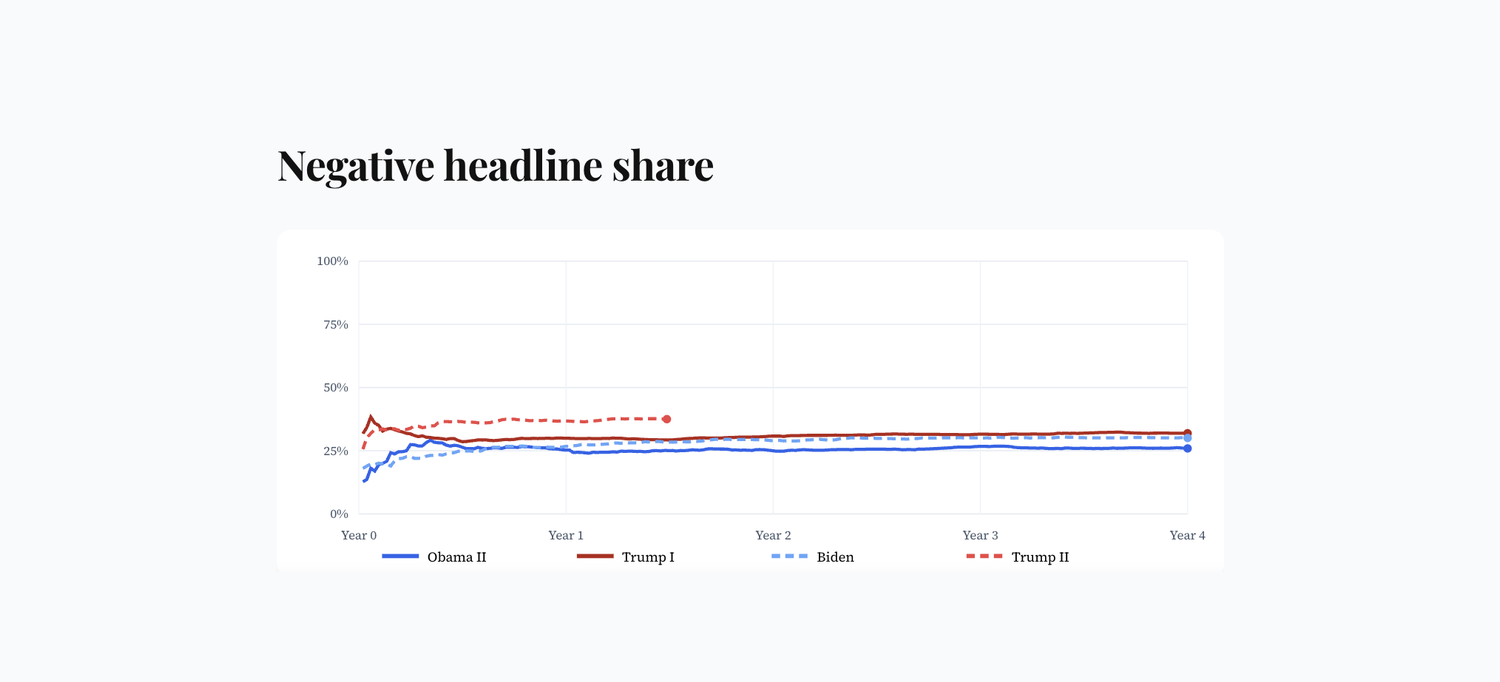
Frozen census chart: The large number on each card is every retrieved headline that explicitly names, by surname, the person who was the sitting U.S. president when NPR published it. This strict name-match is reproducible but conservative: a headline may be about a president without naming him, so broader semantic “aboutness” is outside this analysis. Each line begins at inauguration on a common four-year x-axis. Obama II, Trump I and Biden cover their full terms; Trump II ends at the study cutoff of July 17, 2026. The small difference between Trump II’s stored and graph counts reflects records whose exact publication timestamps fall outside the chart’s cutoff despite their URL dates.
2,532 total name-matched headlines currently stored
2,532 are in the completed-date-span graph sample · inspected through 2017-01-20 · day 1461
9,749 total name-matched headlines currently stored
9,749 are in the completed-date-span graph sample · inspected through 2021-01-20 · day 1461
3,889 total name-matched headlines currently stored
3,889 are in the completed-date-span graph sample · inspected through 2025-01-20 · day 1461
5,734 total name-matched headlines currently stored
5,710 are in the completed-date-span graph sample · inspected through 2026-07-17 · day 543
Negative headline share
Neutral headline share
Positive headline share
Overall headline tone score (−100 to +100)
Automated lexical screening only. Percentages do not measure factual accuracy, fairness, target, newsworthiness or bias. This chart is frozen to the completed July 23, 2026 database snapshot; the 510 disclosed retrieval gaps are not imputed.
Final merged sitting-president name-match corpus: 21,904 records
Refreshed July 23, 2026: This frozen snapshot merges the validated 14,647-record corpus with newly archived headlines that explicitly name the sitting president by surname. That strict rule is reproducible but conservative: headlines that are about a president without naming him are outside this name-match analysis. The census inspected 363,600 of 364,110 in-scope sitemap URLs (99.86%); 510 source pages remained unavailable after primary- and legacy-archive retries and are disclosed as retrieval gaps.
Reader scale: Tone score is the underlying VADER compound value multiplied by 100: −100 is maximally negative wording, 0 is lexically neutral and +100 is maximally positive wording. Rescaling does not change any classification or statistical result.
2,532 name-matched headlines
25.9% negative · 44.8% neutral · 29.3% positive
Tone score +1.5
9,749 name-matched headlines
31.9% negative · 42.8% neutral · 25.3% positive
Tone score -3.8
3,889 name-matched headlines
30.0% negative · 42.7% neutral · 27.2% positive
Tone score -1.8
5,734 name-matched headlines
37.5% negative · 40.1% neutral · 22.4% positive
Tone score -7.5
Positive, neutral and negative headline shares
Tone score with 95% confidence intervals
Author-administration lexical-tone extremes
Shown only for author-administration groups with at least 30 name-matched headlines. Parentheses show each tone category’s percentage of that group. “(NPR)” identifies the publication represented in this corpus; it is not a claim about the author’s complete employment history. Headline wording is frequently set by editors or a publication’s copy desk rather than by the bylined reporter; this table measures the lexical tone of published headline text only and is not a claim about who chose that wording. These lexical scores do not establish that an author is biased, and inclusion in this table is not a finding or implication regarding any individual’s journalistic integrity, competence, intent, or conduct.
| Author | Score | Neg. | Neutral | Pos. | Admin. | Total |
|---|---|---|---|---|---|---|
| Pam Fessler (NPR) | -30.9 | 32 (69.6%) | 9 (19.6%) | 5 (10.9%) | Trump I | 46 |
| Camila Domonoske (NPR) | -24.5 | 25 (51.0%) | 19 (38.8%) | 5 (10.2%) | Trump I | 49 |
| Bobby Allyn (NPR) | -20.8 | 57 (55.9%) | 28 (27.5%) | 17 (16.7%) | Trump I | 102 |
| Brian Mann (NPR) | -20.2 | 30 (57.7%) | 11 (21.2%) | 11 (21.2%) | Trump II | 52 |
| NPR Staff (NPR) | -19.6 | 24 (58.5%) | 10 (24.4%) | 7 (17.1%) | Trump II | 41 |
| Maria Aspan (NPR) | -17.7 | 16 (45.7%) | 14 (40.0%) | 5 (14.3%) | Trump II | 35 |
| Jeff Brady (NPR) | +7.0 | 10 (28.6%) | 11 (31.4%) | 14 (40.0%) | Trump I | 35 |
| Tom Gjelten (NPR) | +8.7 | 8 (17.8%) | 25 (55.6%) | 12 (26.7%) | Trump I | 45 |
| Alison Kodjak (NPR) | +10.2 | 12 (28.6%) | 9 (21.4%) | 21 (50.0%) | Trump I | 42 |
| Korva Coleman (NPR) | +13.8 | 22 (26.8%) | 1 (1.2%) | 59 (72.0%) | Trump I | 82 |
| Nina Totenberg (NPR) | +23.5 | 15 (21.1%) | 10 (14.1%) | 46 (64.8%) | Trump I | 71 |
| Nina Totenberg (NPR) | +41.6 | 3 (8.1%) | 2 (5.4%) | 32 (86.5%) | Trump II | 37 |
VADER measures wording, not factual accuracy, fairness, target, newsworthiness or evidentiary support.
Example-by-example evidence ledger
These examples show why tone and factual support must be scored separately. “Provisional” means the NPR page has been preserved and its visible support inspected, but the underlying primary record has not yet completed independent verification.
| NPR wording | What the preserved page establishes | Current verdict |
|---|---|---|
| “Trump promised evidence of election fraud. Experts say there was none” | The dispute involves different propositions: system vulnerabilities, registration irregularities, fraudulent votes actually cast and whether a result changed. Those propositions cannot be collapsed into one evidentiary test. | Unresolved precision concern. Not presently established as false. |
| “Tried to convince,” “sowed doubts,” and “offered no new evidence” | The complete NPR sentence says there was no new evidence detailing fraudulent votes, then acknowledges newly declassified material concerning alleged vulnerabilities. Vulnerability evidence is not necessarily proof of fraudulent votes. | Framing concern; contradiction not established. |
| “The Trump administration kills nearly all USAID programs” | The article cites a State Department figure saying 92% of reviewed grants were terminated. “Kills” is forceful, but “nearly all” is quantitatively consistent with the cited figure. | Loaded wording; provisionally supported. Primary-record verification pending. |
| “Rural communities were promised millions in disaster funds. Trump is ending it” | The preserved article identifies awarded grants and the administration’s cancellation of the BRIC program. The causal construction is strong but tied to a specified policy action. | Provisionally supported. Grant-by-grant verification pending. |
| “Trump has used government powers to target more than 100 perceived enemies” | NPR says the number comes from its own review and supplies examples. Whether every case satisfies the same definition depends on NPR’s inclusion rules. | Method-dependent count. Independent reproduction pending. |
| “U.S. stocks are volatile as selloffs sweep through global markets” | The article presents contemporaneous market movements. Negative vocabulary describes market conditions rather than necessarily expressing NPR’s attitude toward Trump. | Descriptive and supported by cited market data. |
Preserved HTML and SHA-256 hashes are retained in the USA Times evidence archive. Verdicts will be updated when primary-source checking changes the evidentiary status.
The argument over taxpayer support for National Public Radio is often presented as a simple contest between two slogans. One side says NPR is an indispensable public service threatened by political retaliation. The other says it is a progressive broadcaster that should be free to speak but should not expect conservatives to pay for speech directed against them.
The evidence does not fit completely inside either slogan.
NPR does important journalism. Its national network and member stations have reported from war zones, statehouses, rural communities and disaster areas. Public radio distributes emergency information, maintains reporting capacity in communities abandoned by commercial news organizations and makes much of its work available without a subscription. Millions of Americans value it.
NPR also has a trust problem that cannot honestly be dismissed as a partisan invention. Its audience and credibility are sharply divided by party. A veteran NPR editor publicly accused the organization of allowing a progressive worldview to narrow its journalism. A congressional hearing exposed uncomfortable questions about editorial judgment, leadership and ideological diversity. And the final 21,904-record name-match corpus shows a measurable automated tone difference among presidential administrations. That result supports further editorial review, but it is not proof of partisan bias because lexical sentiment does not control for events, subjects, newsworthiness, quotation, factual accuracy or target.
That finding is not proof that every negative headline about Trump was unfair. A president who generates conflict, receives intense scrutiny and makes false or disputed statements will naturally attract negative words. Nor is a computer capable of deciding whether a story is true. The final lexical pattern is sufficient to justify a deeper editorial audit, but not to determine its outcome.
There is also an important fact missing from the proposed demand to “stop funding NPR”: Congress did not eliminate NPR’s entire budget, but it did terminate the federal CPB financing system that supported local stations, infrastructure and some NPR-related services. President Trump signed the Rescissions Act of 2025 on July 24, 2025. It rescinded roughly $1.1 billion that Congress had previously approved for the separate Corporation for Public Broadcasting for fiscal years 2026 and 2027. After losing those advance appropriations and receiving no fiscal 2026 operating appropriation, CPB announced its wind-down and later voted to dissolve. The old federal financing arrangement is no longer operating as it did when the political fight began.
The question in 2026 is therefore not merely whether Washington should stop a subsidy. It is whether the decision already made was supported by the evidence, whether it punished the right institution, and what standards should govern any future public-media funding.
This report reaches four conclusions.
First, the presidential-headline data shows a real language difference. Biden headlines averaged -0.004; Trump headlines averaged -0.076. Trump’s group was 40.2% negative and 23.1% positive, compared with 30.0% negative and 35.4% positive for Biden. The estimated mean difference was -0.072, and its preliminary bootstrap interval narrowly excluded zero.
Second, that result supports scrutiny but does not prove unfairness. The test does not determine whether negative headlines accurately reflected different events, whether criticism was directed at the president, or whether comparable conduct received different treatment.
Third, the data therefore does not yet prove that NPR deserved to lose public funding. It strengthens the case for an independent, target-aware editorial audit. It does not establish that rescinding CPB’s appropriations—and thereby removing support from local stations and public-media infrastructure—was a proportionate remedy.
Fourth, the claim that NPR systematically misappropriated public money remains unsupported. Editorial imbalance, if later established, would be a public-mission failure—not automatically financial theft.
The honest answer is not “NPR was neutral” or “the data proves the CPB rescission was deserved.” The evidence presently says: there is a statistically detectable warning signal, and the decisive fairness test is still underway.
What “publicly funded NPR” actually meant
NPR, the Corporation for Public Broadcasting and local public-radio stations are related, but they are not the same organization.
Congress created CPB under the Public Broadcasting Act of 1967 as a private, nonprofit corporation intended to support public telecommunications while insulating program decisions from direct government control. NPR is a separate nonprofit that produces and distributes national radio journalism and programming. Local stations are separately owned organizations—often community nonprofits, universities, state entities or tribal organizations—that may become NPR members and purchase NPR programs.
That structure matters because political rhetoric frequently treats the entire system as a single federal newsroom.
Before the 2025 rescission, the largest share of CPB money flowed to local television and radio stations through community service grants. The Congressional Research Service reported that 70 percent of the radio portion of CPB funding was allocated to station grants. CPB considered factors such as rural geography, minority audiences, local fundraising capacity and whether a station was the only media provider in its service area.
NPR said direct federal support accounted for about 1 percent of its annual operating budget, excluding support related to the Public Radio Satellite System. That number can understate Washington’s practical role because local stations used some CPB grants to buy NPR programming, pay membership fees and sustain the facilities through which NPR reaches listeners. Still, it is inaccurate to describe NPR’s national organization as principally financed by the federal government.
NPR’s own financial overview lists corporate sponsorships and station fees as its largest recurring revenue sources. It reports contributions, foundations, endowment income, satellite services and investments as additional sources. For local public-radio stations, listener contributions have historically represented the largest combined revenue category, while CPB appropriations represented a smaller but sometimes critical share.
The national average also hides the distributional effect. A few percentage points may be replaceable for a major urban station with wealthy donors. They may be the difference between survival and closure for a small rural or tribal station. The Congressional Research Service noted that lawmakers were concerned that ending CPB funding could leave rural, remote and tribal communities underserved.
CPB also supported the Public Radio Satellite System, managed by NPR. The system distributes programming and presidential emergency alerts. In other words, the federal appropriation did not pay only for political interviews broadcast from Washington. It supported a mixed system containing national news, local reporting, music, educational programs, engineering, interconnection and public-safety functions.
This does not prove that taxpayers should fund it. It establishes what was actually cut.
The legal promise: objectivity, balance and independence
Federal law gave public broadcasting two instructions that are naturally in tension.
Section 396 of Title 47 directs CPB to facilitate programming produced with “strict adherence to objectivity and balance” in programs or series dealing with controversial subjects. The law also directs CPB to operate in ways that assure public broadcasters maximum freedom from government interference or control of content.
Both instructions matter. Public money was not intended to purchase a government propaganda service. Nor was it intended to finance partisan programming insulated from any public accountability.
NPR’s ethics guidance similarly emphasizes fairness, impartiality, completeness and the inclusion of divergent views. It does not promise mechanical balance in every story. NPR’s stated approach is that journalism should follow the weight of evidence rather than give equal time to a demonstrably false assertion merely because it has political support.
That principle is defensible. A reporter covering the shape of the Earth need not balance a geographer with a flat-Earth advocate. A reporter covering a disputed election claim, however, has a more demanding task: identify the specific claim, disclose the evidence offered for it, test that evidence against the best counterevidence, distinguish vulnerability from exploitation and distinguish suspicious conduct from a changed result.
“Experts disagree” is not enough. Which experts? What records did they examine? What claim did they disprove? Were there material facts that cut against their conclusion? Expertise is a qualification, not a substitute for showing the work.
The president has extraordinary access to federal intelligence, but that does not make a president the final expert on every factual dispute. American elections are decentralized. State and county officials hold many of the ballots, voter files, poll books, audit records and chain-of-custody documents. Courts evaluate admissible evidence. Intelligence agencies assess foreign activity. Cybersecurity experts examine systems. Journalists should not reflexively defer to any one of these actors—including the president—but should compare their evidence.
The public standard should therefore be neither “believe the president” nor “believe the experts.” It should be: show the documents, state exactly what they prove and identify what they do not prove.
The sitting-president headline test
The final merged snapshot contains 21,904 NPR URL/headline records that explicitly name the sitting president by surname: the previously validated 14,647-record corpus plus 7,257 newly archived records found by the completed sitemap census. This is a reproducible name-match dataset, not a semantic count of every headline that may be about the president. Its automated tone results and limitations are reported above.
That corpus is now being tested against a broader census of every dated page in NPR’s preserved official sitemap inventory from noon Eastern on January 20, 2013 through July 17, 2026. The census successfully inspected 99.86% of the in-scope sitemap inventory and now supersedes the earlier 14,647-record baseline for this strict surname-match analysis. The 510 unavailable source pages remain disclosed rather than inferred.
The election-security case that prompted this review
On July 17, 2026, NPR published an election-security segment and a related page using phrases including “tried to convince,” “sowed doubts” and “offered no new evidence that details any fraudulent votes.” President Trump also released or cited material concerning election-system vulnerabilities.
Those statements are not automatically contradictory. Evidence of vulnerabilities, suspicious registrations or foreign access to voter information is not necessarily evidence that fraudulent votes were cast or that an election result changed. We therefore do not presently characterize NPR’s passage as a proven falsehood.
The legitimate question is one of framing and precision: whether motive-oriented verbs and absence-first sequencing gave readers an impression broader than the evidence justified. The underlying documents are being checked claim by claim. Until that review is complete, this case is labeled unresolved rather than false or deceptive.
The preserved NPR pages, retrieval metadata, screenshots and cryptographic hashes are retained in the USA Times evidence archive so later wording changes can be compared.
Evidence that the trust problem is institutional
The concern about NPR does not rest on one election headline.
In April 2024, Uri Berliner, then a senior NPR business editor who had worked at the network for 25 years, published an essay arguing that NPR had moved from a liberal orientation with curiosity and internal debate toward a narrower progressive worldview. He criticized its handling of the Trump-Russia investigation, the Hunter Biden laptop, COVID-19’s origins and the use of demographic categories throughout coverage. He also said the Washington newsroom lacked Republican viewpoint diversity.
Berliner’s essay was one employee’s account, not an independent audit. NPR journalists disputed parts of it. Morning Edition host Steve Inskeep argued that it contained errors and omissions. Colleagues pointed to stories that complicated Berliner’s narrative and said he generalized from selected episodes. NPR suspended Berliner for five days, saying he had violated a policy requiring approval for outside work; he then resigned.
The episode nevertheless revealed an institutional failure. A newsroom that depends on public trust should be capable of answering a senior editor’s detailed criticism with transparent data: corrections, story inventories, source diversity, audience composition, newsroom surveys and comparable editorial decisions. Personnel discipline did not answer the substantive question.
In March 2025, NPR chief executive Katherine Maher appeared before the House Subcommittee on Delivering on Government Efficiency. She described NPR’s work as unbiased, nonpartisan and fact-based and cited a weekly audience of approximately 43 million. Republican lawmakers confronted her with NPR headlines, decisions and old personal social-media posts. Maher acknowledged that some of her past language was wrong or did not represent her current views. Democratic lawmakers defended public media’s local and emergency functions and characterized the hearing as political intimidation.
The hearing was partisan and often theatrical. Its title—“Anti-American Airwaves”—announced a conclusion before testimony began. That weakens its value as a neutral adjudication. Yet a partisan forum can still expose real facts. Maher’s previous political statements reasonably raised questions about whether the leader of a publicly supported news organization could persuade skeptical Americans that she would enforce ideological fairness. Her promise that NPR provides nonpartisan journalism creates a measurable standard against which the newsroom can be tested.
Public trust data confirms the divide. In Pew Research Center’s 2025 News Media Tracker, 29 percent of American adults said they trusted NPR as a news source. Pew’s party breakdown showed a much stronger trust relationship among Democrats than Republicans. Associated Press’s summary of the survey reported that more than twice as many Republicans distrusted NPR as trusted it, while Democrats trusted NPR by a 47 percent to 3 percent margin over distrust.
That gap does not prove NPR is biased. Republicans and Democrats also sort themselves into media systems and may judge accurate but unwelcome reporting differently. But a publicly supported outlet cannot treat the near-collapse of trust among one major political coalition as irrelevant. Whether caused by coverage, elite criticism, audience self-selection or all three, the result is a failure of national reach.
What the evidence does not prove
Words such as “fraud,” “theft” and “misappropriation” should be held to the same evidentiary standard demanded of NPR.
The federal government appropriated money to CPB under law. CPB distributed funds through established grants and contracts. NPR and local stations reported revenue and expenses through audited financial statements and tax filings. CPB’s Office of Inspector General audited recipients and, when it found problems, identified questioned costs and recommended repayment or grant adjustments.
The inspector general did find financial problems at individual public-media stations. Audits of Capital Public Radio in California and WTVP in Illinois, for example, identified accounting or grant-compliance problems and questioned costs. Those findings demonstrate that oversight was necessary and that the system was not immune to misuse.
They do not establish that NPR’s national newsroom systematically diverted taxpayer money. Our review found no comparable final audit finding against NPR supporting that allegation.
Nor does the objectivity-and-balance language in federal law automatically convert every disputed headline into financial misconduct. The statute placed responsibilities on CPB and constructed mechanisms for public comment, program review and grant decisions. It also protected editorial freedom from government content control. Applying those clauses to individual stories involves judgment, procedure and constitutional concerns. A political accusation is not a legal finding.
The strongest accurate formulation is that NPR may have failed to deliver the breadth, precision and political neutrality reasonably expected of a public-service newsroom. If proven systematically, that can justify conditions, restructuring or withdrawal of taxpayer support. It should not be mislabeled as embezzlement.
Accuracy is not a courtesy extended only to people we agree with. If this publication criticizes NPR for exaggeration, it cannot answer with its own exaggeration.
Was defunding proportionate?
President Trump’s May 1, 2025 executive order declared that government funding of news media was outdated and corrosive to journalistic independence. It instructed CPB and federal agencies to stop direct and indirect funding of NPR and PBS to the maximum extent permitted by law. The White House cited alleged examples of progressive bias and argued that no media company has a constitutional right to a taxpayer subsidy.
That final proposition is powerful. Freedom of the press prevents government censorship; it does not guarantee a federal grant. In a media market containing commercial radio, podcasts, streaming video, nonprofit journalism and millions of independent publishers, Congress may reasonably conclude that the federal government should not select national news organizations for support.
The opposing argument is also substantial. Public media was designed to supply goods the commercial market underprovides: local civic reporting, educational programming, cultural work, rural coverage and emergency infrastructure. Removing CPB funding because of national political coverage imposed costs on stations that did not produce the disputed stories.
Public opinion did not provide a clear mandate for abolition. In a March 2025 survey, Pew found that 43 percent of adults supported continuing federal funding for NPR and PBS, 24 percent favored removing it and 33 percent were unsure. Support and opposition were highly partisan. A later Harris Poll commissioned by NPR found stronger support, but because NPR sponsored it, readers should weigh its design and framing accordingly.
Congress made the decision. The House initially passed the rescission package by a narrow vote, and after Senate action the final measure cleared the House 216–213. Trump signed Public Law 119-28 on July 24, 2025. The law cancelled the fiscal 2026 and 2027 advance appropriations for CPB. Without a later operating appropriation, CPB began winding down.
Supporters can accurately say that elected officials ended a discretionary subsidy through legislation. Critics can accurately say that the remedy dismantled a funding structure serving far more than NPR’s Washington newsroom.
The cleanest policy would have separated them.
Who bears the cost after Washington’s decision
The financial consequences will not arrive uniformly.
NPR’s national organization has sponsorship revenue, station fees, philanthropy, a large audience and the ability to distribute directly through apps and podcasts. It can reduce costs, increase fundraising and sell services. The loss of public support may shrink its reach or newsroom, but it does not automatically erase NPR from the market.
Local stations face a different calculation. A station must pay engineers, maintain transmitters, lease towers, license music, insure facilities and produce local work before it broadcasts a single national program. Much of that cost is fixed. A rural station cannot cut the price of a transmitter simply because it serves fewer potential donors. An urban station may replace a federal grant with one successful campaign; a remote station may have no comparable donor base.
This creates a policy paradox. The political complaint centered on national reporting about Trump, race, gender, the pandemic and other contested issues. The funding mechanism placed much of the risk on local institutions, including stations that broadcast farming information, state legislative news, weather warnings, tribal languages, classical music or high-school sports. Some bought NPR news; others used public-media infrastructure for programming far removed from Washington politics.
Defunding advocates can reply that worthwhile local services should attract voluntary contributions or state and private support. They can also argue that scarcity forces discipline and that government should not preserve every legacy institution. Those are reasonable positions. But the transition should be judged by what replaces the service, not by a national brand name alone.
Congress and state governments should now track station closures, newsroom layoffs, emergency-alert capacity, geographic coverage and changes in local original reporting. Private philanthropy should disclose where replacement money goes. If affluent metropolitan stations recover while isolated communities lose their only regular local newsroom, the reform will have shifted resources toward the places already best served.
None of this excuses an unfair headline. It shows why an argument about editorial standards should identify the institution responsible and design the remedy at the same level.
Congress could have prohibited CPB grant money from being used for national political reporting while preserving rural station and emergency-system support. It could have conditioned funds on annual independent content audits using published methods. It could have required CPB recipients to disclose source diversity, corrections, complaints and viewpoint representation. It could have funded local stations through a competitively neutral infrastructure program. Or it could have offered time-limited matching funds that decreased as local private support grew.
Those alternatives would still raise difficult First Amendment and administrative questions, but they would connect the remedy more closely to the alleged harm.
A neutrality test NPR should be willing to pass
“Neutrality” cannot mean that every political actor receives an identical number of positive adjectives. Facts are not always evenly distributed. A government that commits more misconduct should receive more adverse coverage. A politician who makes more false statements should encounter more fact-checking.
Neutrality should mean consistent rules.
When Trump, a Democratic president, a cabinet secretary or a governor makes an empirical claim, NPR should identify the evidence, apply the same burden of proof and explain uncertainty with the same precision. Allegations should be attributed. Loaded words should appear only when supported by disclosed facts. Expert credentials and relevant conflicts should be stated. The strongest opposing evidence should not be hidden below the first screen or omitted from the headline.
NPR could rebuild trust by publishing a quarterly accountability file containing:
- all political corrections and material headline changes;
- the number and ideological range of guests on major political programs;
- a random, independently coded sample of stories about the president, congressional parties and major candidates;
- separate measures for factual accuracy, headline fidelity, tone, sourcing and omission;
- public complaints and the disposition of each substantial complaint;
- comparisons of how equivalent controversies involving different parties were covered; and
- an external review board whose members represent different political traditions and publish dissents.
The raw story sample should be released, subject to copyright limits, so other researchers can reproduce the analysis. Automated sentiment should be used only as a screening tool. Human reviewers should be trained, politically diverse and blind to the outlet where feasible. NPR should be permitted to respond before findings are final, but it should not control the reviewer.
USA Times should meet the same standard. Our data and rules should be open to criticism. We should correct errors prominently. And we should not confuse a result we expected with a result we proved.
Did the data show NPR deserved to lose funding?
Not yet.
The presidential-headline test found a meaningful directional disparity. NPR headlines naming President Trump were more negative and less positive than headlines naming President Biden while he held the same office. That is evidence warranting investigation; it is not a complete finding of partisan unfairness.
To justify the stronger conclusion, the difference must survive human review of who each headline targets, the underlying event, article type, factual support, headline fidelity and comparable cases involving both administrations. Negative but accurate reporting cannot be counted as bias merely because it is negative.
The funding remedy also extended beyond NPR’s national political newsroom to local, rural, tribal, technical and emergency-service infrastructure. The headline data alone cannot establish that eliminating that wider funding system was proportionate.
Our current verdict is therefore conditional: NPR produced enough of a measurable presidential-tone disparity to justify strict independent auditing and funding conditions, but the available data does not yet prove that rescinding CPB funding for the broader public-media system was proportionate.
If the matched evidence review shows unsupported or asymmetric treatment, this verdict will become more critical. If the difference is explained by events and accurate reporting, USA Times will say so and the accusation should recede.
Methodology and source note
USA Times ran symmetrical month-by-month Google News RSS searches restricted to NPR. A headline entered the primary dataset only if it named the sitting president by surname on its publication date. Duplicate normalized headlines were removed. The presidential transition is fixed at noon Eastern on January 20, 2025.
Each row records the headline, publication date, sitting president, source URL, whether both Biden and Trump were named, VADER compound score and positive, neutral or negative screening class. The CSV, monthly aggregation and SHA-256 hashes are retained locally.
VADER measures vocabulary, not journalistic truth, target or fairness. Coverage volume differs sharply and monthly Biden counts are often small. Human target coding and article-level evidence review remain necessary before attributing the measured difference to bias.
Publication links
- Federal public-broadcasting statute, 47 U.S.C. §396
- Congressional Research Service: Public Broadcasting
- Rescissions Act of 2025
- March 2025 House hearing record
- NPR public-radio finances
- NPR Ethics Handbook (archived PDF)
- Pew: NPR trust profile
- Pew: public support for NPR/PBS funding
- White House order ending taxpayer subsidies
- White House 2026 election-integrity release
- The NPR election segment examined