Starting March 1, 2026, Uber and Lyft drivers in New York City became entitled to a minimum of $1.283 per mile and $0.681 per minute on every trip, a 3.36% increase from the prior year, according to a New York City Taxi and Limousine Commission industry notice issued February 24, 2026. That’s the sixth increase to the city’s mandatory rideshare driver pay floor since the rule took effect in 2019, and every one of the last six has been positive — meaning the legal minimum a driver can be paid for a mile or a minute behind the wheel has never gone down. Layered on top of that, since January 2025, every app-hailed ride into Manhattan’s core has carried a separate $1.50 per-trip congestion surcharge that goes to the MTA, not the driver. Two different city and state interventions are now permanently built into every NYC rideshare fare, and they move in the same direction: up.
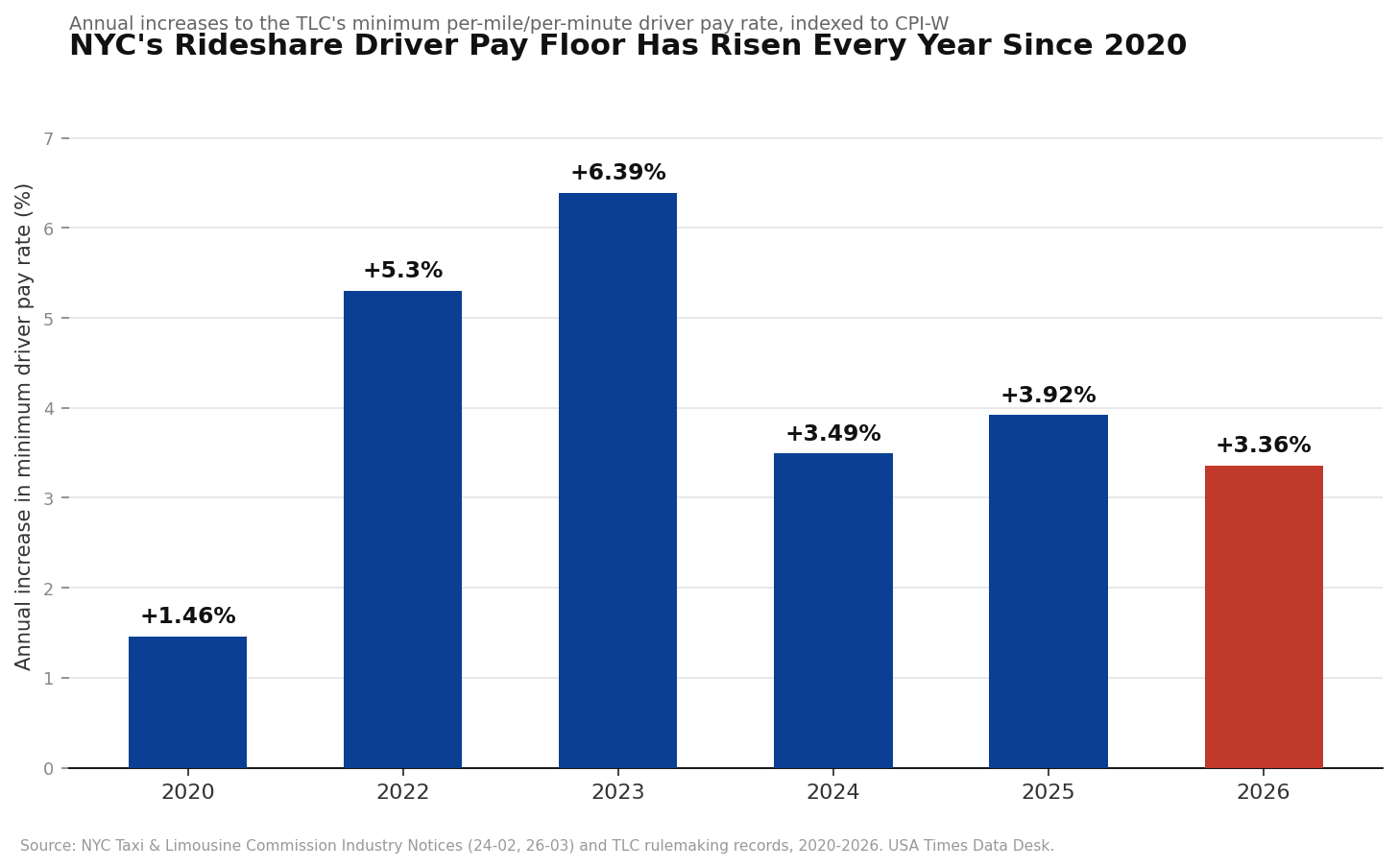
Six Straight Years of Increases to the Minimum Driver Pay Rate
Hover any bar for what drove that year’s number.
Batmandir · The Circle Full access to theatres, museums & exhibitions. S2 · ongoing membership, without a Founder’s seat. Explore membership →How the driver pay floor actually moves each year
The TLC’s minimum pay rule, first implemented in 2019 after a TLC-commissioned independent study and City Council legislation, doesn’t set a flat number that stays fixed — it’s indexed. Under TLC Rule § 59D-22(a)(4), the per-mile and per-minute minimums adjust annually based on the change in the Consumer Price Index for Urban Wage Earners and Clerical Workers (CPI-W) for the New York-New Jersey-Pennsylvania metro area, comparing the previous calendar year to two years prior. That formula has produced six increases since 2020: 1.46% in 2020, 5.30% in 2022, 6.39% in 2023, 3.49% in 2024, 3.92% in 2025, and 3.36% in 2026. Compounded together, those six increases mean the mandatory pay floor is roughly 26% higher today than it was before the first adjustment took effect — an increase set entirely by a fixed regulatory formula, not by negotiation between drivers and the two companies the rule applies to, which the TLC identifies by name in its notices as “currently Lyft and Uber.”
The second increase: congestion pricing’s per-trip surcharge
Separately from driver pay, New York’s congestion pricing program — which began charging vehicles to enter Manhattan below 60th Street on January 5, 2025 — added its own layer to rideshare costs. Uber, Lyft, and taxis pass a congestion charge through to riders as a flat per-trip surcharge: $1.50 for app-based rideshare trips and $0.75 for yellow taxi trips, on top of whatever the metered or surge fare already is. Unlike the driver pay floor, this money doesn’t go to drivers — it funds transit. According to the MTA’s own one-year anniversary report, released in January 2026, the program generated over $550 million in net revenue in its first year, funding $15 billion in transit capital projects including Second Avenue Subway Phase 2, signal upgrades on the A/C and B/D/F/M lines, and accessibility improvements at more than 23 subway stations.
What congestion pricing did to actual traffic volume
The MTA’s first-year data shows the surcharge accompanied a real, measurable drop in vehicles entering Manhattan’s Congestion Relief Zone: 27 million fewer vehicle entries over the year, an 11% average daily reduction — more than 73,000 fewer vehicles entering the zone on a typical day. Crossing speeds improved substantially at every major bridge and tunnel into the zone, from a 6.7% speedup at the Manhattan Bridge to a 51% speedup at the Holland Tunnel. Total vehicle miles traveled within the zone fell 7.1%, and the share of personal vehicles (as opposed to commercial and for-hire vehicles) entering the zone dropped six percentage points since launch. None of the MTA’s release breaks out how much of that reduction specifically came from rideshare trips versus personal cars, commercial vehicles, or taxis — the 11% figure is an all-vehicle-class average for the zone as a whole.
Two policies, two different beneficiaries
The structural difference between these two add-ons is worth spelling out plainly. The driver pay floor increase is a wage rule: it raises what Uber and Lyft are legally required to pay the person driving, and the cost of meeting a higher floor is ultimately borne by the companies, which can choose to absorb it, raise fares, or some combination of both. The congestion surcharge is a pass-through tax: it’s collected from the rider on behalf of the MTA and never touches driver pay at all. A rider who has watched their NYC rideshare fares climb since 2019 has, in effect, been paying into two entirely separate public-policy mechanisms simultaneously — one designed to raise driver income, one designed to fund transit and reduce car volume — that happen to show up as the same thing on a receipt: a higher total fare.
Why this is likely to keep compounding
Both mechanisms are built to continue automatically rather than requiring fresh legislative action each year. The TLC’s CPI-W indexing formula is written into rule, meaning a seventh consecutive annual increase in 2027 is the default outcome unless the TLC affirmatively changes the rule — not something that requires a new proposal each year. Congestion pricing’s surcharge structure survived a federal legal challenge in 2025, with a preliminary injunction in MTA v. Duffy keeping the toll in effect over the Trump administration’s objection, and Governor Hochul’s office has signaled no intention to revisit the per-trip pass-through rate. For riders, that means the two increases documented here aren’t one-time adjustments to absorb and forget — they’re the first data points in what both the TLC’s rule structure and the MTA’s funding model treat as an ongoing, compounding cost layered onto every NYC rideshare trip going forward.
What we did
The driver pay figures come directly from two NYC TLC Industry Notices — #26-03 (February 24, 2026, announcing the 3.36% increase effective March 1, 2026) and #24-02 (announcing the 2024 increase) — plus the TLC’s own public “Driver Pay Rates” page, which lists the current effective rates. The full sequence of annual increases (2020 through 2026) was cross-referenced against TLC rulemaking records and secondary trade coverage of each year’s notice. The one figure in this piece that is our own calculation rather than a TLC-published number is the “roughly 26% cumulative increase since 2020” — we multiplied the six individual annual percentage increases together (1.0146 × 1.0530 × 1.0639 × 1.0349 × 1.0392 × 1.0336) rather than simply adding the percentages, because each year’s increase compounds on the prior year’s already-higher base; TLC does not publish this cumulative figure itself. The congestion pricing figures — the $1.50/$0.75 surcharge amounts, the 27-million-vehicle and 11% reduction figures, and the $550 million revenue figure — come from the MTA’s own January 2026 one-year-anniversary press release and report. We did not independently verify the underlying vehicle-count methodology behind the MTA’s 11% figure; that measurement is the MTA’s own, collected through its tolling infrastructure, and we’ve attributed it accordingly rather than presenting it as independently confirmed.