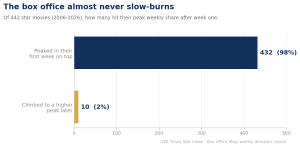
A star movie, by the USA Times definition, is any film that takes at least 26.18% of a full week’s U.S. box office — a film big enough to own its moment. But owning a moment and owning a month are very different things. Across twenty years and 442 qualifying star movies, the striking truth is how fleeting most of that glory is.
One week, then gone
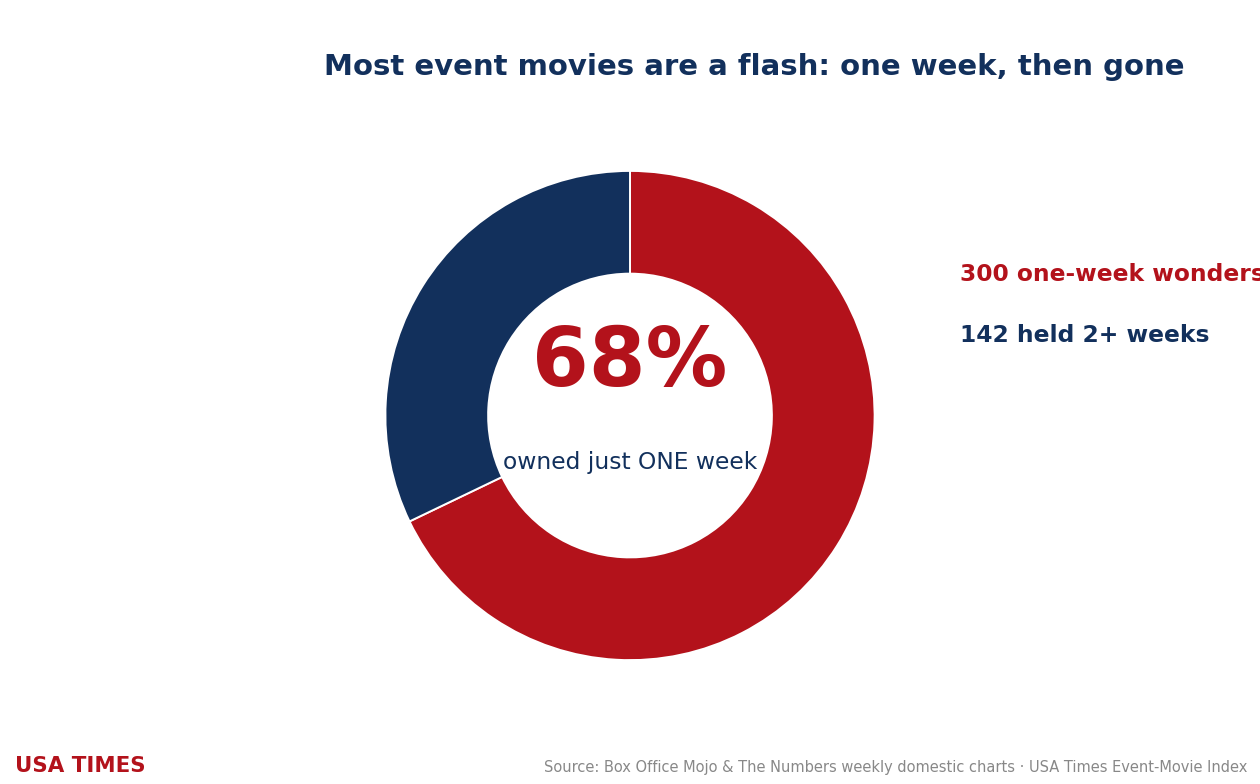
300 of the 442 star movies since 2006 — 68% of them — owned exactly one week and were dethroned the next. They are the box office’s shooting stars: a monster opening, wall-to-wall marketing, a single week on the throne, and then a fresh blockbuster shoves them aside. Only 142 films managed to hold the top even a second week.
The biggest one-and-dones
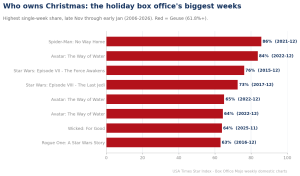
Some of these single weeks were enormous. These are the films that hit the highest share of the entire market — and still lost the crown seven days later.
Batmandir · Founders A numbered seat at the table. S3 · The Founders Club — 161 seats per location. By invitation. Explore membership →| # | Film | Year | Peak tier | Peak week share |
|---|---|---|---|---|
| 1 | Michael | 2026 | Geuse | 66.3% |
| 2 | The Conjuring: Last Rites | 2025 | Geuse | 66.0% |
| 3 | Tom & Jerry | 2021 | Geuse | 65.4% |
| 4 | Wonder Woman 1984 | 2020 | Geuse | 63.0% |
| 5 | John Wick: Chapter 4 | 2023 | Betelgeuse | 61.6% |
| 6 | Harry Potter and the Deathly Hallows: Part 2 | 2011 | Betelgeuse | 60.2% |
| 7 | The Hobbit: An Unexpected Journey | 2012 | Betelgeuse | 58.6% |
| 8 | The Little Mermaid | 2023 | Betelgeuse | 58.4% |
| 9 | Deadpool 2 | 2018 | Betelgeuse | 58.1% |
| 10 | The Amazing Spider-Man 2 | 2014 | Betelgeuse | 57.3% |
The pattern says something about how the modern release calendar works. Studios stack their giants one after another, each clearing the last off the throne within a week. Domination is real — but it is also disposable, engineered to last exactly until the next giant arrives. The rare films that hold on for two, three, even five weeks are a different species entirely.
Why domination is so often disposable
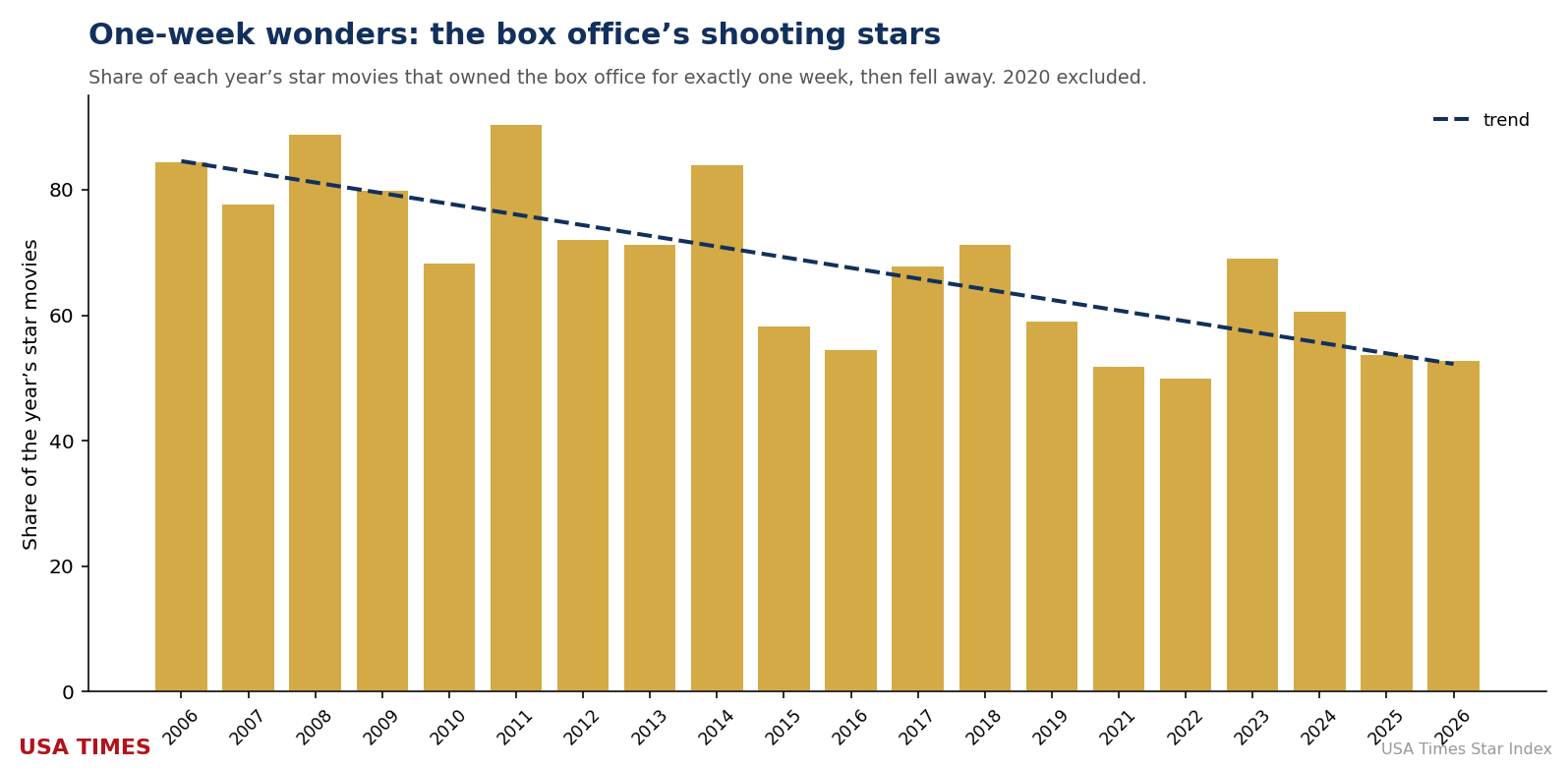
The prevalence of one-week wonders — films that seize the top for a single week and are gone the next — is not a sign of weak films but of a release calendar engineered for turnover. Studios stack their biggest titles one after another, each timed to knock the last off its perch within seven days. A film can open to a genuinely dominant share and still be dethroned immediately, not because it faded but because next week’s giant was always scheduled to arrive. In this sense, the one-week wonder is the default product of the modern box office: domination designed to last exactly until the next domination begins.
This conveyor-belt structure means that the length of a film’s reign often says more about what opened after it than about the film itself. A strong film unlucky enough to open the week before a mega-blockbuster will register as a one-week wonder despite excellent word of mouth; a comparable film with a clear runway behind it might hold the top for a month. The one-week wonders are, many of them, victims of timing as much as of their own limitations — films that dominated fully and were simply next in line to be replaced.
The rare films that break the pattern
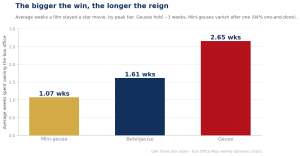
Against that backdrop, the films that do hold the top for multiple weeks stand out as a genuinely different species. To reign for two, three, or more consecutive weeks, a film must not only open big but out-earn every new arrival that follows — a far harder test, and one that depends on the word of mouth and repeat business that a single explosive opening cannot supply. The multi-week holdovers are the films audiences actively chose again and again, week after week, over everything new. They are the opposite of the shooting star: not a flash that fades, but a fire that keeps burning. Their rarity is precisely what makes them worth studying, and it is why the index tracks sustained reigns as a category of their own.
What the shooting stars tell us about the calendar
Viewed in aggregate, the sheer number of one-week wonders is a portrait of how compressed and competitive the release calendar has become. In an earlier, more spread-out era, a hit could hold the top spot for weeks simply because the next big film was a while off. The modern calendar leaves no such gaps: there is almost always another giant scheduled for next week, ready to end the current reign on time. The shooting stars are the natural output of that density — dozens of films each granted their one week on the throne before being ushered off to make room for the next. It is domination as a relay race, with the baton changing hands every Friday, and the one-week wonders are the runners who took their leg and passed it on.
A shooting star is still a star
For all that the phrase “one-week wonder” can sound diminishing, it is worth remembering what it actually describes: a film that, however briefly, was the single biggest movie in America. To lead the entire national box office for even one week places a film in rare company — the overwhelming majority of titles released in any year never spend a single week at number one. The shooting stars are not failures; they are films that reached the summit and simply could not hold it against the next arrival. Their brevity at the top is a feature of the calendar, not a verdict on their worth, and many of them went on to long, profitable runs further down the chart, or found second lives on streaming that dwarfed their theatrical moment. The one-week wonder is a story about the structure of the release schedule far more than about the merit of any individual film, and that is precisely why counting them, and watching how their number changes over time, tells us something real about how the modern box office is built.
Related from the USA Times Data Desk
- NYC Rat Complaints Just Fell Below Pre-Pandemic Levels for the First Time Since the 2021 Surge
- The 38.2% Club: The ‘Betelgeuses’ That Run the Box Office
- The Efficiency Champions: How Cheap Horror Owns the Box Office
- Box Office Tracker: "Minions & Monsters" mantém o 1º lugar e "Michael" ultrapassa US$ 371 mi sem alarde
- Box-office coverage index · the Star Index methodology
Sources
- Box Office Mojo — Weekend Domestic Box Office
- Box Office Mojo — Yearly Domestic Box Office
- The Numbers — Weekly Box Office Chart
- USA Times — Star Index methodology & data sources