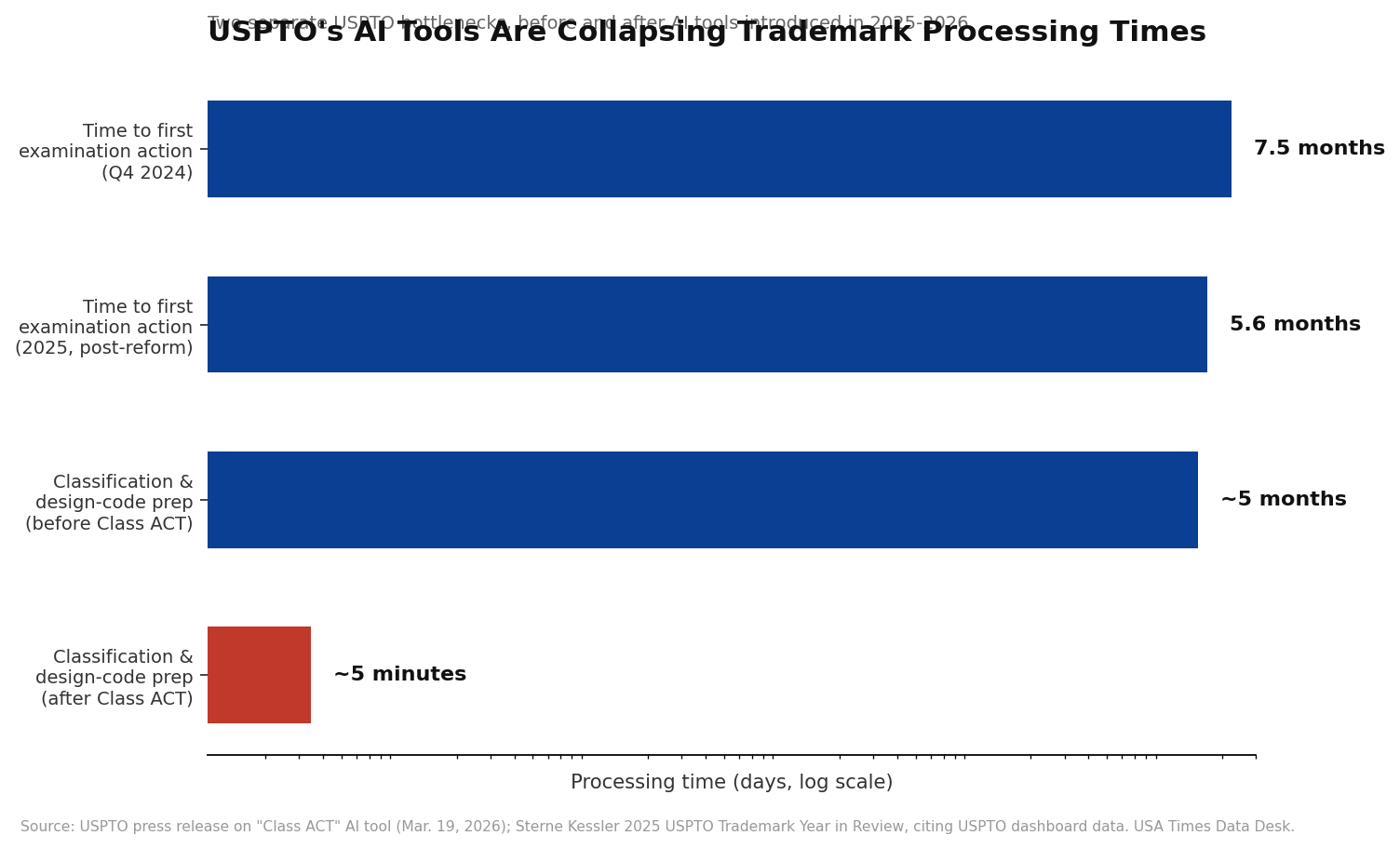
Before an examining attorney at the U.S. Patent and Trademark Office can properly review a trademark application, someone has to classify it — assign it to the right international goods-and-services categories, tag it with design search codes if it includes a logo, and generate a “pseudo mark” if the spelling is unconventional. For applications that arrived unclassified, that prep work was taking up to five months, a bottleneck driven by a sustained surge in trademark filings. In March, USPTO announced the fix: an AI agent called “Class ACT” — the Trademark Classification Agentic Codification Tool — that does the same job in about five minutes.
Two USPTO Bottlenecks, Before and After AI
Bar length shows relative scale (log). Hover for context.
Batmandir · Guest Passes Step inside for a day. Guest passes from $161/day — brought in by a member. See guest passes →What was actually taking five months
The classification step exists because trademark applications with logos, unconventional spelling, or no assigned international class are hard to search — and searchability is what lets examiners check whether a proposed mark conflicts with something already registered. Historically, USPTO staff added the design codes, pseudo marks, and classifications by hand. As filing volume rose, that manual process increasingly became the slowest link in the chain before an application ever reached substantive examination. “Classification and design search coding takes five months? How about five minutes or even five seconds,” USPTO Director John A. Squires said in the agency’s own announcement, describing Class ACT as a “task-directed AI agent” built specifically to handle “the toughest, most information intensive aspect of pre-examination.”
Humans still check the AI’s work
USPTO has been explicit that Class ACT’s output isn’t published untouched. “Now, AI can provide this information immediately at a high level of accuracy,” said Senior Legal Advisor Kathleen Cooney-Porter in the agency’s release, “while the information is still reviewed by humans at the USPTO.” The stated goal isn’t to remove people from the classification step entirely — it’s to compress the time between an application landing in the queue and a human examiner having something searchable and complete to actually review. Acting Trademark Commissioner Dan Vavonese framed the tradeoff directly: with AI handling the pre-processing grunt work, “our employees can focus on applying their experienced judgment and reason to the substantive issues in examination.”
It’s the second AI-driven speedup in the same office this year
Class ACT isn’t an isolated tool — it’s part of a broader set of changes at the Trademarks division that together have measurably shortened the time it takes to get a new application in front of an examiner in the first place. Separate from Class ACT, the office’s own dashboard data (cited in trademark-practice analysis from law firm Sterne Kessler) shows average time to first examination action falling to 5.6 months in 2025, down from 7.5 months in the fourth quarter of 2024 — a decline that predates Class ACT specifically and is tied instead to a January 2025 fee restructuring that penalizes vague, overly broad, or non-compliant filings and rewards applicants who use USPTO’s pre-approved goods-and-services language from its ID Manual. In April 2026, USPTO layered on two more AI features: an image-search tool in its trademark search system that lets examiners and the public search by uploading a logo rather than typing keywords, and a forthcoming mark-description and color-claim generator meant to reduce filing errors at the application stage, before an examiner ever sees the case.
Why the timing matters
The push toward automation at USPTO is happening against the backdrop of a genuine filing surge: the agency’s own FY 2026 budget projections estimated trademark application volume would grow another 4.9% on top of already-elevated recent-year filing levels, much of it attributed industry-wide to founders and companies rushing to protect brand names for AI products, AI agents, and AI-branded features before competitors do. That’s a specific kind of pressure on a classification system originally built around a slower, more predictable filing pace — and it’s part of why USPTO’s own messaging around Class ACT leaned on the tool’s speed rather than framing it primarily as a cost-cutting measure. A five-month classification bottleneck at pre-surge filing volumes would only get worse as volume kept climbing; automating it was presented as a way to keep the review pipeline moving rather than watching the backlog compound.
The person running AI policy came from the private sector
USPTO’s own announcement is notable for who it credits with the tool’s rollout. Rob Hayes, described in the release as USPTO’s Acting Chief AI & Data Officer, “joined Mr. Squires from the private sector as a senior advisor in the Office of the Under Secretary from a senior post at X” — the company formerly known as Twitter. Director Squires credited Hayes directly for having “invigorated all our operations across the office in such a short time.” It’s a specific, publicly stated example of a broader pattern across federal agencies over the past two years: recruiting AI and data leadership directly out of Silicon Valley into operational roles inside agencies that, historically, built most of their technology in-house or through traditional government contractors. Whether that pattern accelerates AI adoption at other agencies the way it appears to have at USPTO’s Trademarks division is not something this dataset can answer on its own, but the personnel move itself — and USPTO’s decision to name it explicitly in a press release — is a data point about how the federal government is currently staffing its AI push.
What we did
The “five months to five minutes” figure and all direct quotes from USPTO Director Squires, Acting Chief AI & Data Officer Rob Hayes, Senior Legal Advisor Kathleen Cooney-Porter, and Acting Trademark Commissioner Dan Vavonese come from USPTO’s own press release announcing Class ACT, published March 19, 2026, which we read in full rather than relying on secondary coverage. The 7.5-months-to-5.6-months examination timeline figures come from Sterne Kessler’s 2025 USPTO Trademark Year in Review, which itself cites USPTO’s own public dashboard at uspto.gov/dashboard/trademarks as its source; we did not independently re-verify the dashboard’s live figures at time of publication, since dashboard values update continuously and the point-in-time figures cited in the law firm’s December 2025 analysis are what our timeline reflects. The April 2026 image-search and mark-description-generator features were confirmed directly against USPTO’s own subscription-center announcement rather than third-party coverage of the rollout.