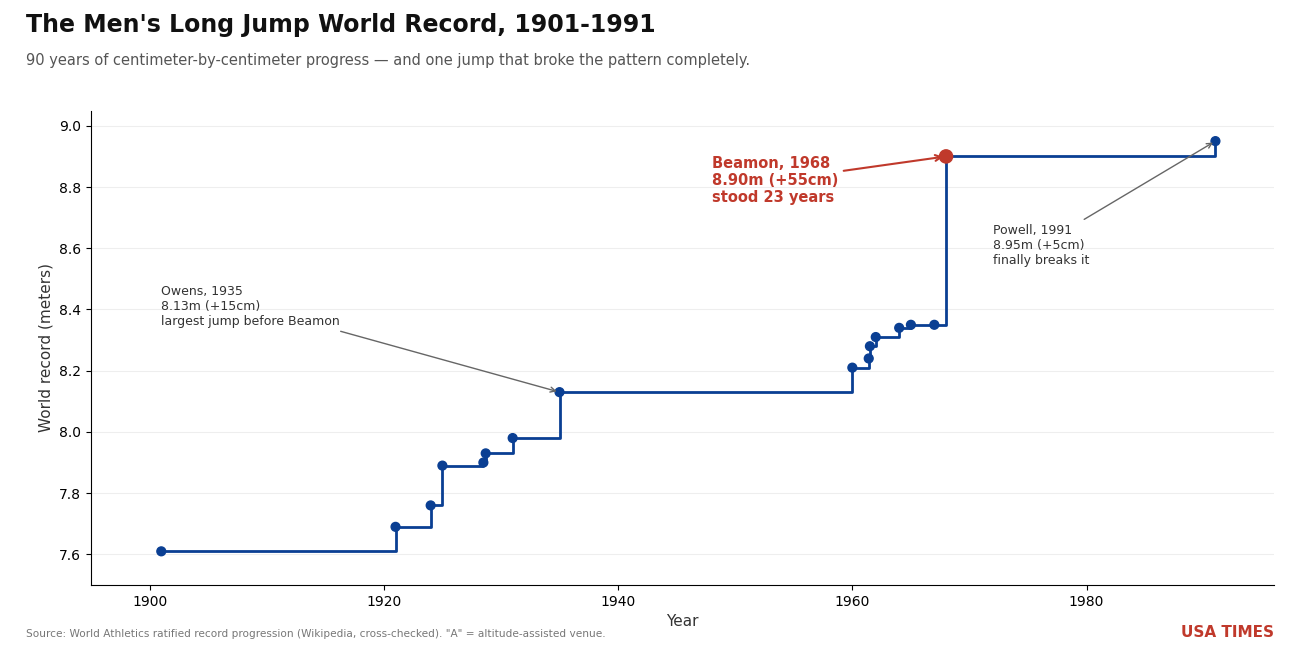
Track and field world records almost never move much. A sprinter shaves a hundredth of a second off a mark that took a rival a decade to set. A thrower adds a few centimeters and calls it a career highlight. That’s the pattern in the men’s long jump’s ratified world-record progression, stretching back to 1901: increments of a centimeter here, eight centimeters there, the occasional stretch of years where nobody moves the number at all.
Then, on October 18, 1968, at the Mexico City Olympics, Bob Beamon jumped 8.90 meters. The standing record, set by Igor Ter-Ovanesyan in that same stadium exactly one year earlier, was 8.35 meters. Beamon didn’t edge it. He added 55 centimeters — nearly 22 inches — in a single jump, on his very first attempt of the final.
The Men’s Long Jump World Record, 1901–1991
Batmandir · The Circle Full access to theatres, museums & exhibitions. S2 · ongoing membership, without a Founder’s seat. Explore membership →Bar height is the record distance. Hover any bar for the athlete, the exact mark, and how much it added over the previous record.
We pulled the full ratified world-record progression for the men’s outdoor long jump, from Peter O’Connor’s 7.61m in 1901 through Mike Powell’s 8.95m in 1991, and measured every increment between consecutive records. In 90 years and 17 record-setting marks, the single biggest jump anyone had ever made over a standing record — before Beamon — was Jesse Owens’ 15 centimeters, set in Ann Arbor in 1935. Most increments were 1 to 8 centimeters. Beamon’s 55-centimeter leap is 3.7 times larger than the biggest “normal” jump in the entire history of the record.
He almost didn’t make the final
None of this was supposed to happen to a jumper on the edge of elimination. A day earlier, in qualifying, Beamon fouled his first two attempts by overstepping the takeoff board — one more foul and his Olympics would have ended before the final even started. Ralph Boston, his teammate, training partner, and the man whose own record Beamon would go on to demolish, talked him through it: start the approach further back, take off well behind the board, sacrifice a few centimeters of distance for a legal jump. Beamon did exactly that, qualified with room to spare, and carried the same conservative, deliberately-short approach into the final the next day.
In the final itself, Beamon jumped fourth. The three jumpers ahead of him — Yamada, Brooks, and Boschert — all fouled on their opening attempt. Beamon’s jump was, therefore, the first legal mark of the entire round. It remained the only legal mark anyone needed.
The measuring tape had to come out
The jump was so far beyond anything the officials had planned for that the stadium’s optical measuring rig — a sliding device on a rail alongside the sand pit, built to track jumps in the range athletes had actually been producing — couldn’t reach far enough to read it. Officials had to bring out a manual steel tape to measure the distance by hand. It took several minutes to get a number. When Beamon’s teammate and former record holder Ralph Boston told him what it was, Beamon’s legs gave out; he dropped to his knees in what’s since been described as a brief cataplexy attack, the shock of the number physically overwhelming him before he’d even had time to process it emotionally.
How much of it was Mexico City?
The obvious explanation, and the one raised immediately in 1968, is conditions. Mexico City sits at roughly 2,240 meters of elevation; thinner air means less aerodynamic drag on a sprinting body and a jumper who can carry more speed into the takeoff board. Beamon’s jump was also wind-aided, with a following wind of +2.0 meters per second — the exact maximum allowed before a jump stops counting as record-eligible. Ter-Ovanesyan’s mark from the year before, in the same stadium, was also altitude-assisted, which is why the record before Beamon’s was already flagged “A” for altitude in the official progression.
That’s a real effect, and it’s been measured, not just speculated about. A 1986 biomechanical analysis by A.J. Ward-Smith, published in the Journal of Biomechanics, modeled the combined effect of Mexico City’s altitude and the maximum legal tailwind and found they were worth approximately 31 centimeters compared to an equivalent jump at sea level in still air.
Subtract that from the 55-centimeter jump, and there’s still roughly 24 centimeters left over — a gap that, on its own, would still have been the second-largest single increase in the record’s history, bigger than everything except the jump it came from. Altitude and wind can explain why conditions were favorable. They don’t explain why nobody else, at that same altitude, with that same legal tailwind, jumped anywhere close to it — not that day, and not for the 23 years that followed.
Twenty-three years, then a normal jump broke it
Beamon’s record stood until August 30, 1991, when Mike Powell jumped 8.95 meters at the World Championships in Tokyo — an increase of 5 centimeters, well inside the normal historical range. The gap between Beamon’s jump and the next-closest legitimate long jump performance was, for over two decades, larger than the gap between the modern record and jumps from the 1930s. No other event in track and field’s ratified record books has a comparable single-jump anomaly relative to the surrounding data.
Why it still stands out, even in a sport full of outliers
Track and field has other jumps and throws that briefly broke from their era’s trend line — steroid-era shot put and discus marks from the 1980s, a handful of sprint times that later drew doping scrutiny. What sets Beamon’s jump apart in the data is that it has never been seriously alleged to be anything other than legitimate. It was measured by hand, in front of a stadium, under rules that capped the wind assistance at exactly the level he received, at a venue whose altitude effect had already been quantified independently. Every input is on the record. The output still doesn’t fully reconcile with the other 16 data points around it, which is precisely why “Beamon” entered the sports lexicon as its own word — used, decades later, whenever a performance in any sport detaches so completely from its own historical trend line that the surrounding numbers stop being useful for predicting what should have been possible.
What we did
We compiled the full ratified world-record progression for the men’s outdoor long jump from the World Athletics record history (cross-checked against Wikipedia’s sourced progression table), calculated the increment between every consecutive record from 1901 to 1991, and identified the largest non-Beamon increase in that span. For the environmental-contribution figure, we relied on Ward-Smith’s peer-reviewed 1986 biomechanical analysis, the standard scientific reference on the subject, rather than estimating it ourselves. The measuring-tape and cataplexy details are corroborated across World Athletics’ own 50th-anniversary retrospective and multiple contemporaneous and historical accounts of the 1968 final.