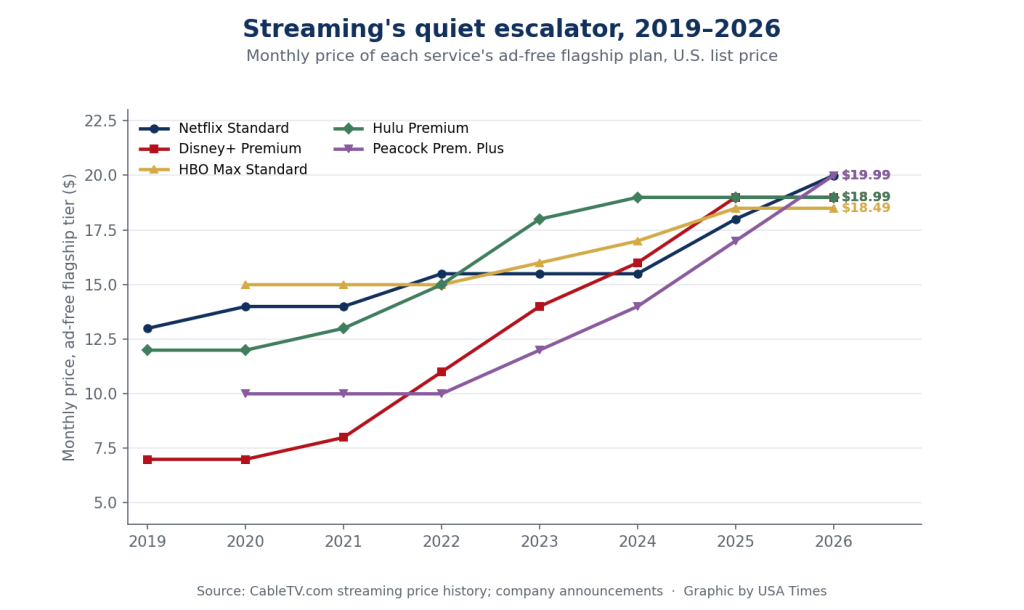
There was a stretch, not so long ago, when streaming was the good deal. You cut the cord, you paid eight or nine dollars a month for a bottomless library, and the price sat there, unchanged, year after year. That era is over. Almost every major streaming service now raises its prices on something close to an annual schedule, and the ad-free plans that used to be the whole point have become the most expensive way to watch. Line the price histories up side by side and a single pattern emerges: a slow, steady escalator that has roughly doubled the cost of the marquee plans in a handful of years.
Here is the two-decade record, service by service, and what it reveals about where the streaming business is heading.
Netflix: the fourteen-year climb
Netflix set the template, and its numbers show the escalator at its most patient. When the company split streaming off as a standalone product in 2011, an ad-free Standard subscription cost $7.99 a month. It rose in increments — $8.99, then $9.99, then a jump to $10.99 in 2017, $12.99 in 2019, $13.99 in 2020, $15.49 in 2022 — before reaching $17.99 in 2025 and $19.99 in 2026. The Premium four-stream tier, $11.99 at launch, now runs $26.99. Roughly speaking, it took Netflix about fourteen years to double the price of its flagship ad-free plan.
Batmandir · The Circle Full access to theatres, museums & exhibitions. S2 · ongoing membership, without a Founder’s seat. Explore membership →Two structural shifts sit underneath those numbers. In 2023 Netflix introduced a cheaper ad-supported tier and, more consequentially, began cracking down on password sharing, converting what had been free household spillover into paid “extra member” slots. And in January 2025 it discontinued its cheapest ad-free option, the old Basic plan, nudging price-sensitive subscribers either down to ads or up to a pricier ad-free tier. The list price is only half the story; the menu itself has been redesigned to move people toward higher-margin choices.
Disney+: double the price in four years
If Netflix is the slow escalator, Disney+ is the express elevator. The service launched in 2019 at $6.99 a month, ad-free, positioned as the cheap, family-friendly cable alternative. That framing did not last. Disney added an ad tier in 2022, and its ad-free Premium plan marched from $7.99 to $10.99 to $13.99 to $15.99 to $18.99 by 2025 — a near-tripling in six years. Where Netflix took fourteen years to double, Disney+ did it in about four.
The steepness reflects a company racing to make its streaming arm profitable after heavy content spending, and it helps explain Disney’s aggressive push toward bundles. The standalone Disney Bundle with Hulu and, at the premium end, ESPN, has become the company’s preferred product — and its own price history climbs in lockstep, with the ad-free Duo and Trio plans reaching $19.99 and $29.99.
Hulu: the acquisition premium
Hulu’s history is a study in what happens when ownership changes. For its first eight years the service barely touched its prices; its basic ad-supported plan sat at $7.99 for most of the 2010s, and even dipped to $5.99 in 2019 as it fought Netflix for subscribers. Then Disney took majority control in 2019 and full control by 2023, and the pattern flipped. Hulu’s ad-free Premium plan climbed from $11.99 to $12.99 to $14.99 to $17.99 to $18.99, and the standalone service is now being folded into the Disney+ app entirely — a consolidation that will, before long, remove the option of subscribing to Hulu on its own.
HBO Max: expensive from the start, and renamed twice
HBO Max never had a cheap era to lose. It launched in 2020 at $14.99 a month, because it could not undercut the HBO cable channel or its streaming predecessor. Its ad-free Standard plan has risen more modestly in percentage terms — from $14.99 to $15.99 to $16.99 to $18.49 — but off a high base, and the service has spent as much energy on identity as on price, rebranding to “Max” in 2023 and back to “HBO Max” in 2025 as its owner, Warner Bros. Discovery, whipsawed between chasing a broad family audience and reclaiming its prestige-television reputation. The Premium four-stream tier now sits at $22.99.
Peacock, Paramount+, Apple, Amazon: the rest of the field
The smaller services show the same trajectory with local variations. Peacock launched its Premium plan at $4.99 in 2020 and, after killing its free tier in 2023, pushed its ad-free Premium Plus plan from $9.99 all the way to $19.99 by 2026 — a doubling of the top tier and one of the sharpest climbs in the market. Paramount+ is the rare service that has occasionally cut a price, splitting the difference when it merged its Showtime bundle, though its Essential and Premium plans have crept up to $8.99 and $13.99.
Apple TV stands out for restraint: one plan, no ads, raised only three times — from $4.99 to $6.99 to $9.99 to $12.99 — over its life. Amazon Prime Video took a different route to the same end, leaving its nominal price alone but injecting ads into most content in 2024 and then charging an extra fee to remove them, effectively creating a new, higher ad-free price without ever announcing a “price increase” on the headline plan.
The pattern behind the numbers
Step back from the individual services and three tactics recur across all of them. First, the ads-as-default flip: services that launched ad-free now steer subscribers toward ad tiers by making the ad-free option markedly more expensive, or, in Amazon’s case, by adding ads to the existing plan and charging to remove them. The advertised “cheap” price increasingly buys you commercials. Second, the menu redesign: discontinuing entry-level ad-free tiers (Netflix Basic), splitting plans into ever-finer gradations (Peacock Select, Premium, Premium Plus), and renaming tiers so year-over-year comparisons are harder to make. Third, the bundle funnel: pushing standalone subscribers toward multi-service packages that look like a discount while raising the floor of what a full entertainment stack costs.
The cumulative effect is the number that stings when people add it up. Independent tallies of the major services find that a basket of the leading subscriptions has risen well over 50 percent in roughly five years — hundreds of dollars more per year for the same shelf of apps. The cord many households cut to save money has quietly been replaced by a bundle of subscriptions that, taken together, can rival a cable bill. The escalator is slow enough that any single hike feels tolerable. Charted across two decades, the direction is unmistakable.
Related reading from USA Times: our look at how much of America’s moviegoing habit has vanished as home viewing took over, the consolidation of the studios feeding these services, and the FTC’s broader fight over hidden and creeping consumer fees.
The flagship ad-free plans, year by year
The table below lists the monthly U.S. list price of each service’s ad-free flagship tier. A dash means the plan did not yet exist in that form.
| Year | Netflix Standard | Disney+ Premium | Hulu Premium | HBO Max Standard | Peacock Premium Plus |
|---|---|---|---|---|---|
| 2019 | $12.99 | $6.99 | $11.99 | — | — |
| 2020 | $13.99 | $6.99 | $11.99 | $14.99 | $9.99 |
| 2021 | $13.99 | $7.99 | $12.99 | $14.99 | $9.99 |
| 2022 | $15.49 | $10.99 | $14.99 | $14.99 | $9.99 |
| 2023 | $15.49 | $13.99 | $17.99 | $15.99 | $11.99 |
| 2024 | $15.49 | $15.99 | $18.99 | $16.99 | $13.99 |
| 2025 | $17.99 | $18.99 | $18.99 | $18.49 | $16.99 |
| 2026 | $19.99 | $18.99 | $18.99 | $18.49 | $19.99 |
What a household actually pays now
The individual figures understate the household experience, because almost no one subscribes to just one service. A viewer who wants Netflix, Disney+, and HBO Max ad-free — a common combination for a family that follows prestige drama, kids’ content, and a marquee franchise or two — is now spending well over $50 a month before adding a live-sports package or a music subscription. Five years ago the same three plans cost roughly $35. Add Hulu or Peacock for a specific show, layer in the ad-removal surcharges that services like Amazon now impose, and the monthly total edges into territory that once belonged to a full cable bundle.
What makes the increase easy to miss is its distribution. No single service delivers a shock; each raises its price a dollar or two, once a year, often framed around new content or a tier reshuffle. The pain is only visible in aggregate, and only over time — which is precisely why charting the whole field at once is the honest way to see it. The streaming bargain was real. It is also, for the ad-free viewer, largely gone.
What we did
The price histories in this article and the accompanying chart are compiled from CableTV.com’s continuously updated streaming price-history tables, which draw on company announcements and contemporaneous reporting, cross-checked against individual services’ announced changes. Our chart tracks each service’s ad-free flagship plan — Netflix Standard, Disney+ Premium, HBO Max Standard, Hulu Premium, and Peacock Premium Plus — at U.S. list prices from 2019 through 2026, the window in which all five plans coexist; earlier data points for Netflix and Hulu (which predate several rivals) are discussed in the text but omitted from the chart to keep the comparison like-for-like. Prices shown are standard monthly list prices and exclude promotions, annual-billing discounts, and bundle pricing. Where a service (such as Amazon Prime Video) changed its ad policy rather than its headline price, we note the effect in the text rather than the chart.
- CableTV.com: The complete history of streaming service prices
- Tom’s Guide: What streaming costs in 2026
- Deadline: Streaming subscription prices and ad tiers
- HonestlyRanked: Streaming now costs hundreds more per year than in 2021