Read in: English · Español · Русский · 中文 · Português
File a federal trademark application and something predictable happens within days: the letters start arriving. Some come by post, on heavy stock, printed with an official-looking seal, a Washington or Alexandria return address, and a reference number that matches your real application. Others come by email or text. They congratulate you on your filing, warn that a deadline is approaching, and ask for a payment — often several hundred to several thousand dollars — to “register,” “monitor,” “publish,” or “renew” your mark. Almost none of them come from the United States Patent and Trademark Office. They come from an industry built on the fact that trademark applications are public records, and that a first-time filer usually has no idea what the government actually charges or requires.
This is one of the oldest and most durable scams in the intellectual-property world, and it has proven remarkably resistant to enforcement. Understanding how it works — where the mailing lists come from, what the fake invoices ask for, and where the money ends up — is the best protection a small business or solo applicant has.
Batmandir · The Circle Full access to theatres, museums & exhibitions. S2 · ongoing membership, without a Founder’s seat. Explore membership →Why the letters find you so fast
The mechanism is not mysterious. When you file with the USPTO, your name, mailing address, email, the mark itself, and your application’s key dates all become part of a searchable public database. Solicitation operations scrape that database continuously. Within hours of a filing appearing, an automated pipeline can generate a personalized invoice that quotes your exact serial number and the genuine statutory deadlines — the five-to-six-year maintenance filing, the ten-year renewal — because those dates are public too. The specificity is the trick. A letter that knows your serial number and your renewal date feels like it must be official.
The USPTO maintains a running list of the entity names these operations use, and the roster is long and deliberately confusing: names that shuffle the words “patent,” “trademark,” “office,” “bureau,” “agency,” “registration,” and “compliance” into combinations that sound governmental without being it. The agency’s guidance is blunt and worth memorizing: the USPTO communicates about your application by email from the domain uspto.gov, and all genuine fees are paid through its own electronic filing system. It does not send paper invoices for “monitoring,” and it never asks for payment or your account password by phone, email, or text.
The menu of fake services
The solicitations cluster into a few recurring products, all of them variations on charging for something the government provides for less, or does not offer at all.
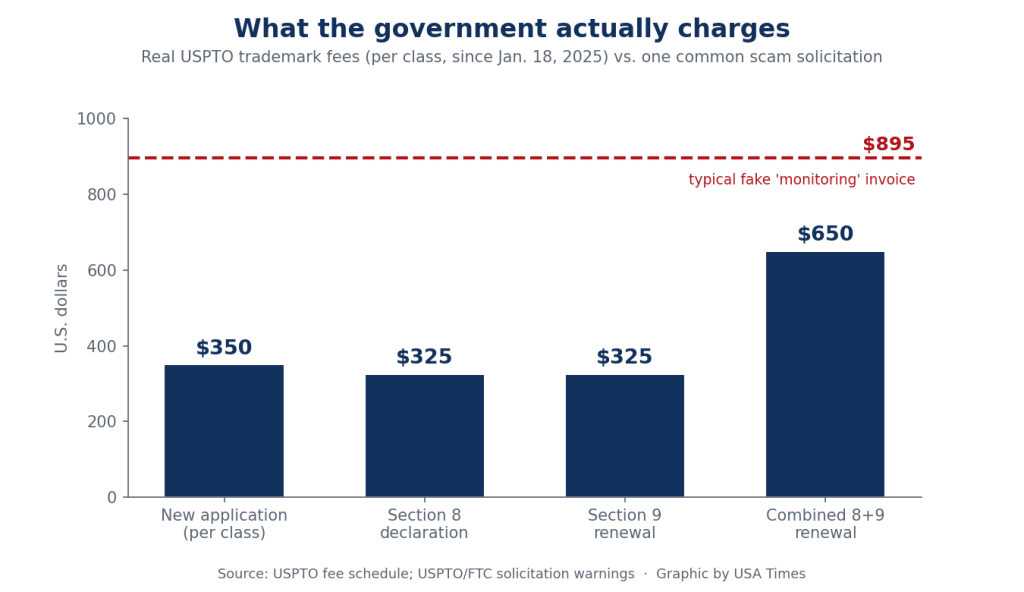
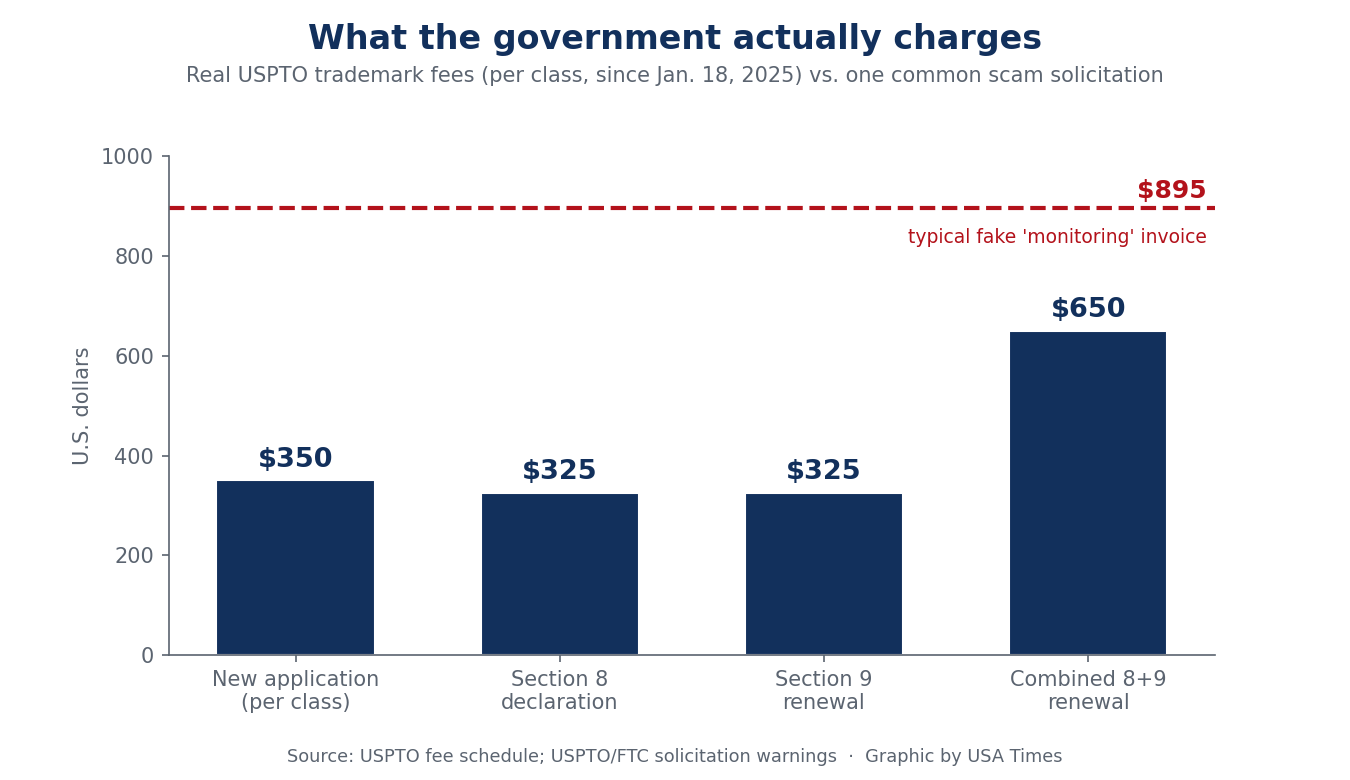
“Monitoring” or “watch” services are among the most common. A typical unsolicited invoice offers to watch your trademark for potential infringement for a fee on the order of $895 a year. The USPTO does not sell any such service; monitoring is something a trademark owner or their attorney can do, and while legitimate commercial watch services exist, the scam versions bank on recipients assuming the fee is a mandatory government charge.
Fake registration and “publication” fees target applicants mid-process, offering to record the mark in a private registry or an international directory that carries no legal weight. Renewal solicitations are aimed at owners whose maintenance or renewal deadlines are approaching; these are especially insidious because the underlying deadline is real, so a distracted owner may pay the inflated private fee believing they have satisfied a genuine obligation. In one criminal case, the operator misrepresented that registrations would expire earlier than they actually would, manufacturing urgency to drive payment.
The newest wrinkle is impersonation by email and text. Recent scams tell applicants they must schedule or attend a “mandatory verification appointment” with an examining attorney, and threaten that failure to appear will cause the application to be abandoned. There is no such requirement. The goal is either an upfront payment or, increasingly, the applicant’s USPTO.gov login credentials — which let the fraudsters hijack the file directly.
The gap between the real fee and the fake one
The entire business model depends on information asymmetry, and the numbers make the gap plain. Since January 18, 2025, the USPTO’s base fee for a new trademark application is $350 per class of goods or services. Maintaining a registration costs $325 per class for the Section 8 declaration of continued use and $325 per class for the Section 9 renewal, or $650 per class filed together at the ten-year mark. Those are the real, published figures.
Against that, a fake “monitoring” invoice for $895 — for a service the government does not even provide — costs more than a genuine combined ten-year renewal. Renewal-scam letters frequently quote sums well above the true statutory fee, pocketing the difference. For an applicant who has never seen the fee schedule, none of this looks out of place: filing a trademark is expensive and bureaucratic, so another few hundred dollars for an “official” step does not immediately register as fraud.
Following the money
Where does the money go? Enforcement records over the past several years sketch an ecosystem that runs from lone operators to industrial-scale filing mills.
At the individual end is the case of Viktors Suhorukovs, a Latvian citizen who ran trademark-renewal solicitation schemes under entities called the “Patent and Trademark Office” and the “Patent and Trademark Bureau.” He created the impression that these were the genuine USPTO, told registrants their marks were expiring sooner than they were, and charged far more than the government required. He pleaded guilty to mail fraud, was sentenced to more than four years in federal prison, and was ordered to pay over $4.5 million in restitution — a figure that gives some sense of how much a single well-run solicitation operation can extract.
At the industrial end are the filing mills. In January 2022 the USPTO issued a sanctions order against Abtach Ltd., 360 Digital Marketing LLC, and Retrocube LLC, a linked set of low-cost trademark-filing and design websites. The agency’s investigation tied them to more than 5,500 invalidly filed applications — filings that clogged the examination system, misled the customers who paid for them, and in many cases used tactics like doctored specimens and unauthorized use of attorneys’ names. The USPTO has since terminated tens of thousands of applications and registrations connected to fraudulent filing schemes, and it has built out a dedicated apparatus for sanctioning bad actors.
The two ends of the ecosystem feed each other. The mills generate a flood of cheap, often-defective filings; the solicitation operations harvest the resulting public records to send fake invoices; and both rely on the same core vulnerability — applicants who do not know what the process should cost or how the government actually contacts them.
The cross-border problem
A large share of the ecosystem operates from outside the United States, which is part of why it has been so hard to shut down. Solicitation operations and filing mills have been traced to jurisdictions well beyond the reach of a routine USPTO sanction or a state consumer-protection action, and they can dissolve one entity and re-form under another name faster than regulators can respond. The USPTO has also warned about a related channel: foreign filing firms improperly soliciting U.S.-licensed attorneys to lend their credentials to bulk filings, a practice that launders questionable applications through the appearance of legitimate representation. When enforcement does land, it tends to be against the operators careless enough to leave a domestic footprint — a mailing address, a bank account, a name on a lease — which is why the cases that reach sentencing represent a fraction of the activity.
For victims, the cross-border reality has a practical consequence: once the money is sent, it is usually gone. Chargebacks and restitution are the exception, not the rule, and the $4.5 million ordered in the Suhorukovs case is notable precisely because recovery on that scale is uncommon. Prevention — recognizing the letter before you pay it — is not just the best defense; it is very often the only one that works.
How to read a solicitation before you pay
The defensive checklist is short. Confirm the sender: genuine USPTO email comes from uspto.gov, and the office does not bill you by paper invoice or demand payment by phone or text. Be suspicious of urgency; manufactured deadlines are the scam’s signature. Check any quoted fee against the USPTO’s published schedule before paying a cent. Ignore offers to “monitor,” “record,” or “publish” your mark in a private registry — none of that is a government requirement. If you are represented, route everything through your attorney, and if you are not sure whether a notice is real, contact the USPTO directly through the address on its own website rather than any number or link in the letter. And never enter your USPTO.gov password in response to an unsolicited message.
The scam persists because it is cheap to run, the mailing list refreshes itself with every new filing, and the marks — first-time applicants proud of a new brand — are the least equipped to spot it. The single most useful thing any filer can do is learn the real numbers. A fraudster’s whole advantage is that you don’t.
Related reading from USA Times: a reader’s firsthand account of the solicitations arriving within days of filing, our report on the USPTO terminating tens of thousands of fraudulent filings, and how the office is modernizing the trademark process itself.
What we did
We drew on the USPTO’s own solicitation warnings and fraud-enforcement notices, the agency’s published 2025 trademark fee schedule (effective January 18, 2025), Department of Justice records of the Suhorukovs prosecution, and the USPTO’s January 2022 sanctions order against Abtach, 360 Digital Marketing, and Retrocube, supplemented by law-firm analyses of the solicitation problem. The chart compares genuine per-class USPTO fees with the roughly $895 charged by a common fake “monitoring” solicitation; the $895 figure is drawn from documented solicitation examples and is illustrative rather than a fixed price, since scam invoices vary. Dollar figures for restitution and application counts are taken from the DOJ and USPTO records cited below. This article is general information, not legal advice.
- USPTO: Caution — misleading notices (solicitation warnings)
- USPTO: Criminal conviction in a trademark renewal solicitation scam
- USPTO: Sanctions against scammers for fraudulently filing thousands of applications
- Stites & Harbison: The fake “verification appointment” impersonation scam
- Overview of the 2025 USPTO trademark fee changes