Read in: English · Español · Русский · 中文 · Português
For about sixteen months, it looked as though the noncompete agreement, that clause buried in millions of American employment contracts, was headed for extinction. In April 2024 the Federal Trade Commission finalized a rule that would have banned virtually every employee noncompete in the country, voided most of the ones already signed, and required employers to tell workers those clauses were no longer enforceable. It never took effect.
In August 2024, a federal judge in Texas set the rule aside nationwide, and in September 2025 the Commission itself formally abandoned the fight, voting 3–1 to drop its appeals and accede to the rule’s vacatur. What that means in practice is simple and consequential: there is no federal noncompete rule, and there is not going to be one soon. Whether the clause you signed can be enforced against you depends almost entirely on which state you signed it in.
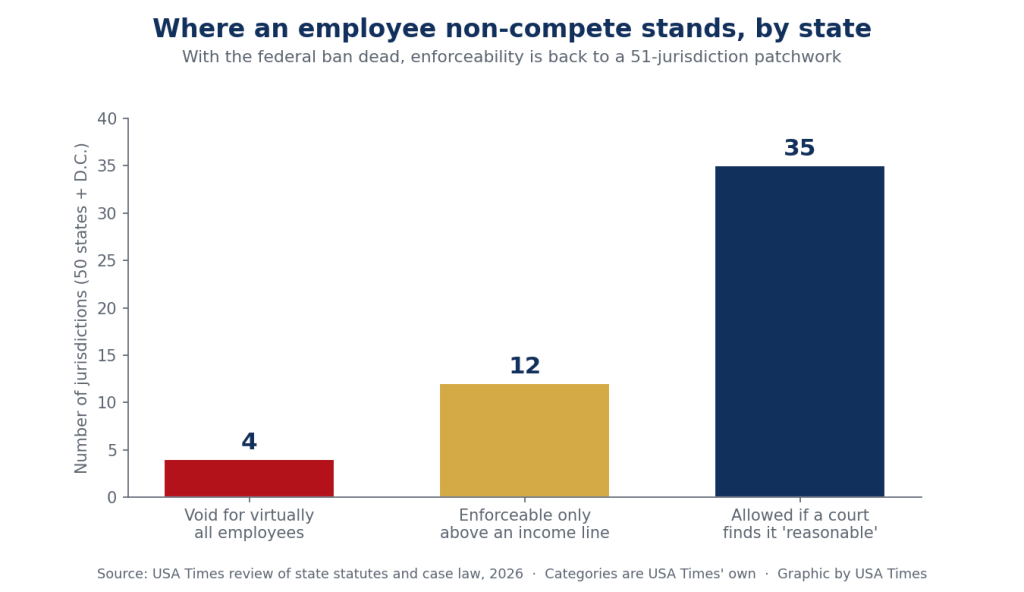
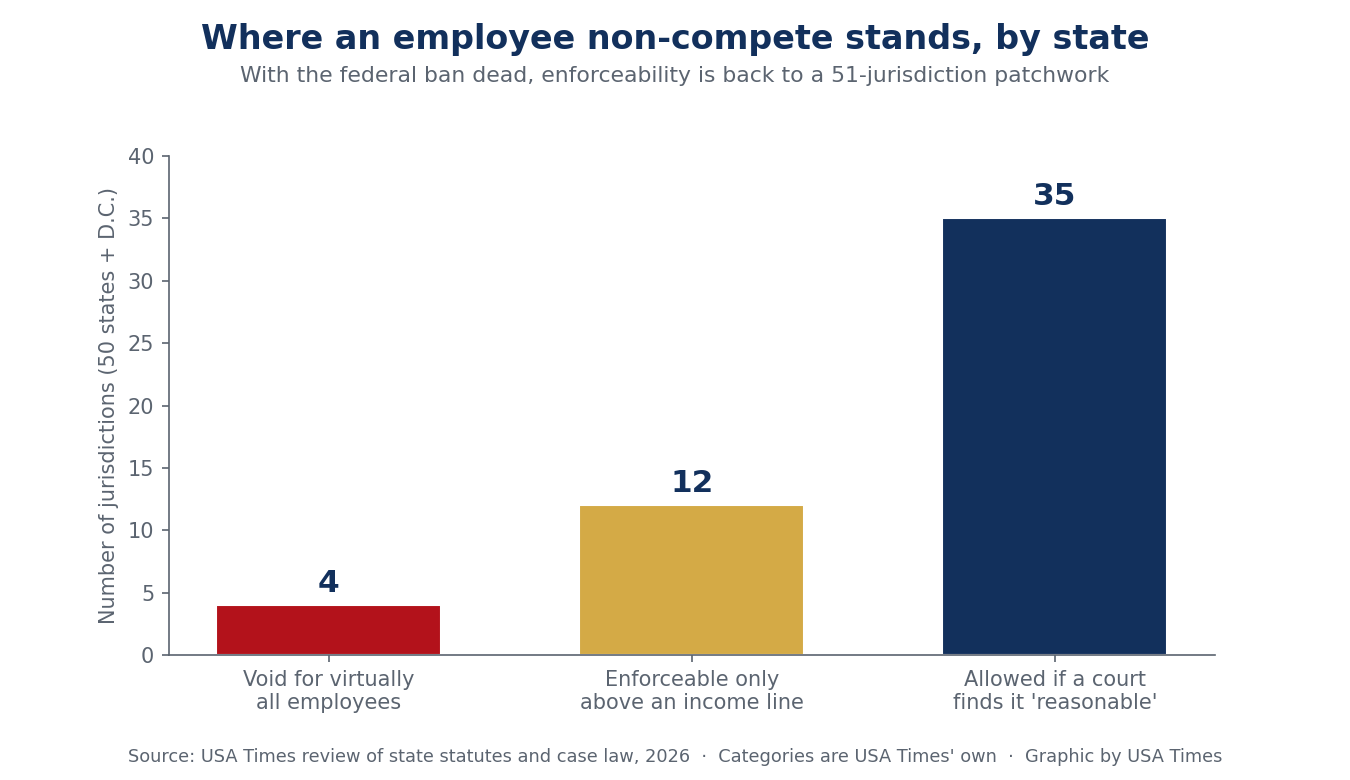
Batmandir · Guest Passes Step inside for a day. Guest passes from $161/day — brought in by a member. See guest passes →That is not a tidy answer. It is fifty-one different answers — one for each state plus the District of Columbia — and they range from “completely void, forget it existed” to “probably enforceable if a judge thinks it’s reasonable.” This is the map as it stands in late 2026.
What actually happened to the federal rule
The FTC’s 2024 rule was among the most aggressive labor regulations any federal agency had attempted in decades. It rested on the Commission’s authority to police “unfair methods of competition” under Section 5 of the FTC Act. The plaintiffs in Ryan LLC v. FTC argued that Section 5 does not give the agency power to write broad substantive rules of that kind, and the U.S. District Court for the Northern District of Texas agreed, holding that the rule exceeded the FTC’s statutory authority and was arbitrary and capricious.
Rather than gamble on the Fifth Circuit, the reconstituted Commission under Chairman Andrew Ferguson chose to walk away. Ferguson, joined by Commissioner Melissa Holyoak, framed the retreat as a shift in method rather than in goal: the agency would pursue individual noncompete abuses case by case under Section 5, instead of banning the practice by regulation. Commissioner Rebecca Slaughter dissented, arguing the rule should have been defended. In February 2026 the FTC published a Federal Register notice formally removing the defunct rule from the books, alongside similar cleanups of other blocked rules.
The upshot is that the legal center of gravity has moved back to state legislatures and state courts, exactly where it sat before 2024. And the states have not been idle.
The four states where noncompetes are simply void
Four jurisdictions treat nearly every employee noncompete as unenforceable, full stop. California is the oldest and strictest: Business and Professions Code section 16600 has voided employment noncompetes for more than a century, and in 2024 the state went further, enacting laws (AB 1076 and SB 699) that make it unlawful even to include a void noncompete in a contract and that require employers to notify affected employees. North Dakota and Oklahoma have long statutes to the same effect.
The newest member of the club is Minnesota, whose 2023 statute bans every employment noncompete signed on or after July 1, 2023 — with no carve-out for executives, no salary threshold, and no exception for so-called key employees. In these four states, the death of the federal rule changed nothing, because the state ban is broader than the federal one would have been.
The income-threshold states: enforceable, but only for the well-paid
A growing bloc of states has taken a middle path. They permit noncompetes, but only for workers who earn above a specified income line, on the theory that lower-wage employees have the least bargaining power and the most to lose from being locked out of their trade. The details differ sharply from state to state, and several thresholds are indexed to inflation and rise each year.
The District of Columbia sets one of the highest bars in the country: an employer generally cannot bind a worker to a noncompete unless the worker earns at least roughly $150,000 a year. Washington, Oregon, and Colorado all use six-figure, inflation-adjusted thresholds and layer on additional notice and timing requirements. Illinois voids noncompetes for anyone earning $75,000 or less (a figure that steps up over time under the state’s Freedom to Work Act). Maine, Maryland, New Hampshire, Rhode Island, and Virginia each bar noncompetes for lower-wage workers, though the mechanics vary: New Hampshire, for instance, ties its floor to a multiple of the federal poverty line, while Virginia keys off the state’s average weekly wage.
The trend line points in one direction. In 2026 Tennessee added a $70,000 income threshold, and Washington moved to tighten its rules further still. Even in states that have not banned the clause outright, legislatures are steadily narrowing the pool of workers to whom it can apply.
The reasonableness states: it’s up to a judge
In the largest group of states — roughly two-thirds of the country — noncompetes remain governed by the common-law “reasonableness” test that courts have applied for generations. An agreement is enforceable if, and only if, it protects a legitimate business interest (trade secrets, customer goodwill, specialized training) and is reasonable in its geographic scope, its duration, and the activities it restricts. Courts in many of these states will “blue-pencil” an overbroad clause, rewriting it to be narrower rather than throwing it out entirely; others will void an overreaching agreement wholesale.
This is the murkiest category for workers, because the answer is genuinely unpredictable until litigated. A two-year, nationwide bar on a mid-level salesperson might be struck down in one state and trimmed to six months and one metro area in another. The practical effect is that the clause often works even when it would not survive a court fight, because most workers cannot afford to test it.
Why the patchwork matters
The FTC estimated that roughly one in five American workers — on the order of 30 million people — was bound by a noncompete when it wrote its rule, including many in jobs where trade-secret protection is a stretch: fast-food workers, hairstylists, warehouse staff. The agency’s economists argued the clauses suppress wages and mobility across the labor market, not just for the individual signer.
With the federal rule gone, that debate now plays out fifty-one times over. A software engineer in San Francisco and one in Nashville can sign identical contracts and face completely different odds of being held to them. Employers operating in multiple states can no longer rely on a single national policy; they have to draft to the strictest state in which they hire. And the FTC’s promised case-by-case enforcement, while real, is inherently slower and narrower than a rule would have been — it targets specific egregious actors rather than the practice as a whole.
For any worker weighing a noncompete, the single most important fact is now geographic. Before signing — or before assuming an existing clause is ironclad — find out what your state actually does. The answer may be that the clause is worth precisely the paper it is printed on.
Related reading from USA Times: our coverage of the FTC formally withdrawing the noncompete rule, the agency’s pivot toward case-by-case enforcement on pricing, and how Washington’s other big economic decisions are breaking down.
Do old noncompetes still bind you?
One of the most common questions since the rule collapsed is whether an agreement signed years ago is still alive. In the states that void noncompetes outright, the answer is generally no — California’s 2024 legislation is explicit that pre-existing void clauses cannot be enforced and must not be dangled over departing employees. But in the reasonableness states, an old clause is exactly as enforceable as a new one, judged by the same tests. The passage of time does not weaken it; if anything, an employer that has continued to invest in a worker’s training or client relationships may have a stronger claimed interest to point to.
There is also a quieter category of restriction that the noncompete fight has left almost untouched: nondisclosure agreements, nonsolicitation clauses (which bar you from poaching former clients or colleagues), and “garden leave” arrangements that pay you to sit out a period rather than forbidding you from working. Several states that have curbed noncompetes explicitly preserve these narrower tools, and employers have leaned on them harder as the outright bar on competition has become legally riskier. A worker who successfully escapes a noncompete may still find a nonsolicit standing in the way of the clients they know best.
The enforcement gap the FTC left behind
Chairman Ferguson’s promise of case-by-case enforcement is not empty — the Commission retains authority to challenge specific noncompetes it deems unfair methods of competition, and it has signaled interest in agreements imposed on low-wage or rank-and-file workers where no legitimate business interest is plausible. But an enforcement action is a fundamentally different instrument than a rule. It reaches one employer, or one industry, at a time; it requires the agency to marshal resources and win; and it does nothing for the millions of workers whose clauses will never draw federal attention. The rule would have shifted the default for everyone at once. Its absence means the default now varies not just by state but by whether any regulator ever notices your particular contract.
Some of that slack is being taken up by state attorneys general, several of whom have brought their own actions against noncompetes they view as abusive, and by state legislatures that continue to introduce bills each session. But the direction and speed of change is now set locally, which is why two workers in the same industry, same job title, and same salary can face opposite outcomes depending on the state line between them.
What we did
We reviewed the FTC’s 2024 Non-Compete Clause Rule, the Ryan LLC v. FTC decision, the Commission’s September 2025 vote to accede to vacatur, and the February 2026 Federal Register notice removing the rule. We then compiled the state-by-state enforceability picture from state statutes, published 50-state legal surveys, and reporting on 2025–2026 legislative changes, cross-checking the four total-ban states and the income-threshold states against primary statutory citations where available. The categories in our chart — “void for virtually all employees,” “enforceable only above an income line,” and “allowed if a court finds it reasonable” — are USA Times’ own groupings and are necessarily simplifications; individual state rules contain exceptions (for the sale of a business, for physicians, for senior executives) that a short summary cannot capture. Nothing here is legal advice. State thresholds change, several are indexed annually, and anyone facing a specific noncompete should consult a lawyer licensed in their state.
- FTC: Commission files to accede to vacatur of Non-Compete Clause Rule (Sept. 2025)
- Federal Register: removal of the Non-Compete Rule (Feb. 2026)
- WilmerHale: Post-mortem on the FTC’s blocked non-compete rule
- The American Prospect: States take the lead on banning noncompetes
- Katz Banks Kumin: U.S. noncompete 50-state survey