For about 17 months, from February 2008 to July 2009, competitive swimming was not really testing swimmers. It was testing suits. Full-body polyurethane “supersuits” — engineered to trap air, compress the body into a more hydrodynamic shape, and repel water almost like a wetsuit — took over the sport so completely that 140 world records fell during that window. Twenty-three of the 25 individual world records set at the 2008 Beijing Olympics were swum in one. At the 2009 World Championships in Rome, 43 world records fell in eight days, a single-meet number that has no precedent before or since. FINA, swimming’s global governing body, banned the suits effective January 1, 2010. But banning the suit didn’t erase the records it produced. Those times stayed on the books, and the sport spent the next decade and a half slowly, unevenly, catching back up to itself. As of this month, only five of the original 140 remain — and for the first time since the ban, none of them belong to a woman.
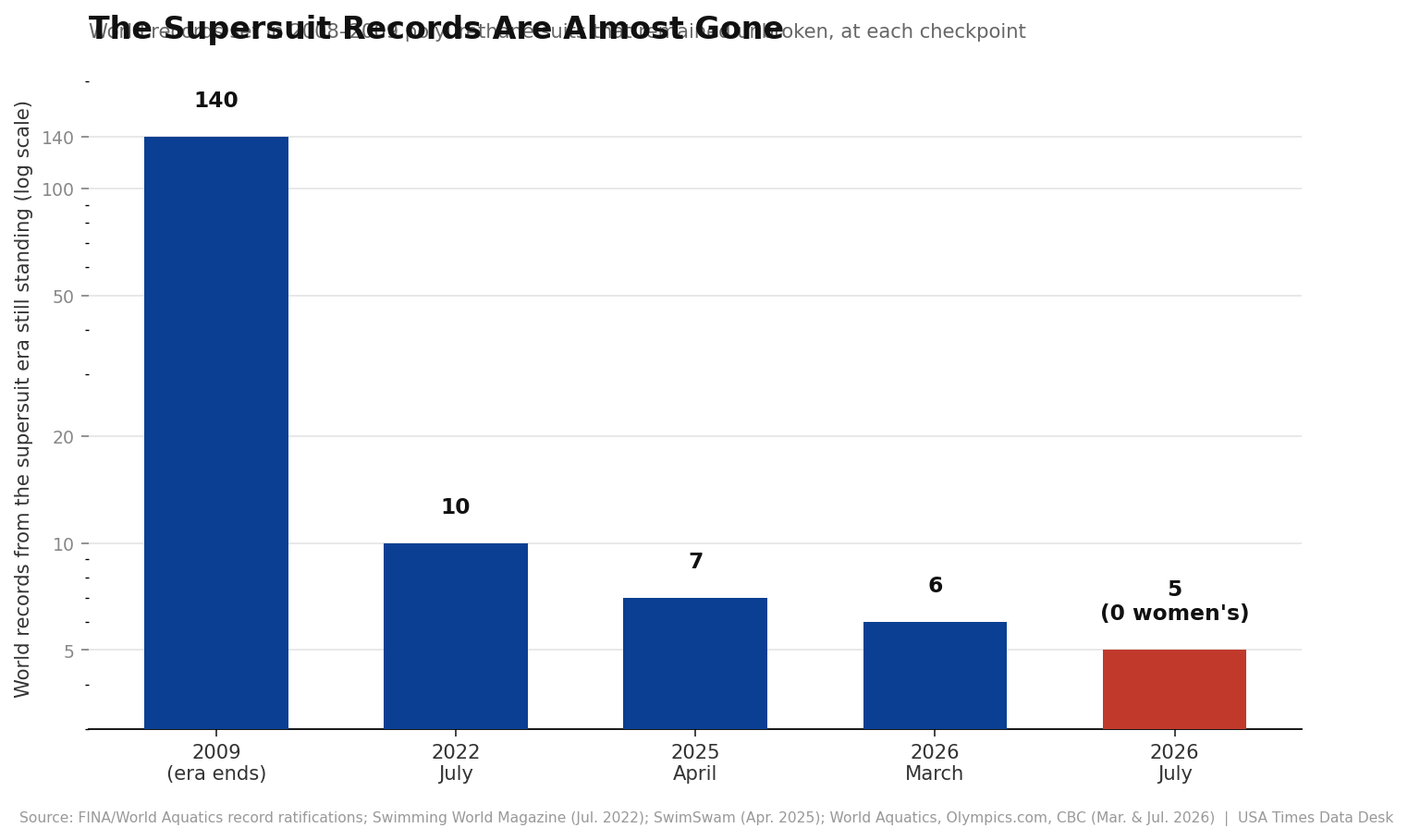
Supersuit-Era World Records Still Standing, 2009–2026
Log scale — bar height compresses the drop from 140 to 5. Hover any bar for what happened at that checkpoint.
Batmandir · The Circle Full access to theatres, museums & exhibitions. S2 · ongoing membership, without a Founder’s seat. Explore membership →A suit that changed what “fast” meant
The suit at the center of it all was Speedo’s LZR Racer, introduced in February 2008 and developed with input from NASA on drag reduction. Rival suits from Arena, Jaked, and others pushed the technology further over the following year, adding more panels, more compression, and more buoyancy, to the point where some swimmers described feeling like they were floating higher in the water than they could unassisted. The suits didn’t just shave tenths of a second off elite times — they compressed the gap between a good swimmer and a great one, which is part of why so many records fell in such a short window. A time that might have stood for a decade under normal conditions could get broken three or four times in a single season, by different swimmers, in different suits, at different meets. That instability is exactly what made FINA intervene: the organization’s own reasoning for the ban was that the suits had begun to function as “technological doping,” determining outcomes as much as athletic ability did.
The slow, uneven unwinding
Once the ban took effect, the supersuit-era marks became a kind of frozen leaderboard — times that everyone in the sport knew were inflated by technology, sitting at the top of the record books anyway, because inflated or not, they were still faster than anything a textile suit had produced. Swimmers spent years training specifically with those numbers as the target. Some fell relatively quickly. Others didn’t move for a decade or more. By July 2022, according to a count published by Swimming World Magazine, only ten of the original 140 long-course world records from the supersuit window were still standing — eight held by men, two by women: Federica Pellegrini’s 200m freestyle and Liu Zige’s 200m butterfly. Pellegrini’s mark fell the following year, when Ariarne Titmus broke it at the 2023 World Championships. By April 2025, SwimSwam’s own tracking had the count down to seven — six men’s records and just one woman’s, Liu Zige’s 200 fly, which the outlet’s own reporting described as “widely regarded as the toughest world record on the women’s side.” That same month, Germany’s Lukas Märtens took down Paul Biedermann’s 400m freestyle mark, one of the era’s most iconic — Biedermann had swum it at the 2009 Rome Worlds specifically to beat Michael Phelps in that final.
The last five months brought two of the biggest falls
Two of the remaining marks were among the most stubborn in the sport, and both fell within the last five months. On March 20, 2026, Australia’s Cameron McEvoy — already an Olympic and world champion in the event — broke Cesar Cielo’s 50m freestyle world record at the China Swimming Open in Shenzhen, swimming 20.88 to Cielo’s 20.91. Cielo had set that mark in July 2009, one month before the suits that produced it were banned; it had stood for just under 17 years, longer than any other individual world record in the sport. Then, on July 5, 2026, at the Canadian Swimming Trials in Montreal, 19-year-old Summer McIntosh broke Liu Zige’s 200m butterfly world record, swimming 2:01.65 to Liu’s 2:01.81 — a mark that had stood since October 2009. World Aquatics and multiple outlets covering the swim noted the same fact: it was, at that point, the oldest standing record in women’s swimming, supersuit-era or otherwise, and its fall meant the women’s side of the ledger was, for the first time since 2010, completely clear of supersuit times.
What’s left, and why it’s still standing
As of this month, five supersuit-era world records remain, and all five belong to men:
- Aaron Peirsol — 200m backstroke, 1:51.92, set at the 2009 World Championships in Rome
- Paul Biedermann — 200m freestyle, 1:42.00, also from Rome 2009 (his 400m freestyle mark from the same meet fell in April 2025)
- Zhang Lin — 800m freestyle, 7:32.12, Rome 2009
- United States — 4x100m freestyle relay, 3:08.24, set at the 2008 Beijing Olympics
- United States — 4x200m freestyle relay, 6:58.55, Rome 2009
Three of the five are individual records set at the same meet — the 2009 Rome World Championships, which alone accounted for 43 of the era’s 140 records and remains, by that measure, the single fastest meet relative to the surrounding era in swimming history. The two relay records are structurally harder to break than individual ones, since they require four swimmers to peak simultaneously at the same meet rather than one swimmer having a single exceptional race — which is a large part of why relay marks tend to be the last supersuit times standing in any stroke or distance category. None of the five remaining records have official challengers currently within half a second, based on the fastest textile-suit times swum in each event over the past two seasons, though Peirsol’s backstroke mark and Zhang Lin’s 800m freestyle mark are generally regarded within the sport as the two most likely to fall next, given how close recent textile-era swims have come.
What we did
We built a timeline of how many supersuit-era long-course world records remained unbroken at five checkpoints: the end of the suit era itself (140, the widely reported total number of world records set between February 2008 and the ban), July 2022 (10 remaining, per Swimming World Magazine’s own count published that month), April 2025 (7 remaining, cross-checked directly against SwimSwam’s April 27, 2025 tracking article and its specific list of which records were still standing), and two 2026 checkpoints tied to specific, individually verified record falls: March 20, 2026, when Cameron McEvoy broke Cesar Cielo’s 50m freestyle mark (confirmed against World Aquatics’ own report and Olympics.com), and July 5, 2026, when Summer McIntosh broke Liu Zige’s 200m butterfly mark (confirmed against World Aquatics, Olympics.com, and CBC Sports’ coverage of the Canadian Swimming Trials). We did not rely on any single outlet’s running tally for the current count — we verified each of the five remaining records individually against its original meet result and confirmed none had been broken as of publication.