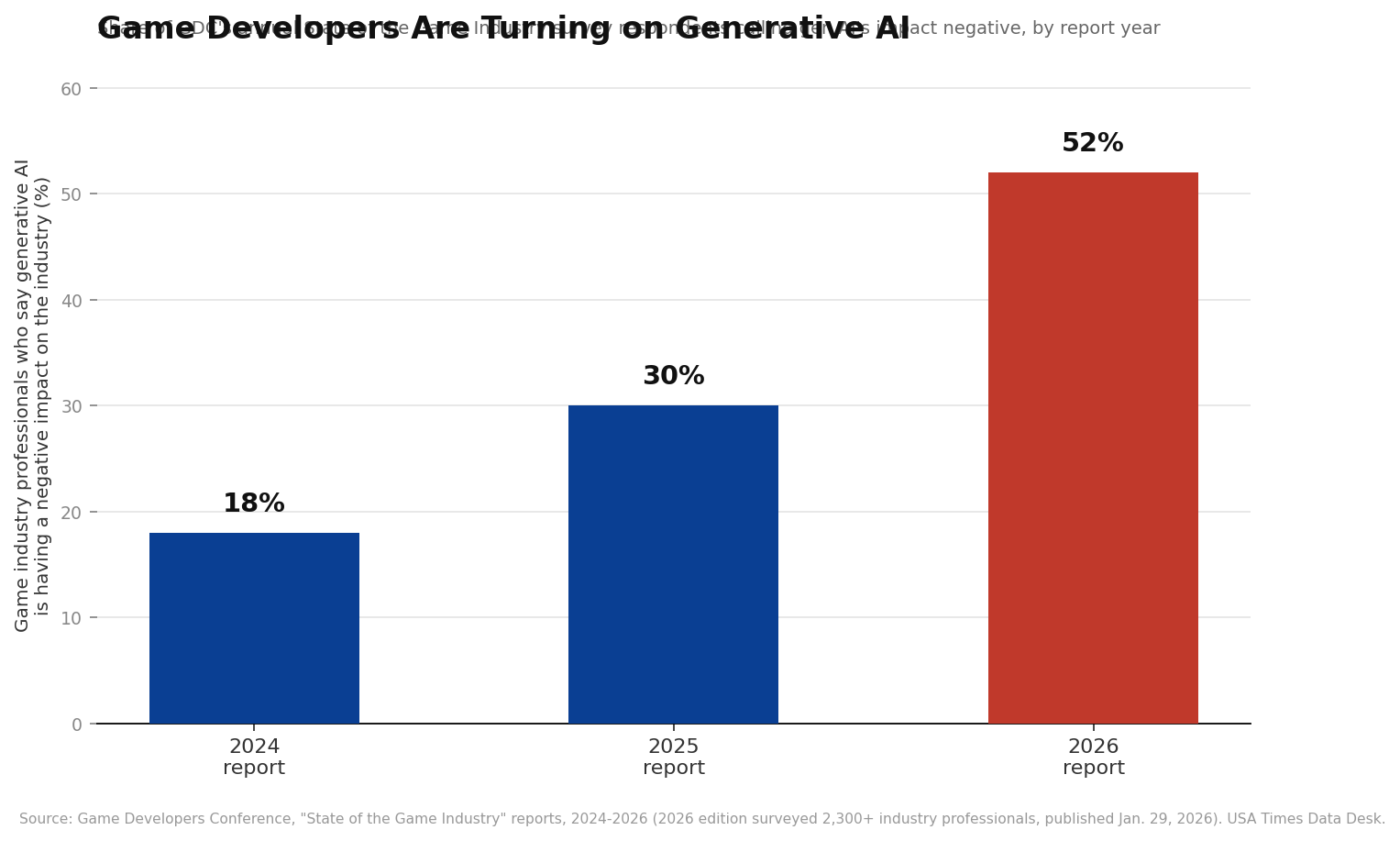
Every year, the Game Developers Conference surveys thousands of people who actually make video games and asks them, among other things, what they think generative AI is doing to their industry. The trend line in the answer has moved fast: 18% of respondents called AI’s impact negative in the 2024 report. That rose to 30% in 2025. In the 2026 report, published this January and based on responses from more than 2,300 industry professionals, it hit 52% — for the first time, a majority of the people surveyed say generative AI is bad for the industry they work in. Positive sentiment moved the opposite direction, from 13% a year ago to just 7% now.
Share of Game Industry Pros Calling Generative AI’s Impact “Negative”
GDC’s annual State of the Game Industry survey. Hover any bar for context.
Batmandir · Founders A numbered seat at the table. S3 · The Founders Club — 161 seats per location. By invitation. Explore membership →The sentiment shift lines up with layoffs, not just opinion
The same 2026 survey found that 28% of respondents had been laid off in the past two years — a figure that rises to 33% among people working in the United States specifically. Half of all respondents said their current or most recent employer had conducted layoffs within the past 12 months. The pattern wasn’t evenly distributed: two-thirds of people working at AAA studios reported layoffs at their companies, compared with one-third at indie studios. Independent layoff-tracking projects that log individual game-industry job cuts as they’re announced put the 2026 total at roughly 9,800 confirmed layoffs through late July, with full-year estimates trending toward 14,000 — which would make 2026 the second-worst year on record for the industry, behind only 2024.
Square Enix put a number on what AI is meant to replace
Most companies don’t publicly connect layoffs to AI adoption in specific, quantified terms. Square Enix did. The publisher behind Final Fantasy and Dragon Quest confirmed layoffs across its U.S. and European divisions the same period it disclosed plans to expand generative AI use in game development — and put a specific target on it: the company said it aims to have generative AI handle 70% of quality assurance and debugging work by the end of 2027. QA and debugging are entry-level-heavy roles in game development, which is part of why the GDC survey found particular pessimism among people trying to break into the industry: 74% of surveyed students said they’re concerned about their job prospects, citing not just fewer entry-level openings but competition from laid-off, more experienced workers and what they described directly as AI-led displacement.
Who’s actually using the tools, and for what
The negative sentiment doesn’t mean the tools have gone unused — usage and disapproval are rising together. Overall, 36% of surveyed game industry professionals said they use generative AI as part of their job. But that average hides a sharp role-based split: only 30% of people working directly at game studios use AI tools, versus 58% of people in publishing, support, and marketing and PR roles — an almost two-to-one gap between the people making games and the people selling and supporting them. Among the studio-side developers who do use AI tools, the most common tool by far is a general-purpose chatbot — 74% use ChatGPT specifically, ahead of Google Gemini (37%) and Microsoft Copilot (22%) — and the most common use case is research or brainstorming (81%), followed by routine writing tasks and code assistance (47% each) and prototyping (35%). Disapproval is highest among exactly the disciplines closest to the creative and technical craft of making a game: 64% of visual and technical artists hold an unfavorable view of generative AI’s industry impact, followed by 63% of designers and narrative professionals and 59% of programmers.
The same survey shows a hardware and engine shift underway
Buried in the same report is a separate, less contentious trend: what developers are actually building for and with. Unreal Engine is now the primary engine for 42% of surveyed developers, ahead of Unity at 30% — but that headline number splits sharply by studio size and age. Unreal dominates at bigger studios, used by 59% of developers at AA studios and 47% at AAA studios, while a majority (54%) of developers at older, more established indie studios are still primarily on Unity. Godot, the free open-source engine, has picked up meaningful traction specifically among newer indie developers (11%) in a way it hasn’t among established ones — a generational split inside the indie category itself, not just an indie-versus-AAA one. On hardware, Valve’s Steam Deck was added to the survey for the first time this year and immediately placed fourth among platforms developers are building or optimizing for, with 28% of developers already doing so and 40% expressing interest — enough to put it roughly on par with interest in the Nintendo Switch 2 (39%), a notable result for a single-vendor handheld competing against an entire console generation.
The unionization number moved too
The same conditions driving AI sentiment appear to be driving interest in collective bargaining. Among U.S.-based respondents, 82% said they support unionization of game industry workers, with just 5% opposed. Support was highest — 88% — specifically among people who had been laid off in the past two years, suggesting the two trends (AI anxiety and layoff exposure) are concentrated in overlapping groups of workers rather than running as separate, unrelated stories. About one in ten respondents said they already belong to an industry-wide union, including the United Videogame Workers-CWA, which launched at GDC in 2025 — a new enough organization that the current 10% membership figure likely understates where that number is headed, given that 62% of all respondents said they’re interested in joining a union.
What we did
The sentiment trend line — 18% negative in 2024, 30% in 2025, 52% in 2026 — comes directly from GDC’s own published recap of its “2026 State of the Game Industry” report, which itself explicitly cites the prior years’ figures for comparison; we did not back-calculate or estimate those historical figures ourselves. The 2026 report surveyed more than 2,300 game industry professionals, according to GDC’s own reporting on the release. The Square Enix AI-and-layoffs figures were cross-checked against coverage of the company’s own public statements about its generative AI QA/debugging target, rather than relying solely on a single secondary summary. For the cumulative 2026 layoff total, we used a specialized games-industry layoff tracker’s running count as of late July 2026 rather than a single point-in-time news estimate, since layoff totals in this industry are typically revised upward as more cuts are confirmed throughout the year — we treat that figure as directionally reliable rather than final, given the year wasn’t yet complete as of publication.