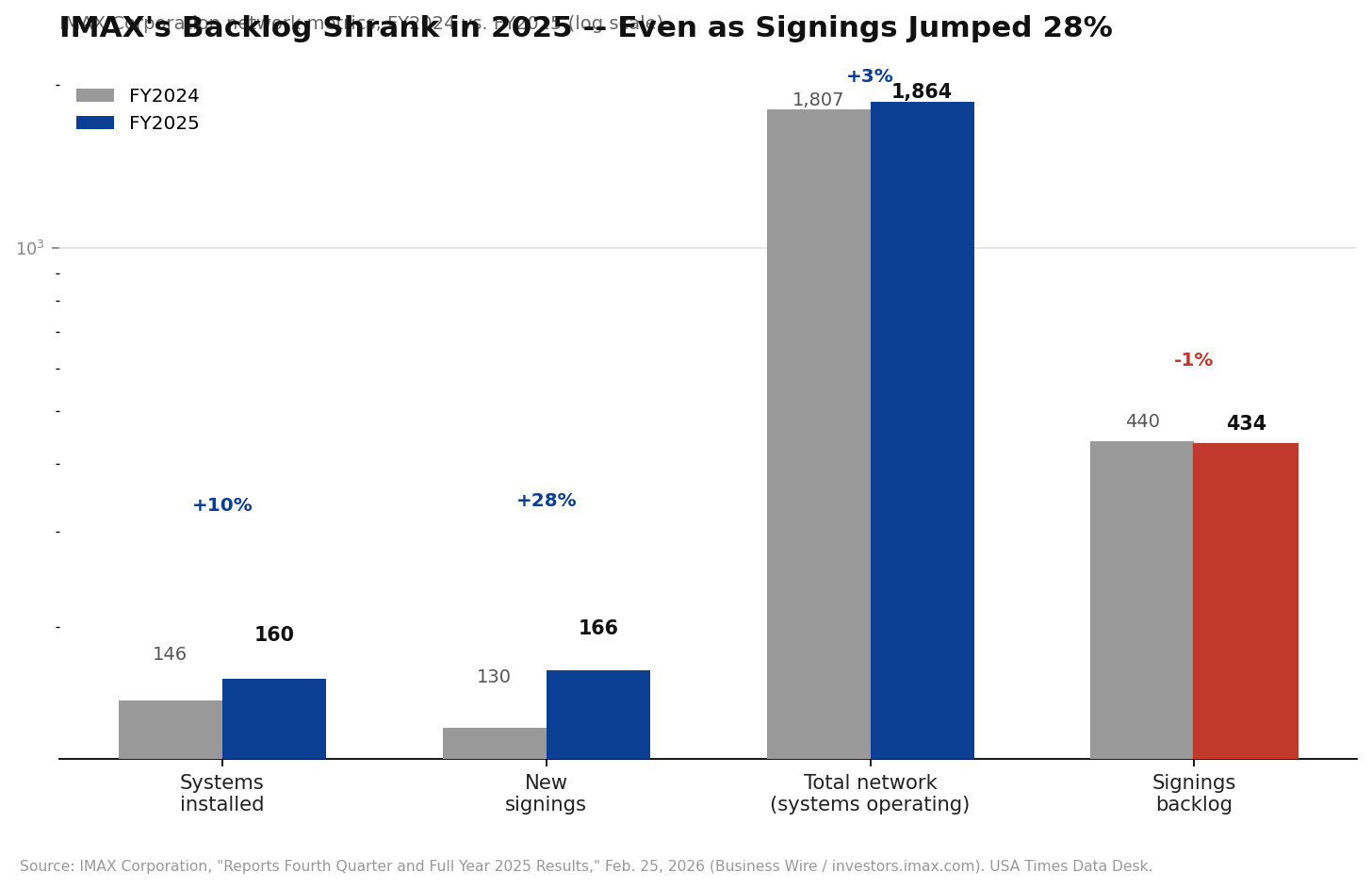
IMAX Corporation’s own year-end numbers describe a company running two races at once and winning both. In its fourth-quarter and full-year 2025 results, filed with the SEC and released February 25, 2026, IMAX reported signing 166 new theater systems for the year — up 28% from 130 in 2024. It also installed a record 160 systems, up from 146. Ordinarily, when a company signs deals faster than it can build them, its backlog of unbuilt commitments grows. IMAX’s did the opposite: total signings backlog fell slightly, from 440 systems at the end of 2024 to 434 at the end of 2025. The company isn’t behind on its pipeline. It’s clearing it faster than it’s being replenished, even while replenishing it at the fastest rate in years.
IMAX Network Metrics: 2024 vs. 2025
Bar length is proportional within each metric. Hover for exact figures.
Batmandir · Guest Passes Step inside for a day. Guest passes from $161/day — brought in by a member. See guest passes →The math behind a shrinking backlog during a growth year
Backlog is a running balance: it grows when a theater chain signs a new contract and shrinks when that contract converts into an actual, operating IMAX screen. For a backlog to fall even as signings rise, installations have to be outpacing new signings by an even wider margin — which is exactly what happened. IMAX installed 160 systems against 166 new signings, a gap of just 6. But some of 2025’s installations were converting contracts signed in prior years, not 2025 signings themselves, which is why the net backlog figure can fall even when the year’s signings-to-installs ratio looks close to even. The practical read: IMAX’s 434-system backlog, spread across 91 countries, now represents roughly 2.7 years of construction at the current installation pace — down from a longer runway in prior years, meaning the company is converting its pipeline into open theaters faster than at almost any point in its recent history.
The network keeps getting bigger regardless
None of this means IMAX’s footprint shrank — the opposite. The company ended 2025 with 1,864 total systems operating worldwide, up from 1,807 a year earlier: 1,796 commercial multiplexes, 10 commercial destinations, and 58 institutional locations (museums, science centers, and similar venues). Of the 160 systems installed in 2025, 98 went into brand-new locations rather than upgrades or replacements of existing IMAX screens, up from 77 new-location installs in 2024. IMAX’s own boilerplate description of its scale — “in 91 countries and territories” — has been broadly stable for years, meaning 2025’s growth was substantially about theater chains and venues in already-IMAX markets adding more screens, not the company entering large numbers of brand-new countries.
Why the company says it can keep this up
CEO Rich Gelfond’s framing in the release ties the installation pace directly to box office performance: IMAX reported $1.28 billion in global box office for 2025, its highest-grossing year ever, up 40% year-over-year, and a record 3.8% share of total global box office — a 70-basis-point increase from 2024. The company’s stated logic is that stronger per-screen box office performance justifies theater chains signing for more IMAX installations, which is what produced the 28% signings jump. Gelfond’s own quote sets an explicit target for how much further this could run: “we’ve increased our total addressable market to nearly 4,500 zones worldwide — double our current combined number of systems in operation and backlog.” Named markets for near-term expansion in the release include Japan, Australia, Germany, and France, which the company describes as “underpenetrated, high-PSA” markets — PSA meaning per-screen average box office, the metric IMAX uses internally to judge which markets can support additional systems.
2026 guidance keeps both numbers climbing
IMAX’s guidance for 2026 calls for 160 to 175 system installations — a range that either matches or modestly exceeds 2025’s record pace — alongside a projected $1.4 billion in global box office and an adjusted EBITDA margin above 45%. The company’s stated 2026 theatrical slate leans heavily on “Filmed For IMAX” titles, including Christopher Nolan’s “The Odyssey” (described in the release as “the first theatrical feature shot entirely with IMAX film cameras”), Denis Villeneuve’s “Dune: Part Three,” Jon Favreau’s “The Mandalorian and Grogu,” and Greta Gerwig’s “Narnia.” Local-language content — films produced and marketed specifically for individual international markets rather than Hollywood exports — also set a record in 2025, with $405 million in local-language box office, up 66% from the prior full-year record, driven partly by the Chinese animated title “Ne Zha 2” and the Japanese anime release “Demon Slayer: Infinity Castle.”
The financial picture behind the expansion
The installation and backlog numbers sit on top of a broader financial turnaround IMAX reported for 2025. Total company revenue reached $410.2 million, up 16% from $352.2 million in 2024 — split between $151.3 million in Content Solutions revenue (up 21%, covering film remastering, documentaries, and live/interactive events) and $251.3 million in Technology Products and Services revenue (up 16%, covering system sales and the joint-revenue-sharing arrangements that make up most of the installed base). Net income rose 39% to $45.5 million, and adjusted EBITDA rose 33% to $184.9 million, a 45.1% margin the release calls a company record. Free cash flow more than doubled, from $29.6 million in 2024 to $85.2 million in 2025. Those figures matter directly to the installation story: a much stronger balance sheet and box office performance is the justification management gives for both accelerating installations and setting a higher 2026 installation target (160-175 systems) than the pace that already set a record in 2025.
What we did
Every figure in this article is drawn directly from IMAX Corporation’s own February 25, 2026 press release, “IMAX Corporation Reports Fourth Quarter and Full Year 2025 Results,” distributed via Business Wire and posted to the company’s investor relations site — we read the release in full, including every financial and systems-network table, rather than a summary. The systems-installed, signings, backlog, and total-network figures are IMAX’s own reported totals, not figures we calculated ourselves. Two figures we sought but could not find in this release, and are flagging as a limitation rather than estimating: a breakdown of the installed base or backlog by laser versus traditional xenon-bulb projection technology, and a country-by-country or region-by-region (e.g., China vs. North America) breakdown of signings, installs, and backlog. IMAX discloses network figures by contract type (sales arrangements, hybrid and traditional joint-revenue-sharing agreements) and by venue type, but not by geography beyond the single 91-countries topline figure and named markets called out in management commentary. A reader wanting a China-specific installation count would need to consult IMAX’s 10-K, its investor presentation, or the separate Hong Kong-listed filings of IMAX China Holding (SEHK: 1970), a subsidiary that operates and reports separately from the parent company’s consolidated release. One figure in this piece is our own calculation rather than a stated IMAX figure: the “roughly 2.7 years of construction at the current pace” estimate is simply backlog divided by the year’s installation total (434÷160 for 2025, versus 440÷146=3.0 for 2024) — a simplified run-rate, not a projection IMAX itself makes, and it doesn’t account for signings continuing to add to the backlog throughout 2026.
Related from the USA Times Data Desk
- Do Star Movies Play in IMAX? A Live Count of the Last 20 Years
- The National Average Movie Ticket Is $10.75. IMAX Routinely Charges Double That in New York and LA.
- Britain’s Biggest Screen Is Selling Out Back to Front: We Checked All 159 Shows — and Every Seat Map — for ‘The Odyssey’
- The IMAX Passport: 55 of the Last 58 Box-Office Geuses Opened on the Giant Screen (2006–2026)
- Box-office coverage index · the Star Index methodology