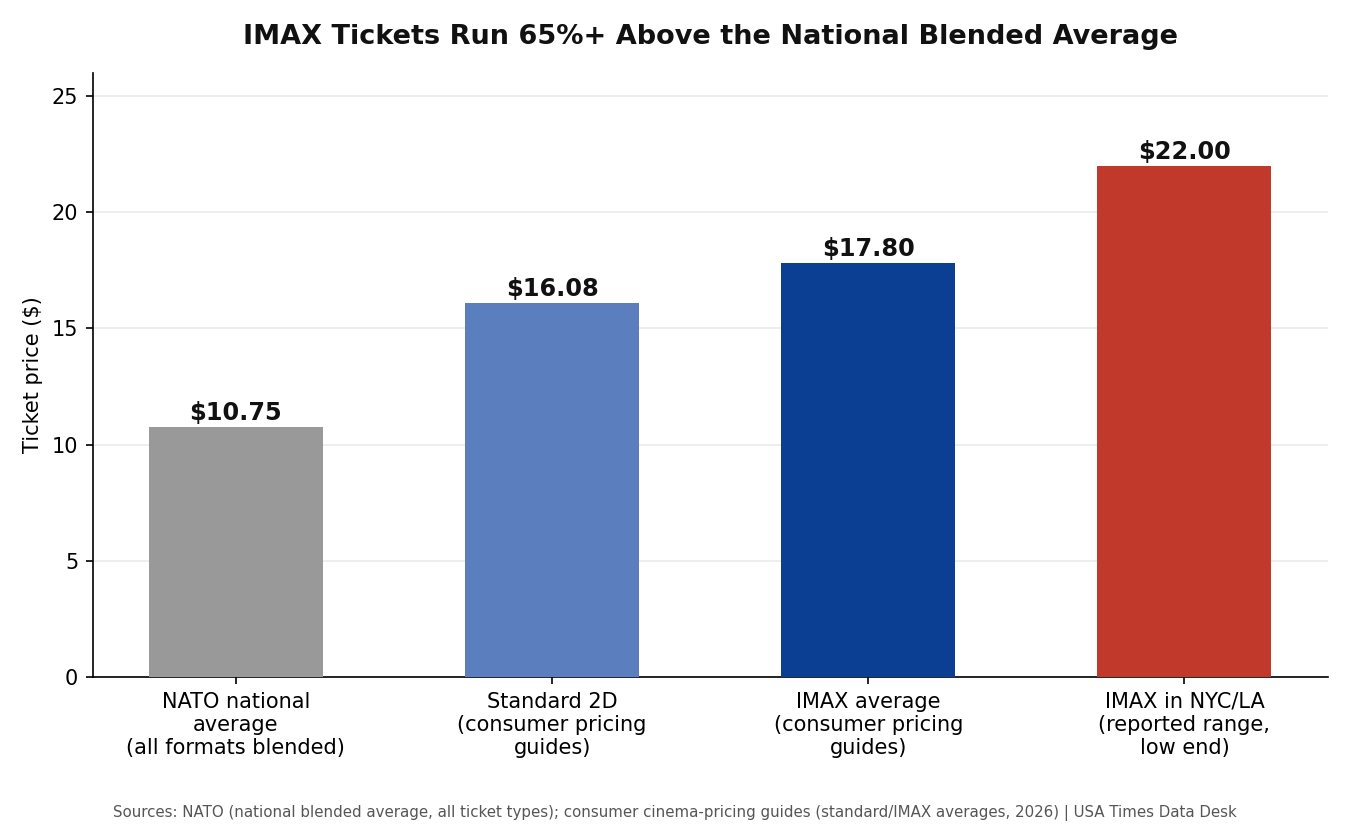
The National Association of Theatre Owners’ most recent blended national average for a U.S. movie ticket — across every format, discount tier, and market, from matinee showings to opening-night premieres — works out to roughly $10.75. IMAX tickets don’t come close to that number. Consumer cinema-pricing trackers put the average IMAX ticket at around $17.80 nationally, and in high-cost markets like New York City and Los Angeles, IMAX pricing routinely clears $22. That’s not a small premium — it’s IMAX tickets running 65% to more than double the blended national average, depending on the market.
There’s no single “IMAX price” — chains set it themselves
Unlike a studio setting a movie’s rental terms, IMAX Corporation does not itself set the retail ticket price moviegoers pay. That’s determined by each exhibitor — AMC, Regal, Cinemark, and independent operators — and it shows in the data: reported IMAX surcharges over a base ticket price range from as little as $1.50 to as much as $6, depending on the chain, the market, and whether the customer is using a subscription or loyalty program. Two theaters in different cities can charge meaningfully different amounts for functionally the same movie on the same release date, simply because their base ticket price and surcharge policy differ.
The premium doesn’t tell you which IMAX you’re getting
Here’s the part that should bother price-conscious moviegoers more than it seems to: paying the IMAX surcharge doesn’t tell you which IMAX projection system you’re actually watching. USA Times’ Data Desk recently broke down IMAX’s seven projection tiers, from 2008-era xenon digital (still the most common system in IMAX’s commercial network) up to true 15/70 film and GT Laser, the flagship dual-laser 1.43:1 system. A ticket buyer paying a $6 IMAX surcharge at one theater could be getting the full GT Laser experience; a buyer paying the same surcharge across town could be watching on hardware that’s closer to two decades old. Chains generally don’t price-differentiate by projection tier the way, say, airlines price-differentiate seat classes — the surcharge is for the “IMAX” brand generally, not for a specific, disclosed hardware configuration.
Batmandir · The Circle Full access to theatres, museums & exhibitions. S2 · ongoing membership, without a Founder’s seat. Explore membership →Why big-city IMAX pricing runs so much higher
The geographic gap — IMAX pricing routinely exceeding $22 in New York and Los Angeles versus a roughly $17.80 national IMAX average — tracks with two things layering on top of each other. First, base movie ticket prices in high-cost, high-rent metro markets are already elevated well above the national blended average, before any premium format surcharge is added. Second, GT Laser and true 15/70 film installations — the highest tiers of the format — are disproportionately concentrated in major metros with the population density and moviegoing demand to support giant-format screens, meaning big-city audiences are more likely to be paying for (and getting) the top of IMAX’s technology stack rather than its base xenon tier.
Why the premium exists: IMAX is a landlord, not just a technology vendor
IMAX Corporation’s own business model helps explain why the premium persists industry-wide rather than getting competed away. A meaningful share of IMAX’s theater network operates under joint revenue-sharing arrangements, where IMAX installs and maintains the projection system in exchange for a cut of box office revenue from that specific auditorium, rather than a flat equipment sale. IMAX’s own second-quarter 2026 results show the company installed 38 new systems in the quarter — the highest Q2 total in a decade — with 18 of those installs under sales arrangements and the remainder under other contract structures that typically include revenue-sharing terms. Under that model, IMAX has a direct financial stake in ticket prices staying elevated, not just in ticket volume — a structurally different incentive than a theater simply buying a projector outright.
That dynamic also helps explain why chains rarely discount IMAX showtimes the way they discount standard screenings on promotional days: doing so cuts into a revenue stream that’s shared with IMAX itself, not one the exhibitor fully controls. For consumers, the practical upshot is a format premium that behaves less like ordinary market competition and more like a fixed toll — one that’s grown large enough that, in expensive markets, a single IMAX ticket can now cost roughly what two standard tickets did just a few years ago at the national blended average.
The national average has barely moved. IMAX pricing hasn’t been so restrained.
NATO’s blended national average ticket price has climbed slowly and steadily over the past several years: from $9.16 in 2019, to $10.53 in 2022, to roughly $10.75 most recently — an increase of about 17% over that stretch, in a period that included a pandemic-driven collapse in theatrical attendance and a since-partial recovery. Premium formats like IMAX haven’t shown anywhere near that restraint. Even taking the lower end of publicly reported IMAX pricing estimates, the gap between “average movie ticket” and “average IMAX ticket” has widened into a $7-plus spread nationally, and considerably more in major metros — meaning the premium-format surcharge has been doing far more of the industry’s overall price growth than the base ticket price has.
That pattern lines up with where the theatrical industry has been placing its bets since streaming reshaped home viewing habits: rather than compete on the price of an ordinary ticket, chains and format providers like IMAX have leaned into premium, differentiated experiences — bigger screens, better sound, laser projection — as the place where they can still charge meaningfully more without losing the audience entirely. Whether that strategy holds up depends heavily on whether moviegoers can tell the difference between what they’re being charged for and what they’re actually getting, which circles back to the tier-transparency problem: an undifferentiated “IMAX” surcharge applied to hardware that spans nearly two decades of technology.
What we did
The $10.75 national blended average ticket price, along with the $9.16 (2019) and $10.53 (2022) historical figures, comes from the National Association of Theatre Owners’ reported data, as cited in trade and consumer press coverage of NATO’s statistics; we were not able to access NATO’s own report directly, so these figures are sourced secondhand through that coverage rather than from NATO’s original release. The $16.08 standard-ticket and $17.80 IMAX-average figures, the $1.50-to-$6 surcharge range, and the New York/Los Angeles pricing figures come from consumer-facing cinema-pricing guide sites that aggregate chain-published pricing; these are not government or NATO statistics and should be read as illustrative market snapshots rather than an official industry index — pricing guide methodologies vary and none of these sites publish their full underlying data collection process. The 38-system installation figure, the 18-sales-arrangement breakdown, and the description of joint revenue-sharing arrangements come directly from IMAX Corporation’s second-quarter 2026 earnings release. The claim that GT Laser and 70mm film installations concentrate in major metro markets is a reasonable inference from USA Times’ own prior mapping of true 1.43:1 theatre locations, not a statistic IMAX itself has published.
Related from the USA Times Data Desk
- The 1% of Screens That Now Rule the Box Office: How IMAX Won the Post-Streaming Era
- IMAX at Home: Every Film That Opens Up to the Expanded Frame — and Why It’s Never the Real 1.43
- The 630-Pound Movie: The Absurd Logistics of Showing ‘The Odyssey’ in 70mm IMAX
- 39 Films in 1.43
- Box-office coverage index · the Star Index methodology