Christopher Nolan wanted audiences to see The Odyssey the way he shot it: on real 70mm film, projected onto a screen the size of a building, in the tall 1.43:1 frame that is the purest form of IMAX. What he did not fully advertise is that granting that wish required one of the strangest logistical operations in the modern history of moviegoing — a supply chain involving forklifts, hand-splicing, salvaged half-century-old machinery, and a print heavy enough to injure someone.
A movie that weighs as much as a motorcycle
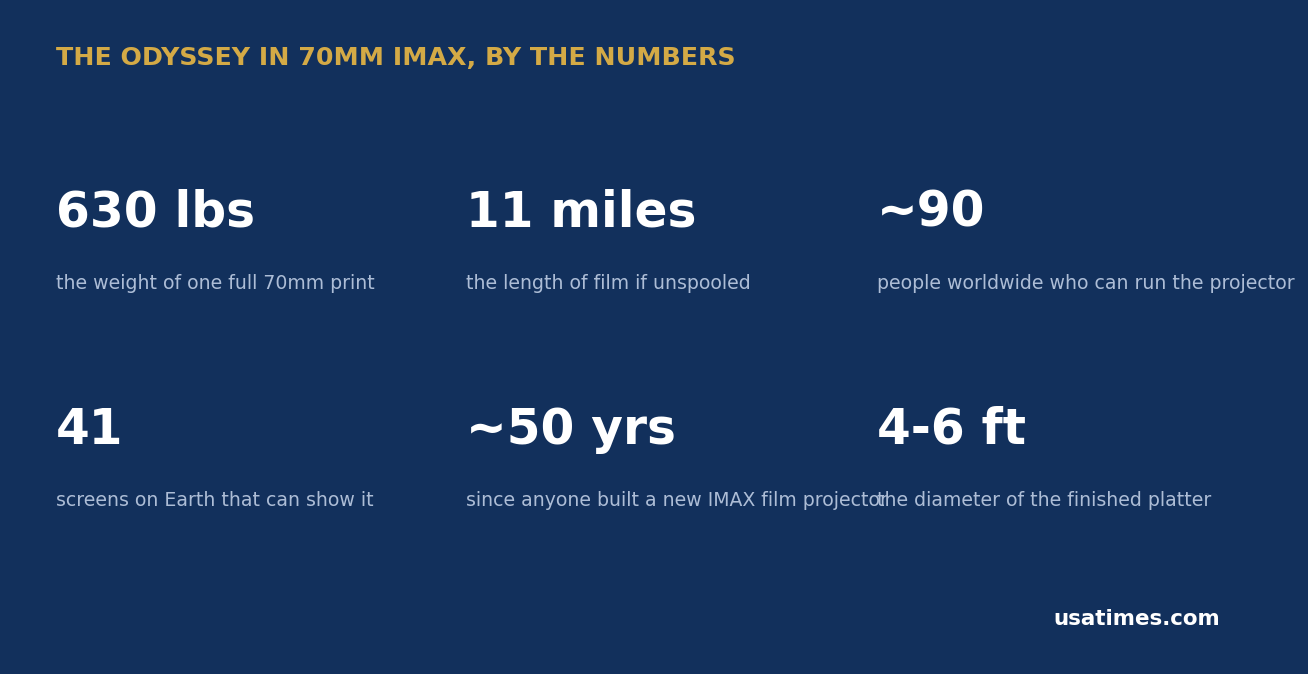
A single full print of The Odyssey in IMAX 70mm weighs roughly 630 pounds and, if you unspooled it, would stretch about eleven miles. This is not a metaphor. The film arrives at theaters in multiple canisters that must be hand-spliced together over several hours into one continuous reel, wound onto a platter four to six feet across — so heavy and so large that moving it requires a special forklift. Nolan told Jimmy Fallon that when the print crossed into Scotland, customs agents opened every canister to inspect it, presumably baffled by 630 pounds of what looked like industrial cable.
The tall 1.43:1 IMAX frame is the reason for the bulk. It captures more vertical image than any other format — roughly the resolution equivalent of 18K — and that fidelity has a physical cost measured in celluloid. Every minute of screen time is a staggering quantity of the widest film stock in commercial use. The image that makes you feel like you could step into the screen is, backstage, a half-ton of plastic that a projectionist has to physically wrangle.
Batmandir · Founders A numbered seat at the table. S3 · The Founders Club — 161 seats per location. By invitation. Explore membership →The machines nobody makes anymore
The deeper problem is that the projectors themselves are effectively antiques. IMAX CEO Richard Gelfond has been blunt about it: nobody has manufactured a new 70mm IMAX film projector in roughly half a century. To mount The Odyssey’s release, IMAX had to hunt down broken, abandoned, and forgotten projectors, salvage parts, and retrofit or rebuild the machines by hand — some components so obscure that no manufacturer on Earth still makes them. It is film exhibition as archaeology.
And the machines are useless without people who can run them. By most estimates, only around ninety people in the world know how to operate a 70mm IMAX film projector. Ahead of the release, IMAX ran a training campaign — sending technicians to theaters, drilling staff on test reels, effectively re-teaching a dying craft in a few months. Threading eleven miles of irreplaceable film through a rebuilt projector, with no margin for a mistake that could tear or scratch a one-of-a-kind print, is not a job you learn from a manual.
Why only 41 screens
Add it all up — the weight, the rebuilt projectors, the tiny pool of trained operators, the sheer space needed to store and thread the platter — and you arrive at the number that has frustrated fans all year: only about 41 screens on the entire planet, roughly 25 of them in the United States, can show The Odyssey the way Nolan intended. Not 41 IMAX screens; 41 that can physically run this print. Tickets sold out weeks and, in some cities, a full year in advance; the run was extended repeatedly as demand refused to cool.
There is a lovely paradox in all of this. In an era when any film can be streamed to a phone in seconds, the most sought-after movie experience of 2026 is one that is deliberately, almost absurdly, hard to deliver — a half-ton of film, a forklift, a salvaged projector, and one of ninety people on Earth qualified to press play. The scarcity is not a bug. It is the whole point. The 1.43:1 IMAX frame remains the closest thing cinema has to a place you can only go in person, and The Odyssey is the proof that audiences will still travel, wait, and pay for the privilege of going there.
The larger fight over film versus digital
The extraordinary effort behind The Odyssey’s 70mm run is the latest skirmish in a decades-long argument about whether photochemical film has any future in an all-digital age. For a small but influential group of filmmakers, real film is not nostalgia but a superior medium — capturing a depth, resolution, and organic texture that digital sensors, for all their convenience, still cannot fully replicate. That conviction is why a handful of directors continue to insist on shooting and projecting on film despite the staggering cost and difficulty, and why studios indulge them: the results, on the right screen, remain visibly different from anything digital projection can produce.
But the logistics laid bare by this release also expose how fragile that future is. When only a few dozen screens on Earth can show a film as shot, when the projectors are half-century-old machines held together by salvaged parts, and when the number of people who can run them is measured in dozens, the entire enterprise hangs by a thread. Each major film-format release is, in effect, a rescue mission for a dying craft — and its success depends on a chain of specialized labor and irreplaceable equipment that grows more precarious every year. The 70mm run is a triumph, but it is also a warning about how close the format sits to extinction.
Why audiences keep showing up
The most telling detail in the whole saga is the demand. Tickets sold out weeks, and in some cities a full year, in advance; the run was extended again and again as screenings vanished within minutes of going on sale. In an era when nearly any film can be summoned instantly to a phone, audiences were willing to travel across states, plan months ahead, and pay premium prices for the specific, irreproducible experience of a giant film image on a giant screen. That hunger is the strongest possible argument for keeping the format alive — proof that scarcity and spectacle, far from being obsolete, remain among the few things that can still make moviegoing feel like an event worth leaving the house for.
Related from the USA Times Data Desk
- IMAX at Home: Every Film That Opens Up to the Expanded Frame — and Why It’s Never the Real 1.43
- IMAX Just Had Its Best Q2 Installation Quarter in a Decade. Its Backlog Grew Anyway.
- Do Star Movies Play in IMAX? A Live Count of the Last 20 Years
- Every True IMAX 1.43:1 Theatre in the World
- Box-office coverage index · the Star Index methodology
Sources
- Box Office Mojo — Weekend Domestic Box Office
- IMAX — format & venue background (Wikipedia)
- USA Times — Star Index methodology & data sources