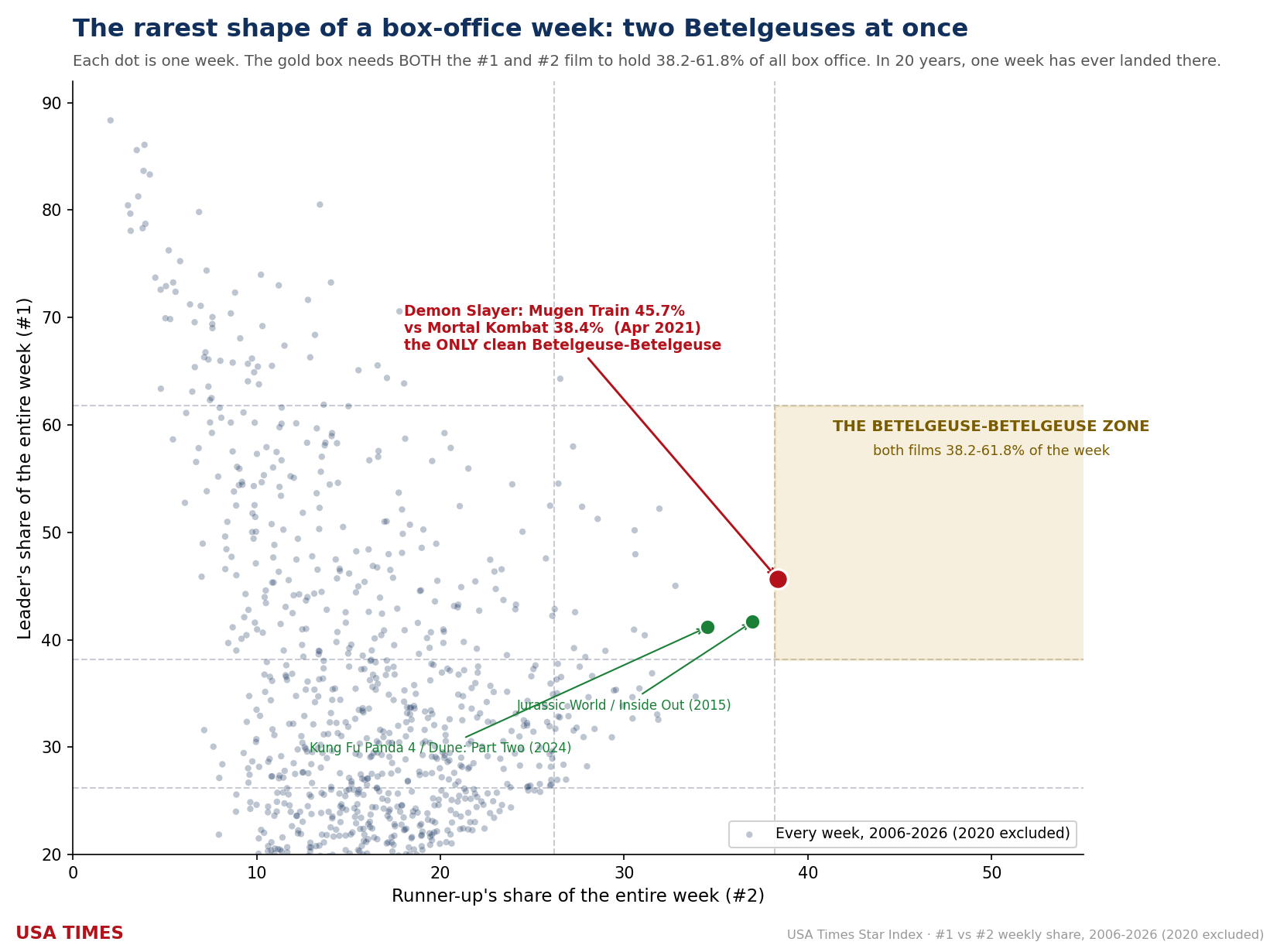
There is a shape a box-office week can take that is so rare it has occurred exactly once in twenty years of American moviegoing. Two films, released within days of each other, each so large that each one alone swallows between 38.2% and 61.8% of every dollar spent at the domestic box office that week — two titans splitting a single week almost down the middle, with everything else in theaters fighting over the scraps. In the USA Times Star Index we call each of those films a Betelgeuse, and a week that produces two of them at once is a Betelgeuse-Betelgeuse. It is the white whale of box-office shapes.
USA Times editor-in-chief Achir Kalra has a call for the next great collision — and it is not a second double. On December 18, 2026, Dune: Part Three and Avengers: Doomsday open head to head, a clash fans already call “Dunesday,” and it is the best Betelgeuse-Betelgeuse candidate the calendar has offered in years. His prediction anyway: it won’t be one. He puts it at 61.8% Geuse-Minigeuse — one giant, almost certainly Doomsday, running past 61.8% and taking the week outright while Dune settles for a strong Mini-geuse second — and 38.2% Betelgeuse-Minigeuse, the two closer together but still with a clear leader. A true Betelgeuse-Betelgeuse, he says, is the long shot.
What a Betelgeuse is, and why two of them is nearly impossible
The Star Index measures the #1 film each week not by its own gross but by how much of the entire week’s domestic box office it commands. A film that takes 26.18% to 38.2% of the whole week is a Mini-geuse. From 38.2% up to 61.8%, it is a Betelgeuse — the muscular middle tier, a film that is not merely leading but genuinely dominating without quite erasing the field. Above 61.8%, a film becomes a Geuse, effectively the whole market. The cutoffs are the golden ratio; the names are ours.
Batmandir · Guest Passes Step inside for a day. Guest passes from $161/day — brought in by a member. See guest passes →Now do the arithmetic on a Betelgeuse-Betelgeuse. Two Betelgeuses require, at minimum, 38.2% + 38.2% = 76.4% of the entire week between just two films. That leaves under 24% of all box office to be divided among every other title in every other theater in the country — the third-place film, the holdovers, the platform releases, all of it. For that to happen, two big movies have to open into the same few days at almost exactly the same altitude, and the rest of the calendar has to be nearly barren. Most weeks cannot do it because one film pulls ahead and becomes the lone story; the other big title slips under 38.2% and the week resolves into a single Betelgeuse over a smaller runner-up, not two Betelgeuses. The balance required is knife-edge.
It is the same math that makes our companion rule — you can never have four star movies in a week — hold. You cannot fit two Geuses in a week (2 × 61.8% = 123.6%, over budget). You cannot fit three Betelgeuses (114.6%). The ceiling is exactly two Betelgeuses, and even that ceiling has been touched only one time.
The one time it happened: Demon Slayer vs. Mortal Kombat, April 2021
The week of April 23–29, 2021, two very different films arrived into a theatrical market still climbing out of the pandemic. Demon Slayer: Kimetsu no Yaiba — The Movie: Mugen Train, the record-shattering Japanese anime, opened to $27.7 million and took 45.7% of the entire week. Day-and-date against it, Warner Bros. released Mortal Kombat, the video-game reboot — simultaneously in theaters and on HBO Max — which still managed $23.3 million in cinemas, or 38.4% of the week. Two films, 45.7% and 38.4%, both squarely inside the Betelgeuse band. Between them they owned 84% of the American box office; the entire rest of the market shared the remaining 16%.
It is a fittingly strange entry for a category this rare: not two superhero tentpoles, but an anime phenomenon and a fighting-game adaptation, colliding in a half-empty spring when the usual blockbusters were still sitting on the shelf. The scarcity of competition is exactly what let both clear the bar at once — and it is the last time the American box office produced the shape at all.
Why 2020 doesn’t count
A purist reading the raw weekly numbers would find three other apparent Betelgeuse-Betelgeuse weeks — all of them in the spring and early summer of 2020. They are mirages. During the shutdown, with the major chains closed and the tentpoles postponed, tiny films could momentarily post enormous shares of a box office that had collapsed to almost nothing. The titles involved — Strike, Resistance, Swallow, The Wretched, Becky — never cleared even $26 million in their entire theatrical runs. A 49% share of a dead week is not domination; it is an artifact of an empty building.
For that reason the USA Times Star Index screens 2020 out of its analysis entirely, and applies a lifetime-gross floor so that pandemic micro-releases can never masquerade as event films. Strip the noise away and the record is clean: one Betelgeuse-Betelgeuse week in twenty years.
The near-misses
Twice the box office came within a whisker. In June 2015, Jurassic World (41.7%) held off a surging Inside Out (37.0%) — the runner-up finishing barely a point under the Betelgeuse line. In March 2024, Kung Fu Panda 4 (41.2%) led Dune: Part Two (34.5%) in a genuine two-horse week that still fell short of a true double. Both are the shape trying to form and not quite setting. They are also a reminder of how specific the conditions have to be: you need two films big enough, close enough, and a calendar quiet enough all at the same time.
What happens when two titans actually clash
History is unkind to the fantasy of a perfectly split week. Across the sixteen genuine two-horse weeks of the last two decades — weeks where the runner-up alone took at least 30% of all box office — the outcome almost always broke one of two ways. Eight resolved into a Betelgeuse over a Mini-geuse: one film pulled clearly ahead, the other took a solid but unmistakable second. Seven fragmented into two Mini-geuses, both respectable, neither dominant. Only one — Demon Slayer against Mortal Kombat — produced a true Betelgeuse-Betelgeuse. Even among real clashes, the double is a one-in-sixteen event.
The cautionary tale is Barbenheimer. It was the ideal setup — two enormous films, two entirely different audiences, opening the same Friday — and it still crowned a winner. Barbie took 52.5% of its week (a clean Betelgeuse) while Oppenheimer managed 26.0%, a hair under the 26.18% line that would have made it even a Mini-geuse. The most celebrated collision in modern box-office history was, by the numbers, one giant and a runner-up. When two titans meet, one almost always eats the other.
The record, and the prediction
| Week | #1 film (share) | #2 film (share) | Shape |
|---|---|---|---|
| Apr 23–29, 2021 | Demon Slayer: Mugen Train (45.7%) | Mortal Kombat (38.4%) | Betelgeuse-Betelgeuse |
| Jun 19–25, 2015 | Jurassic World (41.7%) | Inside Out (37.0%) | Betelgeuse-Minigeuse (near-miss) |
| Mar 8–14, 2024 | Kung Fu Panda 4 (41.2%) | Dune: Part Two (34.5%) | Betelgeuse-Minigeuse (near-miss) |
| Jul 21–27, 2023 | Barbie (52.5%) | Oppenheimer (26.0%) | Betelgeuse, alone (Oppenheimer under the line) |
| Dec 18, 2026 | Avengers: Doomsday (?) | Dune: Part Three (?) | Predicted: 61.8% Geuse-Minigeuse, 38.2% Betelgeuse-Minigeuse |
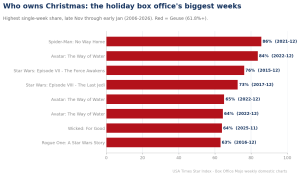
So why not a second double? Because Avengers: Doomsday is not just big — it is Marvel-finale big, and Marvel finales run to Geuse scale. Avengers: Endgame took roughly 88% of its opening week; Infinity War was a Geuse too. A film with that kind of ceiling is far more likely to blow past 61.8% and own the week outright than to politely hold station in the Betelgeuse band. If it does, Dune: Part Three — itself a genuine tentpole, and helped by a thin mid-December calendar — is the natural strong second, landing in the 26.18–38.2% Mini-geuse range. That is the 61.8% case: a Geuse-Minigeuse.
The 38.2% case is that Dune is big enough, and its audience distinct enough, to cap Doomsday below the 61.8% line — keeping the leader in the Betelgeuse band while Dune stays a Mini-geuse. That is a Betelgeuse-Minigeuse, the same near-miss shape as Jurassic World / Inside Out. For it to become a true Betelgeuse-Betelgeuse, both films would have to land inside 38.2–61.8% at once — Doomsday held down and Dune pushed up, with the rest of the calendar nearly empty. It has happened exactly once in twenty years. The smart money says Dunesday crowns a winner; the fun money says it doesn’t.
One last flourish, because the numbers insisted: that 61.8 / 38.2 split is itself the golden ratio — the same 0.618 that draws every line in this index, now setting the odds on its own prediction. A ratio inside the ratio inside the ratio. We couldn’t resist.
Method: shares are each film’s gross as a percentage of the entire week’s domestic box office, from Box Office Mojo weekly charts, 2006–2026, with 2020 excluded as a pandemic anomaly. Statuses by peak weekly share: Mini-geuse 26.18–38.2%, Betelgeuse 38.2–61.8%, Geuse 61.8%+. Prediction and probabilities are editorial.
Related from the USA Times Data Desk
- The 10 Most Dominant Weeks in 20 Years of American Moviegoing
- Box Office Tracker: "Minions & Monsters" Holds No. 1, "Michael" Quietly Crosses $371M
- The 38.2% Club: The ‘Betelgeuses’ That Run the Box Office
- The Billion-Dollar Club, Ranked: Every Star Movie That Crossed the Line
- Box-office coverage index · the Star Index methodology
Sources
- Box Office Mojo — Weekend Domestic Box Office
- Box Office Mojo — Yearly Domestic Box Office
- The Numbers — Weekly Box Office Chart
- USA Times — Star Index methodology & data sources