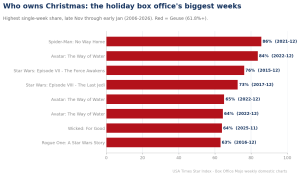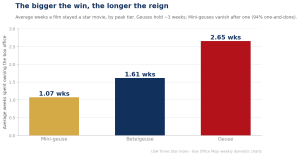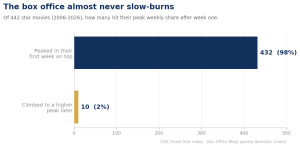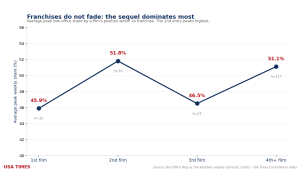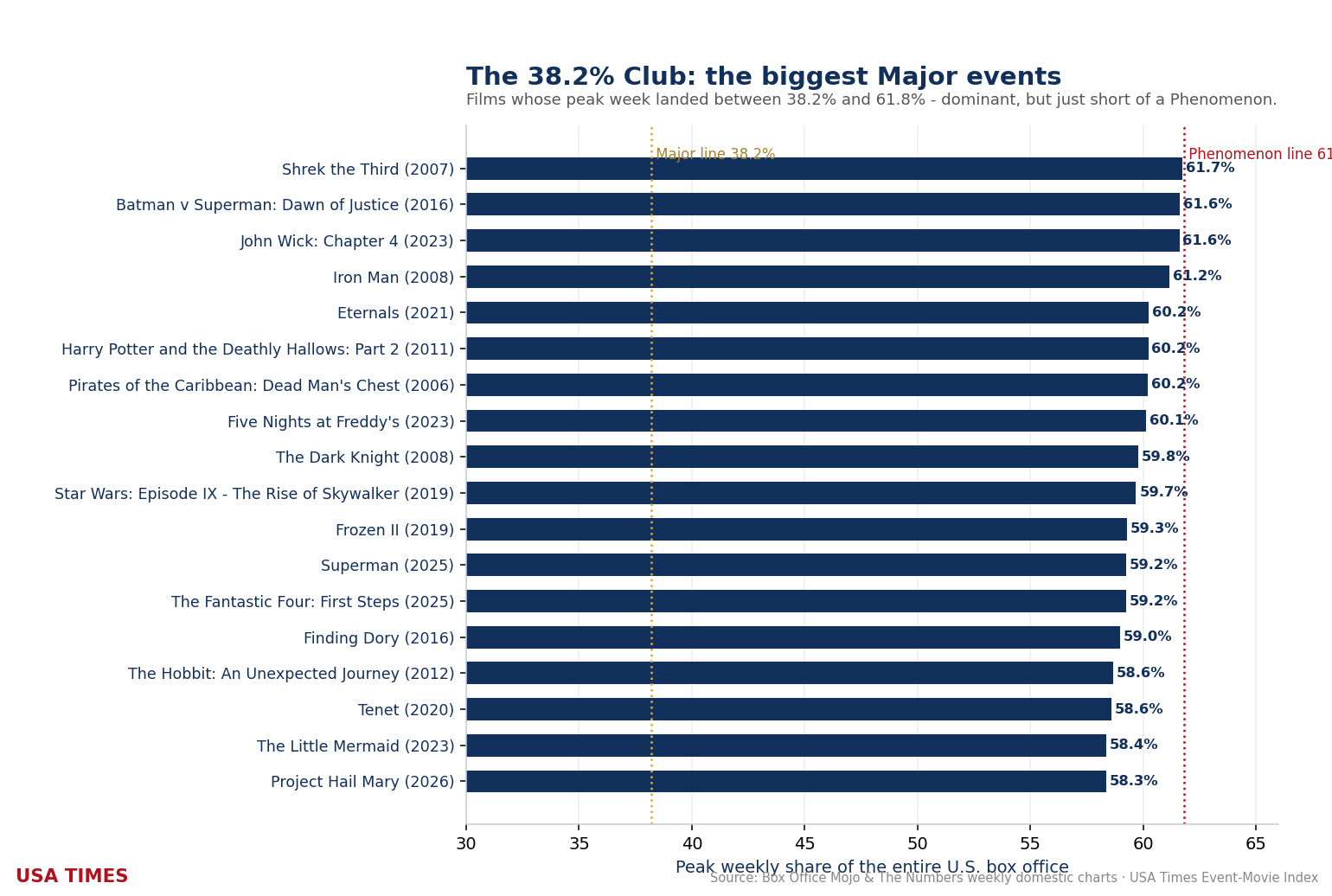
Every ranking has a top and a bottom, and both get all the attention. The USA Times Star Index is no different: the “Geuses” that swallow whole box-office weeks make the headlines, and the humble one-week “Mini-geuses” fill out the long tail. But the most revealing tier is the one in the middle — the Betelgeuse, the film that takes between 38.2% and 61.8% of everything Americans spend at the movies in a given week. It is the workhorse tier of modern moviegoing, and there are 163 of them across the last twenty years.
A quick refresher on how we draw the lines, because the numbers are not arbitrary. The index sorts films by the share of the total weekly box office their opening commands, and it splits that share using the golden ratio. A film that takes at least 26.18% of a week (that is 1 minus 0.618, halved and folded back on itself through the same proportion) is a Mini-geuse. Clear 38.2% — the golden ratio’s smaller complement — and it becomes a Betelgeuse. Break 61.8%, and it is a Geuse. The Betelgeuse tier is the wide middle band: more than a hit, not quite a takeover.
So close to a Geuse
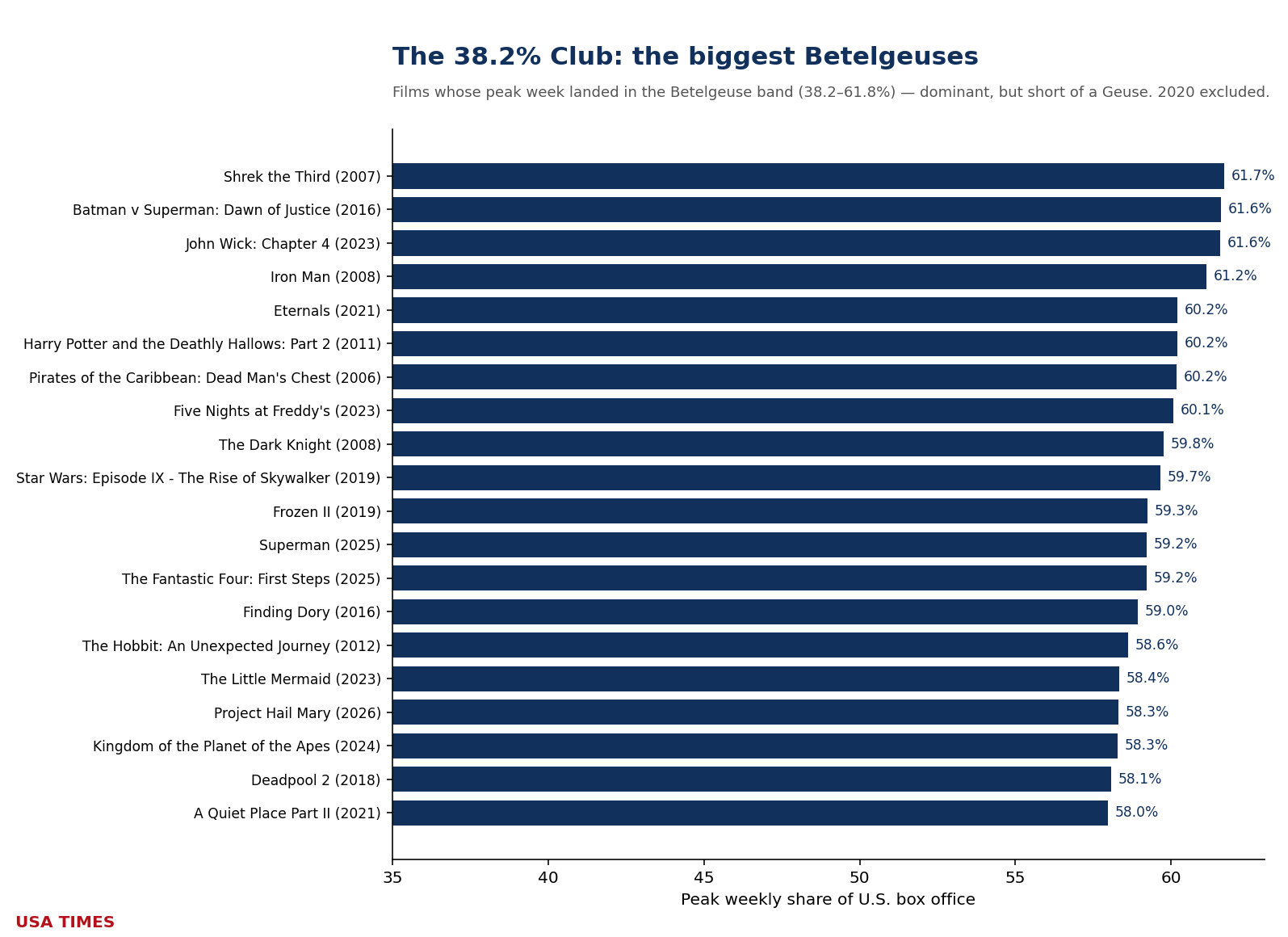
What makes the top of this list poignant is how many films came within a rounding error of the Geuse line and fell back. Shrek the Third peaked at 61.7% of its week in 2007. Batman v Superman: Dawn of Justice hit 61.6% in 2016; John Wick: Chapter 4 matched it in 2023; the original Iron Man reached 61.2% in 2008. Each of these films, for one week, was within a few tenths of a percentage point of owning nearly two-thirds of the entire American box office — and each just missed. They are the sport’s silver medalists, separated from gold by a margin thinner than most weekend estimates.
Batmandir · Founders A numbered seat at the table. S3 · The Founders Club — 161 seats per location. By invitation. Explore membership →| # | Film | Year | Peak week share |
|---|---|---|---|
| 1 | Shrek the Third | 2007 | 61.7% |
| 2 | Batman v Superman: Dawn of Justice | 2016 | 61.6% |
| 3 | John Wick: Chapter 4 | 2023 | 61.6% |
| 4 | Iron Man | 2008 | 61.2% |
| 5 | Eternals | 2021 | 60.2% |
| 6 | Harry Potter and the Deathly Hallows: Part 2 | 2011 | 60.2% |
| 7 | Pirates of the Caribbean: Dead Man’s Chest | 2006 | 60.2% |
| 8 | Five Nights at Freddy’s | 2023 | 60.1% |
| 9 | The Dark Knight | 2008 | 59.8% |
| 10 | Star Wars: Episode IX – The Rise of Skywalker | 2019 | 59.7% |
| 11 | Frozen II | 2019 | 59.3% |
| 12 | Superman | 2025 | 59.2% |
The tier that actually runs the box office
Step back and look at how the three tiers divide the field. Over twenty years, the index counts 222 Mini-geuses, 163 Betelgeuses, and just 57 Geuses. The Geuse is genuinely rare — roughly one film in eight that owns a week ever reaches it. The Betelgeuse, by contrast, is the reliable engine of the modern release calendar: the tentpole that opens huge, dominates its weekend decisively, but leaves just enough oxygen for a counter-programmer or a holdover to breathe.
That distinction matters because it maps onto how studios actually behave. A Geuse requires a nearly empty runway — a weekend cleared of all competition, which only the very biggest franchises can command. A Betelgeuse is what a strong, well-positioned film produces on a normal weekend: think a mid-cycle Marvel entry, a Fast & Furious chapter, a Pixar title, a well-reviewed action picture like John Wick. These are the films that keep theaters in business between Geuses, and there are nearly three of them for every outright takeover.
A tier that has quietly gotten bigger
The Betelgeuse band is also where the box office’s long concentration story shows up most clearly. In the index’s early years, a typical strong opener might take a third of its week and leave the rest to a healthy slate of alternatives. As the market consolidated around a shrinking number of megabudget releases, more and more of those strong openers pushed past 38.2% — not because audiences grew, but because the competition around them thinned. The middle tier swelled as the shared box office emptied out.
It is worth being honest about the limits of a number like this. Share is a measure of dominance within a week, not of quality, popularity over time, or profit. A film can post a towering Betelgeuse-event peak on a quiet weekend and fade quickly; another can settle for a smaller share against fierce competition and out-earn it over a full run. The 38.2% line tells you how completely a film owned its moment — no more, no less. But as a portrait of that moment, the Betelgeuse-event tier is the truest picture of what winning at the modern box office usually looks like: not a total eclipse, but a commanding, unmistakable lead.
Why a ratio, and not a round number
It is fair to ask why the index draws its lines at 38.2% and 61.8% rather than at a tidy 40% and 60%. The answer is partly aesthetic — the golden ratio gives the tiers a self-similar structure, where each band relates to the next by the same proportion — but it is also practical. Round-number thresholds invite round-number thinking: a cutoff at 60% would feel like a grade on a test, a target studios could game or journalists could fetishize. A ratio-derived line carries no such baggage. It simply partitions the space of possible outcomes into a rare top, a wide middle, and a broad base, and lets the films sort themselves.
The proportions the data settled into — 57 Geuses, 163 Betelgeuses, 222 Mini-geuses over twenty years — suggest the lines landed somewhere meaningful. Each tier is roughly one and a half times the size of the one above it, a smooth gradient rather than a lumpy one. If the thresholds were badly placed, one band would be starved or bloated. Instead the distribution looks like what it is: a market with a few total takeovers, a steady supply of decisive wins, and a long tail of modest ones.
The calendar is the co-star
A weekly share is never earned by one film alone; it is earned against a specific field of competitors, and that field is negotiated years in advance. Distributors stake out release dates precisely to avoid colliding with films that chase the same audience, which means a Betelgeuse-sized share often says as much about scheduling as about drawing power. A tentpole that opens opposite a well-matched rival can post a smaller share of a bigger week; the same film, moved three weeks in either direction onto a cleared runway, might have crossed into Geuse territory. The near-misses at the top of this list — films that fell a few tenths of a point short — are in part artifacts of who else happened to be in theaters that week.
A more varied tier than the one above it
Look at the genre spread inside the top of the band: animated sequels (Shrek the Third, Frozen II), superhero pictures at every point of the quality spectrum (The Dark Knight, Batman v Superman), a micro-budget horror adaptation (Five Nights at Freddy’s), and a fourth entry in an action franchise built almost entirely on word of mouth (John Wick: Chapter 4). That variety is itself a finding. Total weekly takeovers tend to belong to a narrow class of generational franchises, but the Betelgeuse tier is open to almost any kind of film that meets its moment — which is another way of saying that decisive box-office wins remain more democratic than the headlines about mega-franchises imply.
What the middle band means for theaters
For exhibitors, the distinction between a Betelgeuse week and a Geuse week is more than academic. A film taking half the market still leaves the other half to be divided, which keeps second- and third-choice screens productive and gives holdovers room to find late audiences. A true Geuse week, by contrast, concentrates revenue on a handful of auditoriums while the rest of the multiplex idles. A calendar dominated by Betelgeuses — big, decisive, but not suffocating — is arguably the healthiest version of the modern theatrical business, and the tier’s numerical dominance over the last two decades suggests the market, left to its own devices, keeps producing exactly that.
What to watch next
The open question is whether the band keeps swelling. The forces that pushed strong openers past 38.2% — fewer wide releases, shorter theatrical windows, audiences trained to show up only for perceived events — have not reversed. If mid-budget films continue to migrate to streaming, the mechanical result is that whatever does open big will command a still larger slice of a thinner week, and films that once would have been comfortable Betelgeuses will start brushing the Geuse line. Whether that counts as strength or fragility depends on where you sit: a market where every hit is enormous is also a market with very little cushion when a presumed hit misses. The middle tier, in other words, is worth watching not because it is dramatic but because it is the market’s vital sign.
Related from the USA Times Data Desk
- NYC Rat Complaints Just Fell Below Pre-Pandemic Levels for the First Time Since the 2021 Surge
- The Betelgeuse-Betelgeuse Week Has Happened Once in Twenty Years. Our Editor-in-Chief Bets December 18 Won't Be the Second.
- The Second-Weekend Cliff: Does the Box Office Fall by the Golden Ratio?
- The Billion-Dollar Club, Ranked: Every Star Movie That Crossed the Line
- Box-office coverage index · the Star Index methodology