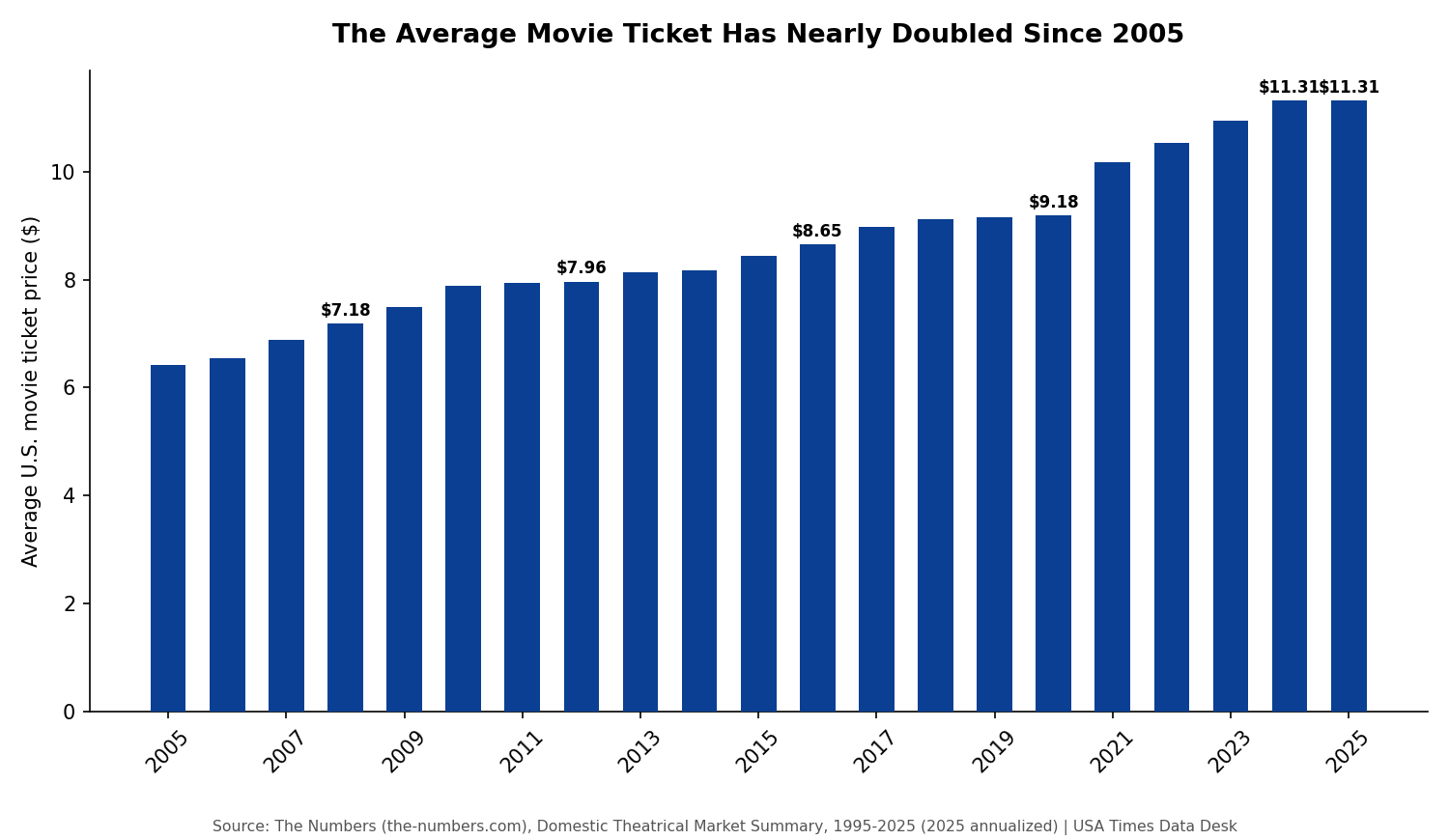
A movie ticket that cost $6.41 in 2005 would cost about $10.58 today if it had simply tracked general U.S. inflation — the same rate at which the price of groceries, rent, and gasoline has drifted upward, on average, over the past twenty years. Instead, the actual average U.S. movie ticket costs $11.31. Moviegoing hasn’t just gotten more expensive alongside everything else; it’s gotten more expensive faster than everything else, by a real and measurable margin.
The two rates, side by side
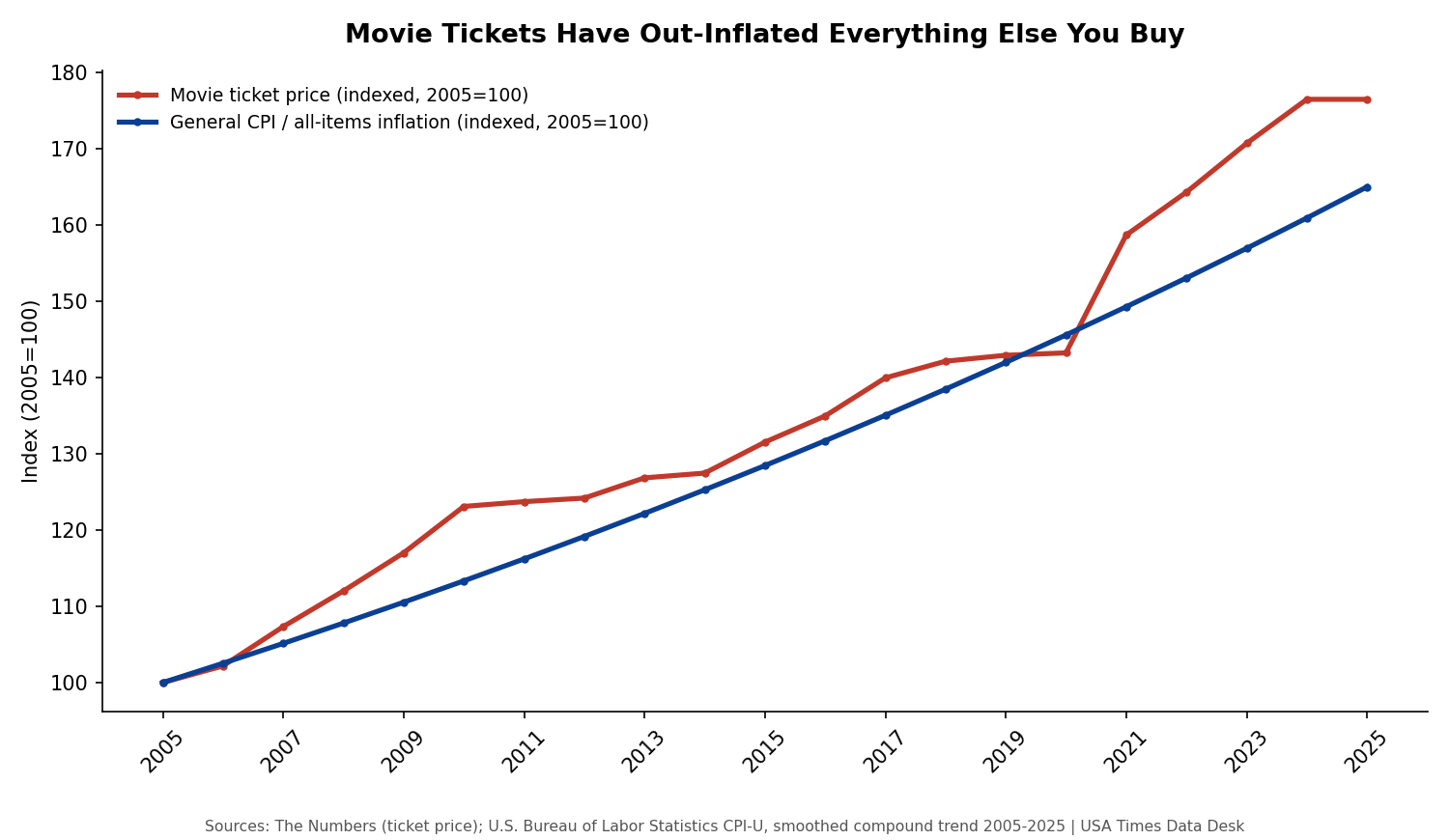
Cumulative U.S. inflation from 2005 to 2025 ran approximately 65%, per Bureau of Labor Statistics Consumer Price Index data — meaning $100 of general purchasing power in 2005 is equivalent to roughly $165 today. Over that identical span, the average movie ticket price rose from $6.41 to $11.31: an increase of 76%. Indexing both series to a common 2005 starting point of 100 makes the gap visible year over year rather than just as a single before-and-after comparison — and the ticket-price line pulls steadily ahead of the general inflation line for most of the period, with the gap widening further after 2020.
Why “just inflation” doesn’t explain it
If movie ticket prices were simply passing through the same cost pressures hitting every other consumer good — rising wages, rents, energy costs — you’d expect the two lines in the chart above to move roughly in parallel. They don’t. The ticket-price line consistently sits above the general CPI line, meaning something specific to the movie business is pushing prices up faster than the broad economy justifies on its own. The most likely candidates, based on what’s publicly documented about the industry: a shrinking pool of moviegoers giving theaters more pricing power over the audience that remains (fewer people to alienate with a price hike when your revenue math depends on the ones who stay), a shift toward premium formats and reserved/dynamic seating that charge a structural premium over the old flat ticket price, and consolidation among the largest theater chains reducing local price competition in many markets.
Batmandir · Founders A numbered seat at the table. S3 · The Founders Club — 161 seats per location. By invitation. Explore membership →The pandemic accelerated the gap
Ticket prices didn’t dip during the 2020 shutdown and pandemic-disrupted years that followed — they kept climbing, from $9.16 in 2019 to $9.18 in 2020 (a year when theaters were closed for months and the few tickets sold were often for near-empty auditoriums) and onward past $10 by 2021. That’s a notable data point on its own: even in a year when demand cratered by more than 80%, the average price per ticket didn’t fall to attract back the audience that remained — it held flat or rose. That’s not how price normally behaves when demand collapses; it suggests theaters treated the shutdown-era audience as relatively price-insensitive (people willing to go to a movie during a pandemic were probably not going to be turned away by a dollar or two), and then never fully walked the increases back once volume started returning.
What this means for the audience that’s left
A ticket price outpacing general inflation isn’t inherently unreasonable for any single business — restaurants, concerts, and plenty of other discretionary spending categories have also out-inflated the broader CPI basket in various stretches. But for an industry simultaneously losing nearly half its customer base over the same twenty years (see the companion piece on the admissions-versus-revenue divergence), a price trajectory that consistently outpaces general inflation raises the obvious question of causality: is moviegoing shrinking because prices rose faster than people’s overall cost of living could comfortably absorb, or did prices rise because a shrinking, more devoted audience was willing to pay more? The data here can’t cleanly separate cause from effect — that would require survey data on why specific households stopped going, which is outside the scope of box office statistics — but the correlation between the two trends, running in opposite directions at a similar pace, is hard to dismiss as coincidence.
A ticket isn’t just a ticket anymore
Part of what the flat “average ticket price” number obscures is that it blends a much wider range of actual prices than it did in 2005. A matinee at a discount chain, a standard evening showing, and a Friday-night premium-format seat with reserved seating and a surcharge are all folded into one average — and the premium end of that range has both grown in relative frequency and grown its own price further, pulling the average upward even for moviegoers who never buy a premium ticket themselves. In that sense, the “average ticket price” figure understates how much more a specific kind of night out — the one most people picture when they think of “going to the movies” the way they used to routinely — has actually cost since 2005.
The decade that actually moved the average
Breaking the twenty-year window into two decades makes clear that the price acceleration isn’t evenly distributed. From 2005 to 2015, the average ticket climbed from $6.41 to $8.43 — a 31.5% increase over ten years, a pace that, while still ahead of general inflation, was not dramatically so. From 2015 to 2025, the average ticket climbed from $8.43 to $11.31 — a 34.2% increase in the second decade, nearly matching the first decade’s percentage gain despite starting from a much higher base, and compressed into a period that included a multi-year stretch (2020-2021) when the industry might have been expected to cut prices to lure back a cautious, shrinking audience instead of raising them.
What other discretionary spending categories did over the same period
Movie tickets aren’t the only discretionary purchase that has outpaced general inflation over the past twenty years — commonly cited examples of categories that have run hotter than the broad CPI basket over extended periods include college tuition, healthcare services, and, more recently, live event and concert ticketing, all of which we did not independently verify for this article but which are widely documented in separate economic reporting. What distinguishes the movie ticket case is the pairing with a simultaneously and sharply shrinking customer base — many of those other categories facing above-inflation price growth haven’t seen anything close to a 45% decline in total volume purchased over the same window, making the movie ticket case a comparatively unusual combination of steep price growth and steep volume loss happening at the same time, in the same market, over the same twenty years.
What we did
Average U.S. movie ticket price figures (2005: $6.41; 2025: $11.31) come from The Numbers’ Domestic Theatrical Market Summary, which calculates ticket price using figures the Motion Picture Association publishes annually; the 2025 figure is explicitly an annualized run-rate, not yet a final closed-year number. The cumulative general inflation figure (approximately 65% from 2005 to 2025, CPI moving from roughly 195.3 to roughly 322.2) comes from Bureau of Labor Statistics Consumer Price Index data as reported by a third-party inflation calculator site; we modeled a smooth compound annual trend between those two published endpoints for the indexed chart rather than pulling the BLS’s full year-by-year series directly, so the CPI line shown is a reasonable approximation of the trend rather than the exact annual BLS figure for every year. The explanation of pricing dynamics (premium formats, dynamic pricing, reduced price competition from consolidation, pandemic-era pricing behavior) reflects general, widely reported industry dynamics and is presented as informed analysis, not verified through chain-level pricing data we did not have access to.