Read in: English · Español · Русский · 中文 · Português
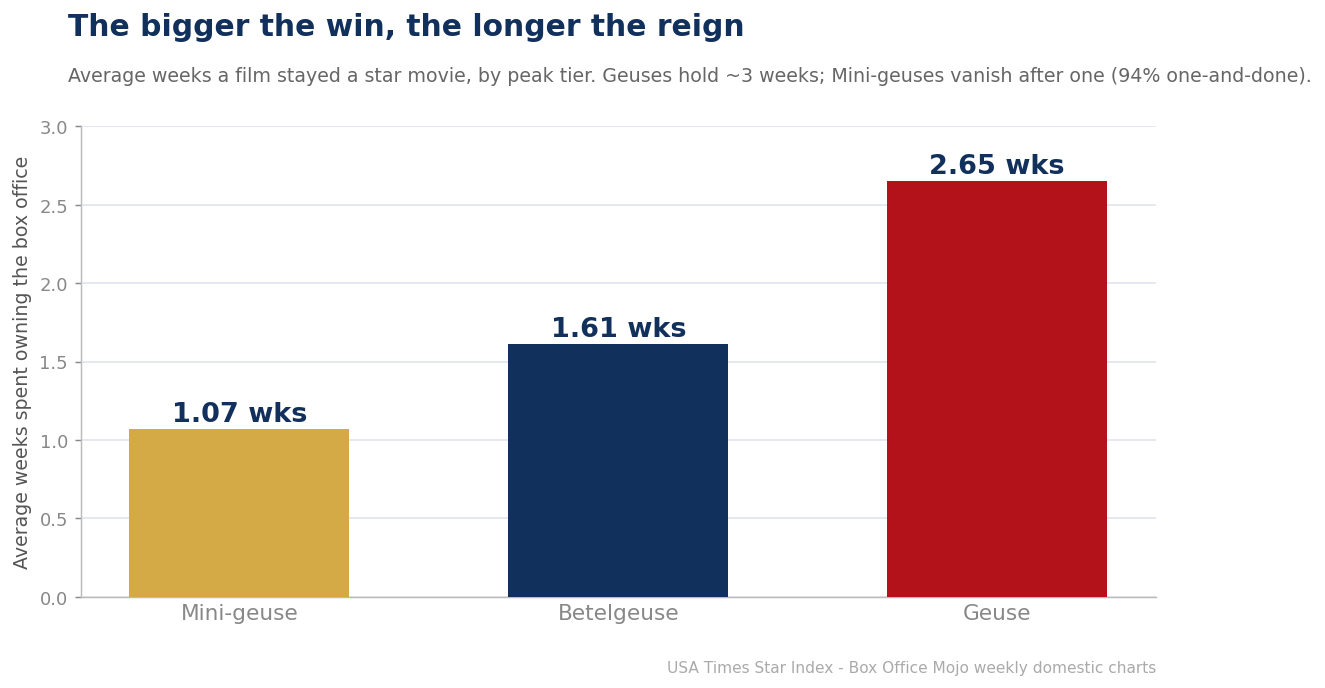
Owning the box office for a week is hard. Owning it for two is a different order of achievement — and the USA Times Star Index shows exactly how that difficulty scales with size. The bigger a film’s peak, the longer it holds the throne. A Geuse (a film that took 61.8%+ of a week) reigns for 2.65 weeks on average; a Betelgeuse (38.2–61.8%) for 1.61; and a Mini-geuse (26.18–38.2%) for barely more than one — 1.07 weeks, with 94% gone after a single week.
Domination compounds
This is not obvious. You might expect every film to fall off at roughly the same rate — the second-weekend cliff applies to everyone. But a film that opens at 65% of the entire market has so much more altitude that even a steep drop still leaves it on top the next week. A Mini-geuse that scraped in at 27% has no such cushion; the very next release knocks it off. Size, in other words, buys time. The films that dominate hardest also dominate longest, and the gap widens at the top: only 5% of Geuses are one-and-done, versus 94% of Mini-geuses.
Batmandir · Guest Passes Step inside for a day. Guest passes from $161/day — brought in by a member. See guest passes →Why the exceptions are almost all Geuses
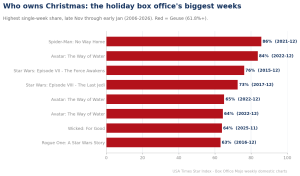
The longest reigns in the index — the films that held for three, four, even six weeks — are overwhelmingly the biggest phenomena: Avatar: The Way of Water, the top Star Wars entries, Top Gun: Maverick, The Super Mario Bros. Movie. Each opened enormous and had the runway to fend off challengers week after week. A long reign is less a sign of unusual staying power than of an unusually high starting point. That is the quiet logic of the modern box office: the rich weeks get richer, and the throne rarely changes hands unless something bigger arrives.
The one-and-done cliff, tier by tier
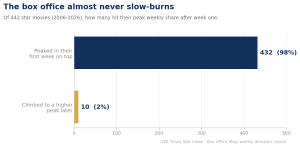
The starkest number in the data is the share of films that own exactly one week and then vanish. Among Mini-geuses it is 94%; among Betelgeuses, 53%; among Geuses, just 5%. In other words, reigning a second week is essentially reserved for the largest films in the market. The middle tier is a coin flip, and the bottom tier is a turnstile — a new Mini-geuse almost every week, each one dethroned by the next arrival.
| Tier | Avg weeks owned | Median | One-and-done |
|---|---|---|---|
| Mini-geuse (26.18-38.2%) | 1.07 | 1 | 94% |
| Betelgeuse (38.2-61.8%) | 1.61 | 1 | 53% |
| Geuse (61.8%+) | 2.65 | 3 | 5% |
Why altitude buys time
The mechanism is simple arithmetic layered on the second-weekend cliff. Every film sheds a large fraction of its audience in its second week — that part is universal. But a Geuse that opens at 65% of the market can shed half its business and still sit at 30%+ the next week, comfortably above whatever new release arrives. A Mini-geuse that opened at 27% has no altitude to give back; a single new wide release is enough to bury it. The tier a film lands in on opening weekend therefore doesn’t just describe how big it was — it all but determines how long it will stay on top.
What it means for how we talk about hits
Popular coverage tends to treat “number one at the box office” as a single achievement. The data argues it is really three very different achievements. A Mini-geuse No. 1 is a one-week placeholder in a quiet market; a Betelgeuse is a genuine hit that may or may not hold; a Geuse is a cultural event that will likely own the conversation for the better part of a month. Collapsing all three into “the weekend winner” obscures the thing that actually matters — not whether a film reached the top, but how far above the pack it stood when it got there.
Have reigns gotten shorter over time?
The tier pattern is stable, but the raw length of reigns has drifted down over the two decades — a consequence of the widening release calendar. As studios learned to stack wide releases nearly every weekend, even a strong film gets challenged sooner than it once did. A Betelgeuse that might have held two weeks in 2008 now more often cedes the top after one, simply because something new opens against it. The Geuse tier is the exception that proves the point: only a film big enough to survive the following week’s new release can string together a multi-week reign, and there are only so many of those in any year.
The theater-economics of a long hold
A multi-week reign is disproportionately valuable to exhibitors, and not only for ticket sales. A film that holds the top for three weeks keeps butts in the largest, highest-margin auditoriums and sustains the concession revenue that actually keeps theaters solvent. It also stabilizes staffing and screen scheduling. This is why a genuine Geuse hold — an Avatar or a Top Gun: Maverick — matters to the industry far out of proportion to a one-week Mini-geuse that grossed a similar opening number: the sustained film compounds, while the flash-in-the-pan is gone before the popcorn margins add up.
Reading the tier, not the ranking
The practical upshot for anyone tracking the business: a film’s tier on opening weekend forecasts its reign far better than its raw ranking. Two films can both “open at No. 1” and have completely different futures — one a 27% Mini-geuse that will be forgotten by the next Friday, the other a 62% Geuse that will own the month. The Star Index tiers exist precisely to make that distinction legible, and reign length is where the distinction shows up most starkly.
The longest reigns on record
At the very top of the hold-time distribution sit a handful of films that strung together three, four, even six weeks of ownership. Tenet technically posted the longest run of star weeks in the index at six, though that was inflated by the empty 2020 market; among normal-market films, The Super Mario Bros. Movie and The Croods: A New Age (five weeks each) and Godzilla vs. Kong (four) lead the way, with Top Gun: Maverick’s three-week reign the most impressive given how competitive its 2022 summer was. Every one of them is a Geuse or high Betelgeuse — there is no such thing as a long-reigning small film.
The dollar value of those extra weeks is enormous and non-linear. A film’s second and third weeks at No. 1 come with far lower marketing costs than the first — the awareness is already bought — so a disproportionate share of the profit on a long-reigning hit is earned during the hold, not the open. This is the financial engine behind the industry’s obsession with “legs”: an extra week on top can be nearly pure margin.
The competitive-calendar squeeze
Reign lengths have also been quietly compressed by the industry’s own scheduling. As studios learned to fill nearly every weekend with a wide release, even strong films get challenged sooner than they once would have. A Betelgeuse that might have coasted to a second week in a sparser 2008 calendar now often cedes the top to whatever opens the following Friday. The Geuse tier resists this only because those films are big enough to survive a new challenger — which is why multi-week reigns have become almost exclusively the province of the very largest releases.
What we did: For every qualifying star movie we counted the total number of weeks it spent at or above the 26.18% star floor, and averaged that by the film’s peak tier. Weekly share is each film’s gross as a percentage of that week’s total U.S. domestic box office, from Box Office Mojo’s weekly charts, 2006–2026. We exclude 2020, whose pandemic-shrunken weeks distort shares below the Star Index qualification floor.
Related from the USA Times Data Desk
- Holding the Throne: Sustained Geuses
- The Marathoners: The Films That Owned the Box Office the Longest
- The Star Index methodology
Sources
- Box Office Mojo — weekly and weekend box office grosses
- The Numbers — historical domestic box office records
- USA Times — Star Index methodology (how our tiers and box-office share are computed)