JUNZI KITCHEN (Columbia, 2896 Broadway, Morningside Heights, Manhattan) — Chinese. Case study #18. Prices compared between junzi kitchen’s own first-party pickup menu and the same store’s Uber Eats storefront, both for the 2896 Broadway shop, captured the same day.
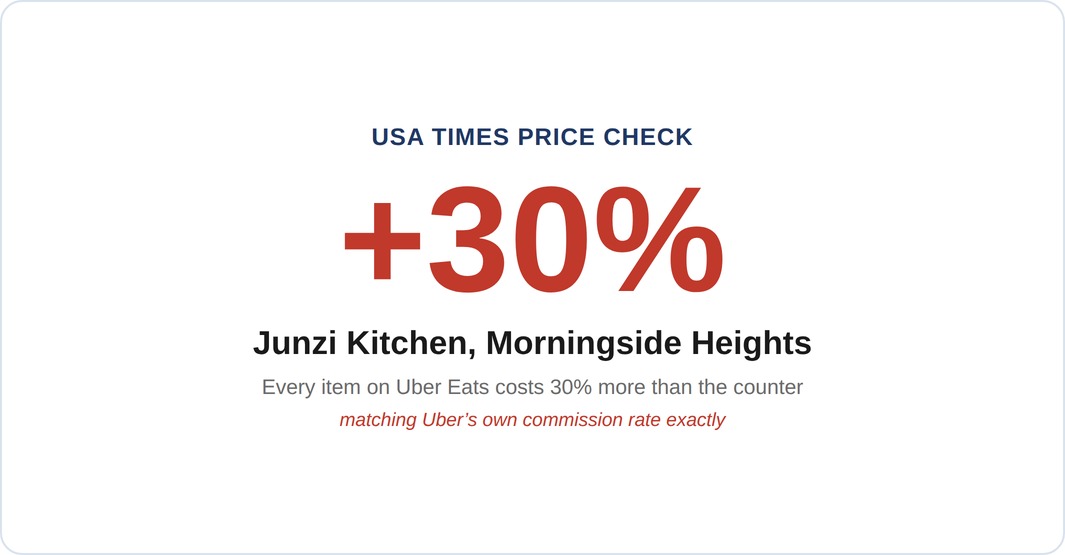
Order Cantonese BBQ chicken over rice for pickup from junzi kitchen’s Columbia shop on the chain’s own ordering site and it is $13.98. Order the same bowl, from the same store, on Uber Eats and it is $18.17 — 30% more. We priced 43 of the store’s items side by side, and the markup was not just present on every one — it was the same number every time. A pint of braised beef runs $16.50 at the counter and $21.45 on Uber (+30%); five steamed pork soup dumplings, $9.99 versus $12.99 (+30%); a bottle of spring water, $2.49 versus $3.24 (+30%); a can of Coca-Cola, $2.49 versus $3.24 (+30%). Across all 43 items the markup averaged 30.0%, with a range of just 29.97% to 30.12% — the tightest, most uniform markup this series has recorded.
junzi kitchen does not set out to be the villain here, and neither does this piece. What the numbers show is a familiar mechanism at its most legible: a single dial, set once, that lifts every price on the delivery app by very close to the amount the app takes in commission — so the customer, not the shop, ends up paying Uber’s cut, folded quietly into the price of a dumpling.
The markup
Across the 43 matched items the markup averaged 30.0%, with a median of 30.0% and a range from 30.0% to 30.1% — effectively a flat 30% applied across the whole menu. A basket of all 43 items costs $365.58 on junzi’s own menu and $475.29 on Uber Eats — about 30% more for the identical order. There is no gentler treatment for the cheap items and no steeper one for the expensive plates: the $2.49 can of soda and the $16.50 pint of braised beef are both marked up by the same 30%. That uniformity is itself the finding. A markup that lands on exactly 30%, on every item, is not the product of item-by-item pricing decisions; it is one lever, and it is set to Uber’s number.
What the shop nets
When a customer orders through Uber Eats, the platform keeps a commission on the sale — a figure that can reach roughly 30% at the top of its fee structure. Apply a 30% commission to these marked-up prices and the shop lands almost exactly back where it started: a $18.17 bowl returns junzi about $12.72, a few cents under its $13.98 counter price; the $475.29 basket returns about $332.70, roughly $33 less than the $365.58 the same food brings in at the counter. On all 43 of the 43 items we checked, the shop nets a hair less than dine-in after a 30% cut. This is the pattern this series calls pass-through (Type A): the markup recovers the commission almost to the cent, the shop comes out about even, and the customer is the one who pays.
The arithmetic flips under New York’s rules. The city caps the core delivery commission at 15%. At that capped rate, a 30% markup does far more than cover the cut: the $475.29 basket would return the shop about $404.00 — roughly $38 more than the $365.58 it makes at the counter, and none of the 43 items would net less than dine-in. In other words, the markup is sized to Uber’s uncapped 30% commission. Where the commission is capped at 15%, as it is in New York, the customer’s 30% premium is double what the law lets the platform charge the restaurant — and the difference does not come back to the diner.
Pickup costs the same as delivery
Switch junzi’s Uber Eats storefront from delivery to pickup — no driver, no delivery — and the prices do not move: Cantonese BBQ chicken over rice is still $18.17, the braised beef pint still $21.45, the custom rice bowl still $14.29. Because the pickup price equals the delivery price, the 30% is not a delivery charge. It is a markup on the food itself, applied whether or not anyone drives it anywhere.
Why it still lands on Uber
Uber does not set junzi kitchen’s menu prices — the shop does. But Uber sets the commission that defines the economics of every order, and the rational response for a merchant is to lift the in-app menu to recover it. A flat 30% dial is what that response looks like when it is done cleanly. Uber even reports to merchants a “Menu Markup” metric that measures exactly this gap between in-store and in-app prices — a figure the platform can see and the customer cannot. Here the gap is 30% on everything, and Uber then charges the customer again at checkout, on top, in delivery and service fees.
The New York context
New York City caps the core commission a delivery app can charge a restaurant at 15% for delivery, plus 5% for other listing and marketing services and 3% for card processing — limits the City Council first made permanent in 2021. A 2025 amendment, signed into law after the platforms sued and settled, now lets restaurants opt to pay an additional up to 20% for “enhanced services” such as wider delivery zones and top-of-search placement, which can push the total a restaurant chooses to pay toward roughly 43%. None of those caps require a restaurant to raise its menu prices, and none of them touch the delivery fee, service fee and tax a customer pays in the app. junzi’s flat 30% in-app markup is exactly double the 15% delivery cap — the slice of the fee structure the law actually regulates. Mayor Zohran Mamdani’s Department of Consumer and Worker Protection continues to review delivery-app fees.
| Item | Counter / first-party | Uber Eats | Markup | Shop nets @30% (vs counter) |
|---|---|---|---|---|
| Rice bowls | ||||
| Taiwan pork sausage over rice | $14.98 | $19.47 | +30% | $13.63 (-1.35) |
| Cantonese BBQ chicken over rice | $13.98 | $18.17 | +30% | $12.72 (-1.26) |
| Noodle bowls | ||||
| Sour spicy rice noodles & braised beef | $16.98 | $22.07 | +30% | $15.45 (-1.53) |
| Tomato egg noodles & slow-braised pork | $15.98 | $20.77 | +30% | $14.54 (-1.44) |
| Noodle soups | ||||
| Bone broth beef noodle soup | $16.98 | $22.07 | +30% | $15.45 (-1.53) |
| Classic chicken noodle soup | $14.98 | $19.47 | +30% | $13.63 (-1.35) |
| Bone broth pork noodle soup | $13.98 | $18.17 | +30% | $12.72 (-1.26) |
| Salads | ||||
| Shanghai scallion chicken salad | $13.98 | $18.17 | +30% | $12.72 (-1.26) |
| Dim sum | ||||
| Steamed vegetable dumplings (6 pc) | $8.99 | $11.69 | +30% | $8.18 (-0.81) |
| Boiled pork & chive dumplings (8 pc) | $8.99 | $11.69 | +30% | $8.18 (-0.81) |
| Steamed pork soup dumplings (xiao long bao) (5 pc) | $9.99 | $12.99 | +30% | $9.09 (-0.90) |
| Steamed chicken & shrimp shumai (6 pc) | $9.99 | $12.99 | +30% | $9.09 (-0.90) |
| Appetizer | ||||
| Pork sausage (1 pc) | $2.49 | $3.24 | +30% | $2.27 (-0.22) |
| Smashed cucumber salad | $2.99 | $3.89 | +30% | $2.72 (-0.27) |
| Classic chicken broth (16 fl oz) | $2.99 | $3.89 | +30% | $2.72 (-0.27) |
| Pork sausages (2 pc) | $3.99 | $5.19 | +30% | $3.63 (-0.36) |
| Egg tart | $3.99 | $5.19 | +30% | $3.63 (-0.36) |
| Junzi chili oil (bottled, 100 g) | $7.99 | $10.39 | +30% | $7.27 (-0.72) |
| A la carte | ||||
| Cantonese BBQ chicken (1 pint) | $10.50 | $13.65 | +30% | $9.55 (-0.95) |
| Firecracker chicken (1 pint) | $10.50 | $13.65 | +30% | $9.55 (-0.95) |
| Griddled tofu (1 pint) | $10.50 | $13.65 | +30% | $9.55 (-0.95) |
| Slow-braised pork (1 pint) | $13.50 | $17.55 | +30% | $12.29 (-1.21) |
| Stir-fried cabbage (1 pint) | $6.00 | $7.80 | +30% | $5.46 (-0.54) |
| Stir-fried bean sprouts (1 pint) | $6.00 | $7.80 | +30% | $5.46 (-0.54) |
| Chilled bok choy (1 pint) | $6.00 | $7.80 | +30% | $5.46 (-0.54) |
| Freshly smashed cucumber (1 pint) | $6.00 | $7.80 | +30% | $5.46 (-0.54) |
| Braised beef (1 pint) | $16.50 | $21.45 | +30% | $15.01 (-1.49) |
| Mapo tofu (1 pint) | $9.00 | $11.70 | +30% | $8.19 (-0.81) |
| Soy egg (3 pc) | $4.50 | $5.85 | +30% | $4.09 (-0.41) |
| White rice (1 quart) | $9.00 | $11.70 | +30% | $8.19 (-0.81) |
| Rice noodles (1 quart) | $9.00 | $11.70 | +30% | $8.19 (-0.81) |
| Drinks | ||||
| Coca-Cola (12 fl oz can) | $2.49 | $3.24 | +30% | $2.27 (-0.22) |
| Spring water (16.9 fl oz) | $2.49 | $3.24 | +30% | $2.27 (-0.22) |
| Sour Plum Juice (16 fl oz) | $2.99 | $3.89 | +30% | $2.72 (-0.27) |
| Yeshu coconut drink (8.2 fl oz) | $2.99 | $3.89 | +30% | $2.72 (-0.27) |
| Vita lemon tea (8.5 fl oz) | $2.99 | $3.89 | +30% | $2.72 (-0.27) |
| Vita mango juice (8.5 fl oz) | $2.99 | $3.89 | +30% | $2.72 (-0.27) |
| Sanzo lychee sparkling (12 fl oz) | $3.49 | $4.54 | +30% | $3.18 (-0.31) |
| Sanzo yuzu sparkling (12 fl oz) | $3.49 | $4.54 | +30% | $3.18 (-0.31) |
| Sanzo pomelo sparkling (12 fl oz) | $3.49 | $4.54 | +30% | $3.18 (-0.31) |
| Sanzo mango sparkling (12 fl oz) | $3.49 | $4.54 | +30% | $3.18 (-0.31) |
| Drinks & sides | ||||
| Mango mille crepe cake | $3.49 | $4.54 | +30% | $3.18 (-0.31) |
| Frozen | ||||
| Frozen pork & chive dumplings (50 pc) | $29.95 | $38.94 | +30% | $27.26 (-2.69) |
| All 43 matched items (basket) | $365.58 | $475.29 | +30% | $332.70 (-32.88) |
By the numbers
- Items matched: 43 (same description and portion, same 2896 Broadway store; build-your-own bowls, multi-item combos and the milk teas — whose in-app portion could not be cleanly matched — were excluded, as was one item on an active 30%-off promotion)
- Markup: mean 30.0%, median 30.0%, range 30.0%–30.1% — effectively a flat 30% on every item
- Basket: $365.58 at the counter, $475.29 on Uber Eats (about 30% more)
- Break-even markup at a 30% commission: 42.9% — the shop’s 30% markup sits below it, so the shop nets slightly less than dine-in at that rate
- What the shop nets: about $332.70 on the basket at a 30% commission (~$33 less than counter); about $404.00 at New York’s capped 15% (~$38 more than counter)
- Items on which the shop nets less than dine-in: 43 of 43 at a 30% commission; 0 of 43 at New York’s capped 15%
- Uber pickup price = Uber delivery price on the items we checked, so the 30% is a food markup, not a delivery cost
- Story type: A (pass-through) — the markup recovers roughly Uber’s commission; the customer pays it
Method
On 15 July 2026, USA Times captured junzi kitchen’s own prices from its first-party pickup ordering site (order.junzi.menu) for the Columbia store at 2896 Broadway — the price a pickup customer pays at that counter, on a live menu carrying the chain’s current 2026 Lunar New Year items. The same day, we captured Uber Eats list prices for the same 2896 Broadway store from the rendered storefront, and separately confirmed that the store’s Uber pickup prices equal its Uber delivery prices. We matched only items with the same description and portion, used list prices rather than promotional prices, and excluded build-your-own bowls, multi-item combos, the milk teas (whose in-app default size or add-ons could not be cleanly matched to the counter menu), and one dim-sum item that was under an active 30%-off promotion at capture. Because a logged-in checkout is required to see them, this automated audit did not capture the delivery fee, service fee, any New York regulatory fee, tax or tip a customer pays on top. The “shop nets” figures are an analytical estimate that applies a 30% (and, separately, New York’s capped 15%) commission to the Uber Eats price; they are our interpretation of the economics, not figures disclosed by Uber, and the true commission tier for this store is a private contract term that is not public. Prices can change and can vary by address; figures reflect the moment of capture.
Right of reply
USA Times contacted junzi kitchen and Uber for comment and will update this report with any response. junzi was asked the one question that decides this story — after Uber’s commission, does it net more, less or the same as a walk-in, and why its in-app prices run a flat 30% above its counter prices — and Uber was asked about its commission tiers in New York and whether it tracks the gap between in-store and in-app menu prices.
Sources
- junzi kitchen counter / first-party prices — junzi kitchen (Columbia, 2896 Broadway) pickup ordering menu, captured 15 July 2026.
- junzi kitchen Uber Eats list prices — junzi kitchen (Columbia) on Uber Eats, captured 15 July 2026.
- NYC delivery fee caps and the 2025 amendment — NYC Department of Consumer and Worker Protection, delivery fee caps, reviewed July 2026.
This report is part of a USA Times series auditing food-delivery pricing. Prices were collected by USA Times on the date noted, compared item by item against the restaurant’s own current menu, and reviewed by an editor before publication.