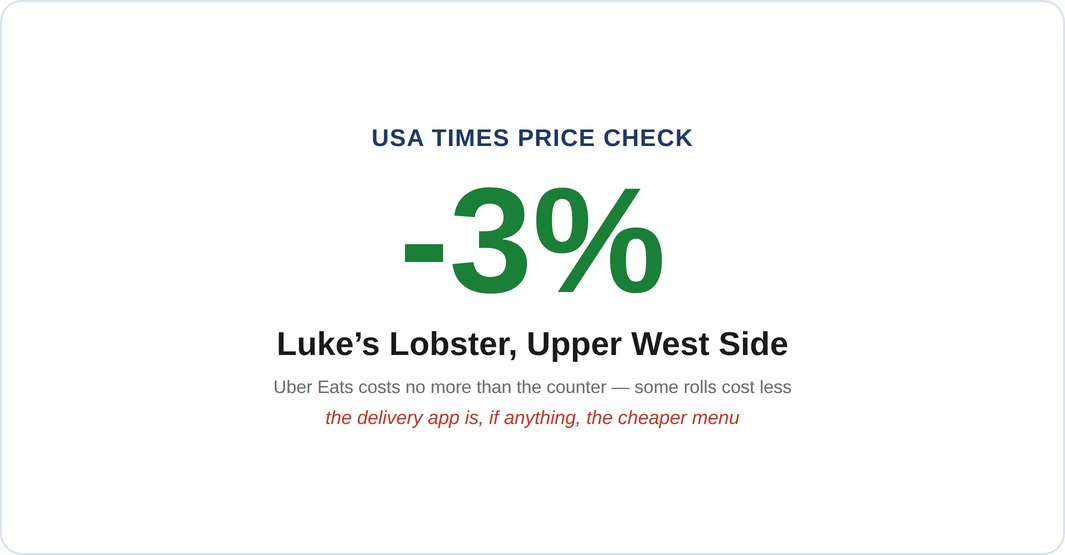
LUKE’S LOBSTER (Upper West Side, 426 Amsterdam Avenue, Manhattan) — Seafood. Case study #19. Prices compared between Luke’s Lobster’s own first-party pickup menu and the same shack’s Uber Eats storefront, both for the 426 Amsterdam Avenue location, captured the same day.
Order a 6-ounce lobster roll for pickup from Luke’s Upper West Side shack on the chain’s own ordering site and it is $38.00. Order the same roll, from the same counter, on Uber Eats and it is $37.00 — a dollar less. We priced 25 of the shack’s items side by side, and on not one of them did Uber Eats cost more than the counter. Every drink, side, soup and dessert — clam chowder at $8, a bottle of water at $3, a $4.50 brownie, a $6 grilled cheese — is priced to the exact cent on both. And each of the six lobster, crab and shrimp rolls runs a dollar cheaper on Uber than at Luke’s own register. Across the whole basket the Uber Eats total comes to $214.25 against $220.25 at the counter — the delivery app is, if anything, the cheaper menu.
That makes Luke’s Lobster the mirror image of most of the restaurants in this series. It has not raised its Uber Eats menu by a cent to cover the commission the platform charges it — and on its signature item it has set the in-app price below the counter. Which means the commission comes out of Luke’s own pocket, not yours.
The markup
Across all 25 matched items the markup runs from −7% to 0%, with a mean of -1.1% and a median of 0%. On 19 of the 25 items — every drink, side, soup, dessert and kids’ plate — the Uber Eats price is identical to the counter price. On the remaining 6 items, the six size-specific rolls, Uber Eats is $1 lower than Luke’s own pickup price: the 4oz lobster roll is $27 at the counter and $26 on Uber, the 4oz shrimp roll $14 versus $13, the 4oz crab roll $19 versus $18. A basket of all 25 items costs $220.25 on Luke’s own menu and $214.25 on Uber Eats — about 3% less for the identical order on the delivery app. There is no cheap-item exception that pays for a premium-item markup; there is simply no markup here to find.
What the shop nets
When a customer orders through Uber Eats, the platform keeps a commission on the sale — a figure that can reach roughly 30% at the top of its fee structure. Because Luke’s charges the same price on Uber as at its counter (and a dollar less on the rolls), that commission lands entirely on the shack. Apply a 30% commission to these prices and a $37 lobster roll returns Luke’s about $25.90 instead of the $38 it makes at the register; the $214.25 basket returns about $149.97 rather than $220.25 — roughly $70 less across the menu, and the shack comes out behind on all 25 of the 25 items we checked. Even at New York’s capped 15% commission, holding prices at (or below) the counter still leaves Luke’s netting about $182.11 on that basket — around $38 less than the counter, behind on all 25 items. With no markup at all, there is no commission rate low enough for the shack to break even on delivery. This is the pattern this series calls absorbing (Type B): the restaurant, not the diner, is paying the platform’s cut.
To be clear about what this is and is not. Luke’s is not overcharging anyone on Uber Eats; it is the most customer-friendly pattern we find, because the diner pays the true menu price for the food — or a dollar under it on a roll. But the customer does not get off free: Uber still adds its own delivery fee, service fee and tax on top at checkout, and those are what the diner pays for the convenience. What is striking is simply where the commission falls — and here, unusually, it falls squarely on the business.
Why it still lands on Uber
Uber sets the commission that defines the economics of every order. Most restaurants respond by lifting their in-app menu prices to recover it, so the customer pays the commission invisibly, folded into the food. Luke’s Lobster has chosen not to, and eats the cost itself — a decision that protects the diner’s price but squeezes the shack’s margin on every delivery order. Either way, the number that sets the floor is Uber’s, and Uber reports to merchants a “Menu Markup” metric measuring exactly this in-store-versus-in-app gap. At Luke’s that gap is zero, or below zero — a fact Uber can see and the customer cannot.
The New York context
New York City caps the core commission a delivery app can charge a restaurant at 15% for delivery, plus 5% for other listing and marketing services and 3% for card processing — limits the City Council first made permanent in 2021. A 2025 amendment, signed into law after the platforms sued and settled, now lets restaurants opt to pay an additional up to 20% for “enhanced services” such as wider delivery zones and top-of-search placement, which can push the total a restaurant chooses to pay toward roughly 43%. None of those caps require a restaurant to raise its menu prices, and none of them touch the delivery fee, service fee and tax a customer pays in the app. Luke’s choice to hold its Uber prices at — or below — the counter level means the commission is borne where the law assumes it might be, by the business, rather than being passed to the diner as a hidden markup. Mayor Zohran Mamdani’s Department of Consumer and Worker Protection continues to review delivery-app fees.
| Item | Counter / first-party | Uber Eats | Markup | Shop nets @30% (vs counter) |
|---|---|---|---|---|
| Rolls | ||||
| Lobster Roll (6oz) | $38.00 | $37.00 | −3% | $25.90 (-12.10) |
| Lobster Roll (4oz) | $27.00 | $26.00 | −4% | $18.20 (-8.80) |
| Crab Roll (6oz) | $27.00 | $26.00 | −4% | $18.20 (-8.80) |
| Crab Roll (4oz) | $19.00 | $18.00 | −5% | $12.60 (-6.40) |
| Shrimp Roll (6oz) | $19.00 | $18.00 | −5% | $12.60 (-6.40) |
| Shrimp Roll (4oz) | $14.00 | $13.00 | −7% | $9.10 (-4.90) |
| Soups & Sides | ||||
| Clam Chowder (12oz) | $11.00 | $11.00 | 0% | $7.70 (-3.30) |
| Clam Chowder (8oz) | $8.00 | $8.00 | 0% | $5.60 (-2.40) |
| Grilled Cheese | $6.00 | $6.00 | 0% | $4.20 (-1.80) |
| Whoopie Pie | $5.00 | $5.00 | 0% | $3.50 (-1.50) |
| Caramel Cookie | $4.50 | $4.50 | 0% | $3.15 (-1.35) |
| Brownie | $4.50 | $4.50 | 0% | $3.15 (-1.35) |
| Slaw | $3.00 | $3.00 | 0% | $2.10 (-0.90) |
| Gluten-Friendly Bun | $2.00 | $2.00 | 0% | $1.40 (-0.60) |
| Lemon Butter | $1.00 | $1.00 | 0% | $0.70 (-0.30) |
| Bun | $1.00 | $1.00 | 0% | $0.70 (-0.30) |
| Pickle | $0.25 | $0.25 | 0% | $0.17 (-0.08) |
| Drinks | ||||
| Coke | $3.00 | $3.00 | 0% | $2.10 (-0.90) |
| Diet Coke | $3.00 | $3.00 | 0% | $2.10 (-0.90) |
| Bottled Water | $3.00 | $3.00 | 0% | $2.10 (-0.90) |
| Sparkling Water | $3.00 | $3.00 | 0% | $2.10 (-0.90) |
| Apple Juice Box | $3.00 | $3.00 | 0% | $2.10 (-0.90) |
| Lemonade | $3.00 | $3.00 | 0% | $2.10 (-0.90) |
| Kids | ||||
| Kids Hot Dog | $6.00 | $6.00 | 0% | $4.20 (-1.80) |
| Kids Grilled Cheese | $6.00 | $6.00 | 0% | $4.20 (-1.80) |
| All 25 matched items (basket) | $220.25 | $214.25 | −3% | $149.97 (-70.28) |
By the numbers
- Items matched: 25 (same description and portion, same 426 Amsterdam Ave shack; the roll comparison is size-for-size — 4oz and 6oz. Build-your-own combos and flights (Seafood Flight, Lobster Roll Flight, The Mainer’s Meal, the Roll + Side + Drink combo, the DIY Roll Kit), the by-the-pound seafood, the Lobster BLT, the lobster bisque, the loose kettle chips and the kids’ seafood roll — all sold only with size or add-on choices we did not fully capture this run — were excluded, as was the quart of chowder, which Uber does not carry)
- Markup: mean -1.1%, median 0%, range −7% to 0% — 0% on 19 items, −$1 on the 6 rolls; Uber Eats never costs more than the counter
- Basket: $220.25 at the counter, $214.25 on Uber Eats (about 3% less on Uber)
- Break-even markup at a 30% commission: +42.9% — Luke’s markup is zero or negative, far below it, so the shack nets well under its counter take on delivery
- What the shack nets: about $149.97 on the basket at a 30% commission (~$70 less than counter); about $182.11 even at New York’s capped 15% (~$38 less)
- Items on which the shack nets less than dine-in: 25 of 25 at a 30% commission; 25 of 25 even at New York’s capped 15%
- Story type: B (absorbing) — the shack, not the customer, pays the platform’s commission
Method
On 15 July 2026, USA Times captured Luke’s Lobster’s own prices from its first-party pickup ordering site (order.online, the shack’s white-label storefront on the DoorDash Commerce Platform, reached through the “Order Takeout” link on Luke’s own Upper West Side page and set to Pickup) for the 426 Amsterdam Avenue store — the price a pickup customer pays at that counter. The same day, we captured Uber Eats list prices for the same 426 Amsterdam Avenue store from the rendered storefront, opening the size choices on each roll and soup to read the exact per-size price. We matched only items with the same description and portion, used list prices rather than promotional prices, and excluded build-your-own combos and flights, the by-the-pound seafood, the Lobster BLT, the lobster bisque, the loose chips, the kids’ seafood roll (all priced only with size or add-on choices we did not fully capture), the quart of chowder (not on Uber), and two canned sodas whose Uber price we did not separately confirm this run. On the six rolls the first-party pickup price ran a dollar above the Uber price; we report that as we found it rather than smoothing it, and note that the restaurant’s own printed menu at lukeslobster.com lists these rolls at prices at or above the pickup figure, so neither reading has Uber charging more than the counter. This automated run did not separately toggle the Uber storefront to Pickup to confirm the in-app pickup price, and did not capture the delivery fee, service fee, any New York regulatory fee, tax or tip a customer pays on top, which require a logged-in checkout. The “shack nets” figures are an analytical estimate that applies a 30% (and, separately, New York’s capped 15%) commission to the Uber Eats price; they are our interpretation of the economics, not figures disclosed by Uber, and the true commission tier for this store is a private contract term that is not public. Prices can change and can vary by address; figures reflect the moment of capture.
Right of reply
USA Times contacted Luke’s Lobster and Uber for comment and will update this report with any response. Luke’s was asked the one question that decides this story — after Uber’s commission, does it net more, less or the same as a walk-in, and why it holds its in-app prices at or below its counter prices — and Uber was asked about its commission tiers in New York and whether it tracks the gap between in-store and in-app menu prices.
Sources
- Luke’s Lobster counter / first-party prices — Luke’s Lobster (Upper West Side, 426 Amsterdam Ave) pickup ordering menu, captured 15 July 2026.
- Luke’s Lobster Uber Eats list prices — Luke’s Lobster (426 Amsterdam Ave) on Uber Eats, captured 15 July 2026.
- Luke’s Lobster Upper West Side location and menu — lukeslobster.com Upper West Side page, reviewed 15 July 2026.
- NYC delivery fee caps and the 2025 amendment — NYC Department of Consumer and Worker Protection, delivery fee caps, reviewed July 2026.
This report is part of a USA Times series auditing food-delivery pricing. Prices were collected by USA Times on the date noted, compared item by item against the restaurant’s own current menu, and reviewed by an editor before publication.