In 1940, India’s biggest film — the melodrama Zindagi — grossed about ₹55 lakh, a little over half a crore. In 2026, the year’s top earner, Dhurandhar: The Revenge, is tracking past ₹1,850 crore. Between those two numbers sit 86 years of Indian cinema — and a business that has been remade twice over.
USA Times charted the highest-grossing Indian film of every year since 1940, then zoomed into the modern era to set the biggest hits against what they cost to make. Two things jump out: the long-run growth is a hockey stick that only really bends after the mid-1990s — and in the last two decades, the biggest film’s return per rupee has actually shrunk, even as budgets exploded.
Eighty-six years, one line

For most of the twentieth century the top number barely moved: Sholay (1975) topped the year at about ₹58 crore; it took until Hum Aapke Hain Koun..! in 1994 for a year’s biggest film to cross ₹100 crore. Then the curve goes vertical. Economic liberalization, the multiplex boom, the overseas diaspora market and — lately — “pan-India” releases dubbed into five languages pushed the top line from tens of crores to thousands within a single generation. (The chart is on a log scale; because the rupees are nominal, part of that rise is simply inflation and a weaker currency.)
Batmandir · Founders A numbered seat at the table. S3 · The Founders Club — 161 seats per location. By invitation. Explore membership →The budget era: spending more, earning less per rupee
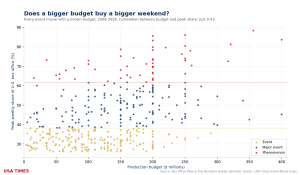
Reliable production budgets only really begin in the 2000s — studios almost never disclose audited costs — so the sharper comparison lives in the last two decades. Here, set each year’s biggest film against the year’s biggest budget, and the lines that once sat far apart begin to converge.

Divide each year’s biggest film by its own budget and the shift is stark. The lean, star-driven dramas of 2014–16 — PK, Bajrangi Bhaijaan, Dangal — returned nine, twelve, even twenty-eight times their cost. The ₹500-crore visual-effects spectacles that followed clear their budgets by far less: 2.0 managed about 1.2×, Pushpa: The Rise about 1.4×.

There’s a second pattern in the table below: the year’s costliest film is very often not the year’s biggest hit. Ra.One (2011), Mohenjo Daro (2016), Saaho (2019) and Adipurush (2023) were among the most expensive films India had ever made — and each underwhelmed. Budget and gross crowns landed on the same film only in the true event years: Enthiran, Baahubali 2, 2.0 and RRR.
A necessary caveat about the numbers
Treat every budget here as an estimate, not a fact, and treat the newest grosses with care too. Records are increasingly declared in real time on social media and unofficial “box-office graph” accounts, long before anything is audited — as when Reddit’s Bollywood forums crowned 2025’s Dhurandhar the top Hindi grosser within days of release.

The budget era, year by year
| Year | Top film | Lang. | Worldwide gross | Budget (est.) | Gross ÷ budget | Year’s costliest film |
|---|---|---|---|---|---|---|
| 2008 | Ghajini | Hindi | ₹194.58 cr | ₹52 cr | 3.7× | Ghajini (₹52 cr) |
| 2009 | 3 Idiots | Hindi | ₹400.61 cr | ₹55 cr | 7.3× | Blue (~₹80 cr) |
| 2010 | Enthiran | Tamil | ₹283 cr | ~₹150 cr | 1.9× | Enthiran (~₹150 cr) |
| 2011 | Bodyguard | Hindi | ₹253 cr | ₹60 cr | 4.2× | Ra.One (~₹135 cr) |
| 2012 | Ek Tha Tiger | Hindi | ₹335 cr | ₹75 cr | 4.5× | Ek Tha Tiger (₹75 cr) |
| 2013 | Dhoom 3 | Hindi | ₹556.74 cr | ~₹125 cr | 4.5× | Dhoom 3 (~₹125 cr) |
| 2014 | PK | Hindi | ₹769.89 cr | ₹85 cr | 9.1× | Happy New Year (~₹150 cr) |
| 2015 | Bajrangi Bhaijaan | Hindi | ₹918.18 cr | ₹75 cr | 12.2× | Prem Ratan Dhan Payo (~₹180 cr) |
| 2016 | Dangal | Hindi | ₹1,968–2,054 cr | ₹70 cr | 28.1× | Mohenjo Daro (~₹120 cr) |
| 2017 | Baahubali 2 | Telugu | ₹1,810.43 cr | ₹250 cr | 7.2× | Baahubali 2 (₹250 cr) |
| 2018 | 2.0 | Tamil | ₹699.89–800 cr | ~₹570 cr | 1.2× | 2.0 (~₹570 cr) |
| 2019 | War | Hindi | ₹475.62 cr | ₹170 cr | 2.8× | Saaho (~₹350 cr) |
| 2020 | Tanhaji | Hindi | ₹368 cr | ~₹150 cr | 2.5× | Tanhaji (~₹150 cr) |
| 2021 | Pushpa: The Rise | Telugu | ₹350–360 cr | ~₹250 cr | 1.4× | Pushpa / 83 (~₹250 cr) |
| 2022 | RRR | Telugu | ₹1,300–1,387 cr | ₹550 cr | 2.4× | RRR (₹550 cr) |
| 2023 | Jawan | Hindi | ₹1,148.32 cr | ₹300 cr | 3.8× | Adipurush (~₹500–700 cr) |
| 2024 | Pushpa 2 | Telugu | ₹1,642–1,800 cr | ~₹500 cr | 3.3× | Kalki 2898 AD (~₹600 cr) |
One thing about each
- 1975 — Sholay: the ₹3-crore “curry western” that ran for over five years at Mumbai’s Minerva theatre and became the template for the Indian blockbuster.
- 1994 — Hum Aapke Hain Koun..!: the first film to push a year’s top gross past ₹100 crore, a decade before Bollywood started counting in “crore clubs.”
- 2008 — Ghajini: the first Bollywood film to cross ₹100 crore net in India, inventing the “100 Crore Club” studios have chased ever since.
- 2016 — Dangal: a ₹70-crore wrestling drama that grossed roughly ₹2,000 crore worldwide (most of it in China) — still the highest-grossing Indian film ever, and the best budget-to-gross return of the modern era.
- 2017 — Baahubali 2: the first Indian film past ₹1,000 crore worldwide, in about ten days.
- 2022 — RRR: “Naatu Naatu” became the first song from an Indian film to win an Academy Award.
- 2024 — Pushpa 2: India’s biggest hit of the year was also marred by tragedy — a stampede at its Hyderabad premiere killed a woman and led to Allu Arjun’s brief arrest.
Methodology & sources: The highest-grossing Indian film and worldwide gross for every year, 1940–2026, are from Wikipedia’s List of highest-grossing Indian films (figures are worldwide gross inclusive of taxes; pre-1990 figures in particular are rough historical estimates, and several years are reported as ranges — the low end is charted). Budgets are the most commonly cited estimates from Wikipedia film pages and trade press including Wikipedia’s List of most expensive Indian films, Box Office India, Bollywood Hungama, Koimoi and Variety; they are not audited, and “budget” is defined inconsistently (production-only vs. inclusive of prints & advertising). All rupee figures are nominal and NOT adjusted for inflation or exchange rates, so most of the long-run rise reflects price changes, a weaker rupee, and the growth of overseas and pan-India markets; the gross-to-budget multiple is the more comparable measure. Selected sources: Ra.One budget (Bollywood Hungama); Baahubali 2 ₹1,000 cr (Box Office India); RRR Oscar (CNN); Adipurush most-expensive (Koimoi); Kalki 2898 AD 2024 costliest (Koimoi); Pushpa 2 stampede (Gulf News). 2025–26 titles (Dhurandhar and its sequel) are recent and their figures remain provisional.
Related from the USA Times Data Desk
- The Star Movies of the Last 20 Years: The Complete USA Times Index
- Wikipedia Credits a 1982 Bollywood Film With Nearly Double Sholay's Gross. Its Citations Are About Completely Different Movies.
- The Star Movies of 2024: Every Film That Took Over a Week at the Box Office
- The Star Movies of 2026, So Far (Updated Weekly)
- Box-office coverage index · the Star Index methodology
Sources
- List of highest-grossing Indian films — Wikipedia
- Box Office Mojo — India box office
- USA Times — Star Index methodology & data sources