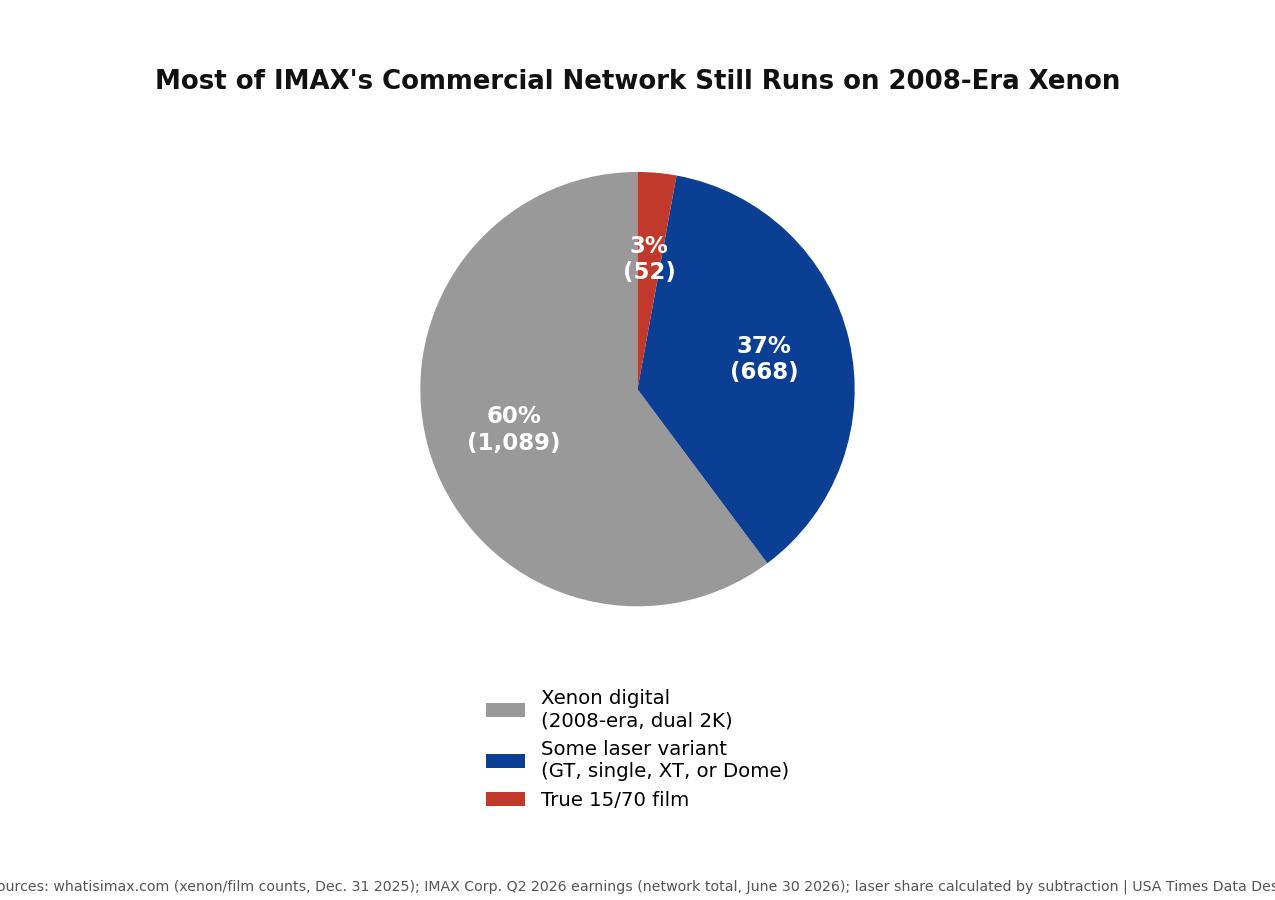
IMAX Corporation has been selling laser projection systems since December 2014, and the company’s marketing has leaned hard into laser as the modern IMAX standard ever since. But according to whatisimax.com’s projection-system reference — which tracks IMAX’s installed base by generation using IMAX Corporation press releases and SEC filings — 1,089 of IMAX’s commercial locations were still running the original 2008-era xenon digital system as of the end of 2025. That’s the single largest technology tier in IMAX’s entire network, more than a decade after the company began phasing in its replacement.
Doing the math on what’s left
IMAX doesn’t publish a single, current, all-up breakdown of its network by projection tier — laser installations aren’t reported separately from the network total in the company’s investor materials. But two figures, read together, get close. Whatisimax.com’s reference puts IMAX’s xenon-system count at 1,089 locations and its true 15/70 film-system count at 52 locations, both as of December 31, 2025. IMAX Corporation’s own second-quarter 2026 earnings release puts the commercial network at 1,809 locations as of June 30, 2026. Subtracting the known xenon and film counts from the total network size — acknowledging the roughly six-month gap between those two snapshots — leaves approximately 668 locations running some flavor of laser projection: GT Laser, single-laser commercial systems, Laser XT, or Laser Dome, combined. That’s a laser-adoption share of roughly 37% of the commercial network, using this approximation — meaningful progress in a decade, but still well short of a full replacement cycle.
Laser isn’t one thing, and most laser isn’t full-frame
The laser share itself isn’t uniform. USA Times’ Data Desk previously covered the technical differences between IMAX’s laser configurations: only GT Laser — the original, dual-projector flagship system — and its dome equivalent are capable of the format’s signature full 1.43:1 frame. The single-projector commercial laser system introduced in 2018, and the lower-cost Laser XT variant introduced in 2021, both cap out at 1.90:1, the same ceiling as the xenon system they’re gradually replacing. In other words, most of the roughly 668 estimated laser installations are almost certainly upgrading brightness, contrast, and maintenance costs — not expanding the picture itself.
Batmandir · Guest Passes Step inside for a day. Guest passes from $161/day — brought in by a member. See guest passes →Only 63 screens on Earth can do what IMAX was originally built to do
USA Times’ Data Desk’s own inventory of true 1.43:1-capable venues — covered in detail separately — counted 63 screens worldwide capable of the full frame: 55 flat screens (a mix of 70mm film and GT Laser) plus 8 dome theatres. Set against IMAX’s total worldwide system count of 1,876 as of June 30, 2026, that means roughly 3% of everything branded “IMAX” globally can actually show the format at its original, defining scale. The other 97% — regardless of whether it’s running decade-old xenon or brand-new laser hardware — is capped at a smaller frame than the format was built around.
Why the replacement cycle is taking this long
A slow xenon-to-laser transition isn’t unique to IMAX — it reflects the economics of premium cinema equipment generally. Projection systems represent a large fixed capital investment for exhibitors, whether they’re purchased outright or installed under one of IMAX’s revenue-sharing arrangements, and neither IMAX nor its theater partners have an incentive to retire a functioning xenon system years before the end of its useful life just because a newer option exists. IMAX’s Q2 2026 results show the company installed 38 new systems in the quarter — its strongest second-quarter total in a decade — which suggests the replacement pace may be accelerating, but even at that pace, working through over a thousand remaining xenon installations one contract cycle at a time is a multi-year proposition, not something that happens in a single upgrade wave.
What this means for the “is it really IMAX” question
None of this means xenon-system IMAX is a bad moviegoing experience — it’s still a substantially larger screen and louder, more immersive sound system than a standard multiplex auditorium. But it does mean that the gap between “IMAX” as a brand and “IMAX” as the specific large-format experience the company was built around in 1970 is wider than most ticket buyers likely assume. A film fan chasing the format’s original promise — the full 1.43:1 frame, the largest possible canvas — has a genuinely small list of screens worldwide that can deliver it, no matter how many locations now carry the IMAX name.
The 57 “institutional” locations are a different story entirely
IMAX’s Q2 2026 network figures separate 57 “institutional” locations — museums, science centers, and similar educational venues — from its 1,809 commercial multiplexes. That distinction matters for the film-versus-digital question specifically. IMAX’s business began in the educational and institutional market in 1970, decades before the company entered commercial multiplexes, and many of its oldest, longest-running installations are in exactly these kinds of venues. It’s a reasonable expectation, though not something IMAX’s Q2 release itself breaks out, that true 15/70 film projection is disproportionately concentrated in this smaller institutional segment relative to IMAX’s much larger commercial network — a legacy of where the format actually started, decades before “IMAX” became a brand most moviegoers associate with blockbuster releases at their local multiplex.
What we did
The xenon-system count (1,089) and 70mm film-system count (52), both as of December 31, 2025, come from whatisimax.com’s projection-format reference, an independent site not operated by IMAX Corporation that compiles its figures from IMAX Corporation press releases, SEC filings, and patent records. The commercial network total (1,809 as of June 30, 2026) and worldwide system total (1,876) come directly from IMAX Corporation’s Q2 2026 earnings release. The approximately 668-location laser estimate and the roughly 37% laser-adoption share are our own calculation — subtracting the known xenon and film counts from the total network size — and should be read as an approximation rather than an IMAX-published figure, given the roughly six-month gap between the underlying snapshots and the fact that IMAX does not itself publish a current laser-specific installation count. The 63-screen true-1.43:1 figure comes from USA Times’ own prior reporting and inventory work, not from IMAX Corporation or whatisimax.com. The institutional-location count (57) comes from IMAX’s Q2 2026 earnings release; the observation that film projection likely concentrates in that segment is our own reasonable inference based on IMAX’s publicly known company history, not a breakdown IMAX itself has published.
Related from the USA Times Data Desk
- 39 Films in 1.43
- Every Screen on Earth That Can Show The Odyssey in True IMAX 70mm — All 41 of Them
- IMAX at Home: Every Film That Opens Up to the Expanded Frame — and Why It’s Never the Real 1.43
- The 1% of Screens That Now Rule the Box Office: How IMAX Won the Post-Streaming Era
- Box-office coverage index · the Star Index methodology