In 2005, studios put 137 movies into wide release in North America. By 2013, that number had fallen to 121 — and it kept falling, bottoming out at just 55 wide releases in pandemic-disrupted 2020 before partially recovering. Even in 2025’s rebuilt release calendar of 169 wide releases (a number inflated partly by smaller, independent-adjacent titles counted in the “all studios” total), the concentration of box office dollars into fewer, bigger films is one of the clearest structural shifts in the twenty-year data — and it’s a direct consequence of the same revenue-per-admission math driving the rest of this series.

The revenue-per-release math
Dividing total nominal box office revenue by the number of wide releases in a given year produces a rough but telling metric: how much box office, on average, each wide release needs to generate to keep the total revenue pool where it’s been. In 2005, that figure was about $64 million per wide release. By 2025, it’s roughly $50 million — a figure that looks like it’s actually fallen, until you account for the fact that 2025’s release count (169) is unusually high relative to the mid-2010s trough years; narrowing to the 2013-2019 period, when release counts sat consistently in the 120-130 range, average revenue per wide release ran closer to $85-90 million, a substantially higher bar than 2005’s $64 million.

Why fewer, bigger releases makes financial sense
If the total pool of moviegoing dollars is roughly flat or growing only slowly (as this series’ opening piece on the revenue-versus-admissions divergence documents), then spreading that pool across fewer releases means each one can, in principle, capture a larger average slice. That’s a rational response to a shrinking-audience environment: rather than fund a wide slate of mid-budget films hoping several find an audience, studios have increasingly concentrated marketing spend, screen counts, and release-date real estate around a smaller number of films expected to be genuine events — franchise entries, established IP, films built around a marketing hook large enough to cut through a media environment with far more competing entertainment options than existed in 2005.
The mid-budget movie is the casualty
What this data can’t directly show — because it counts releases, not budgets — is the category of film most commonly cited as the casualty of this shift: the mid-budget original drama, thriller, or comedy that used to fill out a studio’s release calendar between the tentpoles. Industry reporting on this trend (outside what admissions and release-count data alone can confirm) has consistently pointed to those films moving to streaming platforms, shrinking in number, or getting pushed to independent studios operating with different economics than the major-6 wide-release machine this dataset tracks. The release-count decline documented here is consistent with that narrative, even though it can’t independently prove which specific budget tier absorbed the loss.
2020 as the extreme case, not the new normal
2020’s collapse to 55 total wide releases (versus 130 the year before) is a useful extreme data point precisely because it shows what happens to the release calendar when a shock removes both production capacity and audience demand simultaneously — many films slated for 2020 simply moved to 2021 or later rather than releasing into an empty marketplace. The subsequent recovery in release counts (93 in 2021, climbing back above 140 by 2023-2024) shows the industry rebuilding its release calendar, but the fact that recent years’ release counts (149 in 2023, 174 in 2024) have actually exceeded pre-pandemic norms while per-release average revenue has not proportionally kept pace suggests some of that rebuilding has come from smaller films re-entering the “wide release” count without necessarily restoring the mid-tier blockbuster economics that prevailed a decade earlier.
What this means for moviegoers and the industry
For audiences, fewer, bigger releases mean a theatrical calendar increasingly organized around a handful of high-profile “event” weekends rather than a steady, varied stream of new options every week — part of why the phrase “there’s nothing to see at the movies right now” has become a familiar refrain even in years with respectable total box office. For the industry, it means individual release decisions carry higher stakes: a single underperforming tentpole does more damage to the year’s total when it represents a larger share of the release slate’s expected revenue, and there are fewer other releases in the calendar to absorb the shortfall. Both dynamics are logical consequences of the same underlying pressure — a shrinking, pricier-per-ticket audience that studios have responded to by placing fewer, larger bets rather than continuing to fund the wider spread of films that characterized the mid-2000s theatrical calendar.
The 2020 discontinuity, and what the rebuild actually looked like
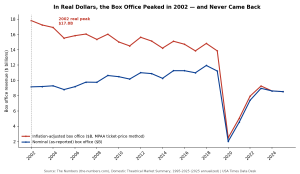
The collapse to 55 total wide releases in 2020, down from 130 the year before, is the sharpest single-year move anywhere in this dataset, and the subsequent rebuild has followed an unusual shape worth spelling out year by year: 93 releases in 2021, 110 in 2022, a jump to 149 in 2023, and 174 in 2024 — a release count that, by the two most recent years, has actually exceeded every pre-pandemic year in the dataset back to 2005. That’s a genuinely surprising finding on its face, since it seems to run against the “fewer, bigger releases” narrative this article otherwise supports. The resolution is in the revenue-per-release math: even with more total releases than a decade ago, 2023’s and 2024’s box office totals were both below the 2018 peak of $11.9 billion, meaning the larger release count is being spread across a smaller total revenue pool — consistent with a rebuild that has restored release volume, largely through smaller and mid-tier films re-entering the wide-release count, without restoring the per-release economics that prevailed before the pandemic.
A tale of two kinds of “wide release”
The Numbers’ wide-release count doesn’t distinguish between a film opening on 4,000 screens with a nine-figure marketing budget and one opening on 1,000 screens with a fraction of that spend — both simply count as one wide release in the year’s total. That’s an important limitation for this analysis: the release-count recovery visible in 2023-2024 could reflect either a genuine return to a more varied release calendar, or simply more films clearing the technical bar of “wide release” status without approaching the scale of the tentpoles that increasingly dominate the revenue side of the ledger. Distinguishing between those two possibilities with confidence would require screen-count or per-title budget data this analysis didn’t have access to — a limitation worth stating rather than resolving with a guess.
What we did
Wide-release counts (both “major 6 studios” and “all studios” totals) and nominal box office figures come from The Numbers’ Domestic Theatrical Market Summary (the-numbers.com), which tracks wide releases by studio back to 1995; the 2025 release count and box office figures reflect an annualized/year-to-date basis per The Numbers’ own labeling. Average revenue-per-release figures were calculated by us by dividing each year’s total nominal box office by that year’s total wide-release count — a rough industry-wide average that does not reflect the actual, highly unequal distribution of revenue across individual films within any given year (a small number of top performers capture a disproportionate share of any year’s total, which this per-release average necessarily smooths over). The characterization of mid-budget films migrating to streaming platforms or independent financing reflects widely reported industry trends and commentary that this dataset’s release-count and revenue figures are consistent with, but does not independently prove; we did not have access to studio-level budget-tier data to verify the mechanism directly.