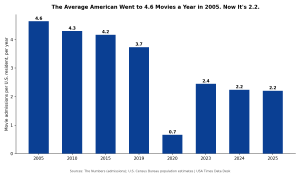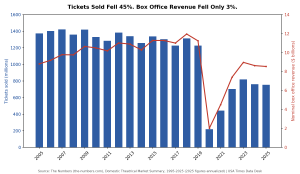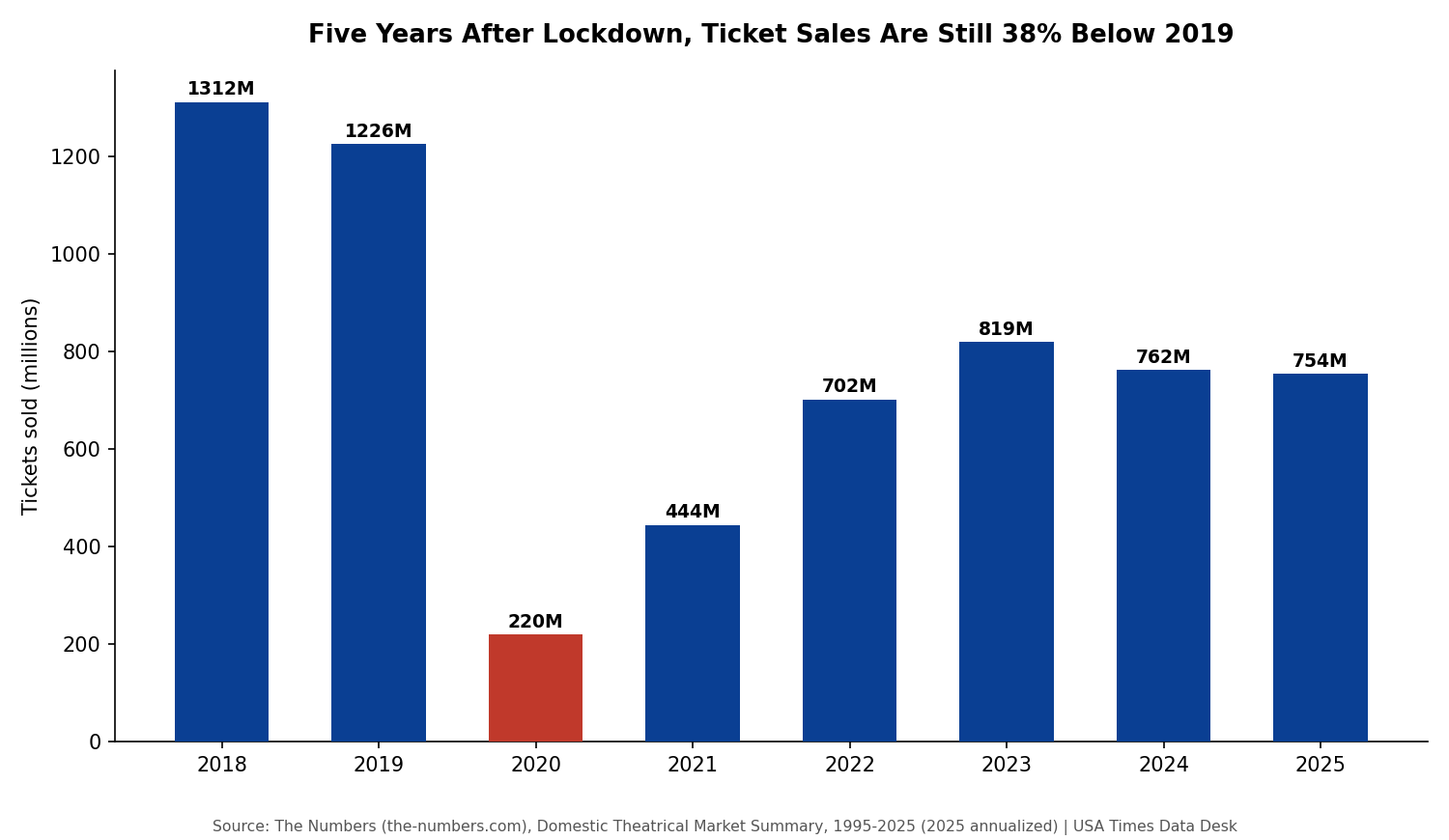
Five years after theaters went dark in 2020, U.S. and Canadian admissions remain roughly 38% below where they stood in 2019. That’s not a snapshot from the depths of the shutdown — 2025’s annualized total of about 754 million tickets is a genuine, multi-year recovery from the 220 million tickets sold in 2020’s wipeout year. But “recovered from the bottom” and “back to normal” are very different claims, and the data makes clear the industry has settled into a new, permanently smaller normal rather than climbing back to its old one.
The scale of the initial collapse
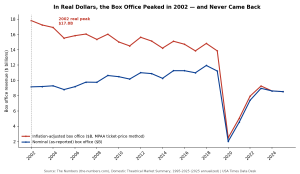
The numbers from 2020 are still startling to look at directly. Admissions fell from 1.23 billion in 2019 to about 220 million in 2020 — an 82% single-year collapse, by far the largest year-over-year move anywhere in the three-decade dataset this series draws on. Box office revenue fell in roughly the same proportion, from $11.2 billion to just over $2 billion. For a period of months, most U.S. theaters were legally closed or operating at sharply reduced capacity, and the films that would normally have anchored 2020’s release calendar were delayed, sometimes repeatedly, into 2021 and beyond.
A recovery curve, not a snapback
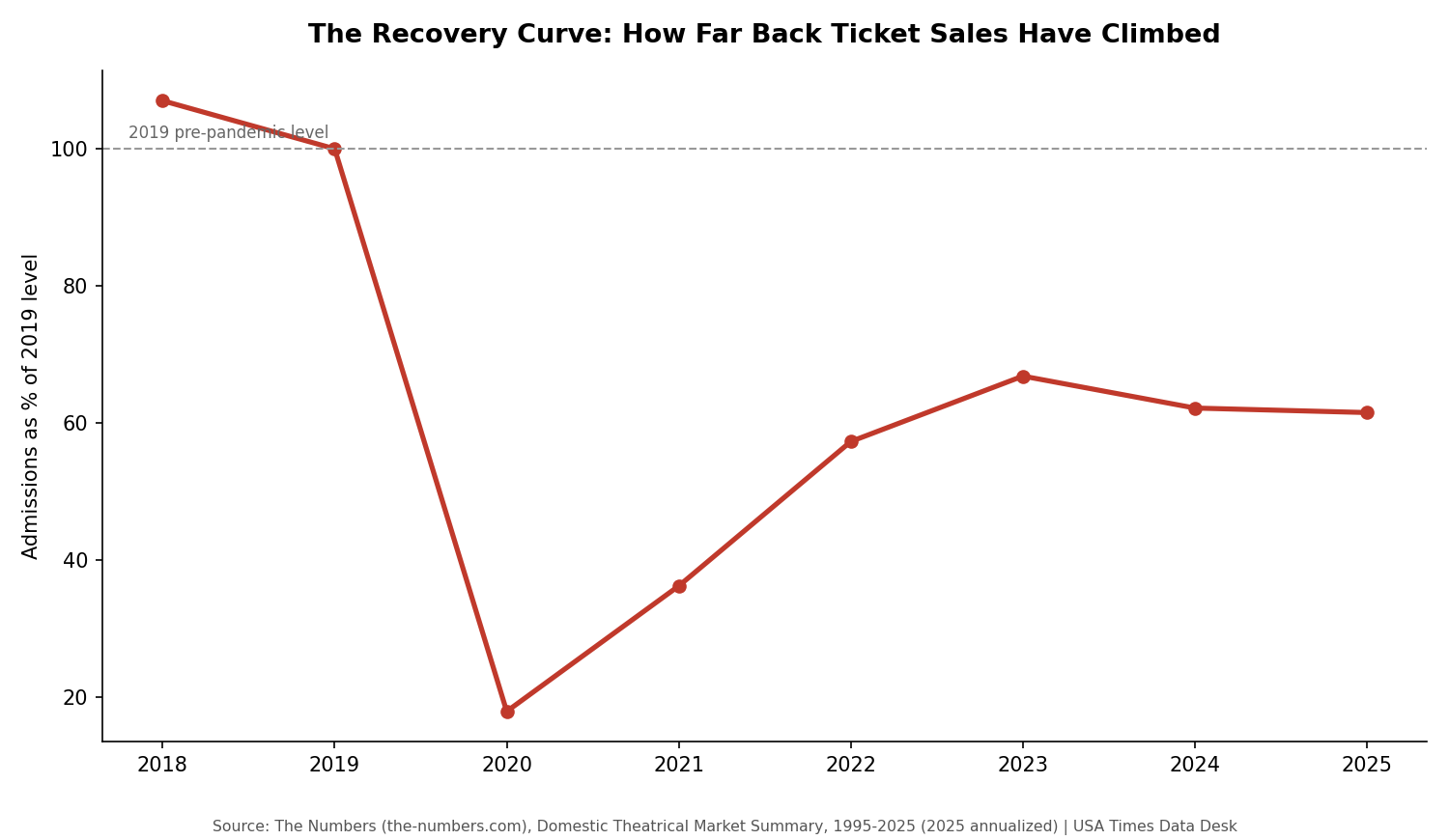
Plotting each subsequent year as a percentage of 2019’s admissions total turns the recovery into a clear, if incomplete, upward curve: roughly 5% of 2019 levels in the depths of 2020, climbing to about 36% in 2021 (as theaters reopened but blockbuster release schedules were still disrupted), 57% in 2022, 67% in 2023, and roughly 62% in both 2024 and 2025 — the recovery appears to have plateaued rather than continuing its earlier upward trajectory. Four to five years out from the initial shock, the industry is not still climbing back at the pace it was in 2021-2023; it has leveled off at a materially smaller size than it was before.
Why the plateau matters more than the initial drop
A sharp pandemic-era collapse followed by an incomplete but ongoing recovery is one story — arguably a reassuring one, since it implies the trend line still points up. A collapse followed by a recovery that stalls out well below the old baseline is a different, more structural story: it suggests a meaningful share of pre-pandemic moviegoers didn’t come back not because they were still cautious about crowds (a temporary, fading effect), but because the shutdown accelerated a permanent shift in how they spend a discretionary evening — toward streaming, toward staying home, toward other forms of entertainment that got materially better and more convenient during the exact period theaters were closed. The plateau in 2024-2025 is the strongest single piece of evidence in this dataset that the shift is durable rather than temporary.
The strike years complicate the picture
2023’s relatively strong admissions total (819 million tickets, the best post-pandemic year on record) came despite — or arguably partly because of — the 2023 Hollywood labor disputes (the WGA and SAG-AFTRA strikes), which disrupted production but didn’t meaningfully affect a release slate that had mostly already been locked in and filmed well before the strikes began. What the strikes did affect was 2024’s slate: fewer films finished production on the normal pre-strike timeline, contributing to a thinner 2024 release calendar and helping explain why 2024’s admissions (762 million) came in below 2023’s, even as the broader public health rationale for staying home had long since faded. Disentangling how much of the 2024 dip reflects strike-driven supply disruption versus a genuine demand plateau is difficult with box office data alone — both were very likely factors, in some proportion this dataset can’t precisely separate.
What would a full recovery even require
Getting back to 2019’s 1.23 billion admissions from 2025’s roughly 754 million would require a 63% increase in ticket sales from current levels — a jump larger than the entire gain achieved across all five years since the pandemic bottom combined. Nothing in the recent year-over-year trend suggests that scale of increase is coming from the current release-and-pricing model; if anything, the 2024-2025 plateau suggests the industry and audience have found a new equilibrium well below the old one. Getting back to 2019 levels, if it happens at all, would likely require either a structural change in what theaters offer that isn’t available at home (which is part of the argument for premium formats, covered elsewhere in this series) or a broader cultural shift back toward theatrical moviegoing that isn’t visible in any current data trend.
Comparing this recovery to the industry’s other shocks
The 2020 collapse dwarfs every other disruption in this three-decade dataset, but it wasn’t the industry’s first shock. The 2008-2009 financial crisis, for instance, barely registers in the admissions data at all — 2009 actually posted the highest single-year admissions total (1.42 billion) in the entire post-2005 window this series examines, a reminder that movie theaters have historically been considered a relatively recession-resistant form of entertainment, an inexpensive escape when household budgets tighten elsewhere. That the pandemic-era decline has proven so much more durable than the financial-crisis-era resilience underscores that 2020’s disruption wasn’t primarily an economic one in the traditional sense — it was a supply shock (theaters physically closed) that appears to have triggered a lasting demand shift (audiences finding satisfactory substitutes at home) rather than a temporary belt-tightening that reverses once household finances recover.
What the release calendar looked like on the way back
Part of the recovery curve’s shape reflects how cautiously studios rebuilt the release calendar rather than purely how cautious audiences were. Major tentpoles that would normally have anchored 2020 and 2021 were pushed back, sometimes repeatedly, as studios waited for theater capacity restrictions to lift and for audience confidence to return — meaning part of 2021’s weak 36%-of-2019 admissions figure reflects a genuinely thin slate of major releases available to see, not purely audience reluctance to attend the releases that did come out. By 2022-2023, as the release calendar normalized and delayed tentpoles finally reached theaters, the recovery curve’s steeper climb in those years likely reflects pent-up demand for specific delayed titles as much as a broader normalization of moviegoing habits — which makes the subsequent 2024-2025 plateau, once that backlog of delayed releases had cleared, arguably a more accurate read of the underlying post-pandemic demand level than the sharper 2022-2023 recovery years were.
What we did
Annual admissions and box office figures (2018-2025) come from The Numbers’ Domestic Theatrical Market Summary (the-numbers.com); the 2025 figure is an annualized run-rate per The Numbers’ own labeling, not a final closed-year total. Recovery-curve percentages were calculated by us, dividing each year’s admissions by 2019’s total. The characterization of the 2023 WGA/SAG-AFTRA strikes’ effect on the 2024 release slate reflects widely reported industry analysis at the time of the strikes and their aftermath; we did not independently verify a causal, quantified link between the strikes and the specific 2024 admissions shortfall, and present that connection as a plausible contributing factor rather than a proven one. The suggestion that streaming and at-home entertainment improvements are drawing away a meaningful share of the pre-pandemic theatrical audience reflects general, widely discussed industry commentary rather than consumer survey data we independently reviewed.