As of July 8, 2026, New York City had 7,625 active sidewalk shed permits on its books, covering more than 1.76 million linear feet of sidewalk — roughly 334 miles, or about the driving distance from Manhattan to Cleveland. The city says the total is shrinking: Buildings Commissioner Ahmed Tigani said in March that “efforts led by the Buildings Department have already led to a 17% decline in sidewalk sheds citywide.” But a closer look at the same data shows a more complicated story underneath that headline number — the sheds that have been up the longest, the ones New Yorkers complain about most, are not just persisting. There are more of them now than there were a year and a half ago.
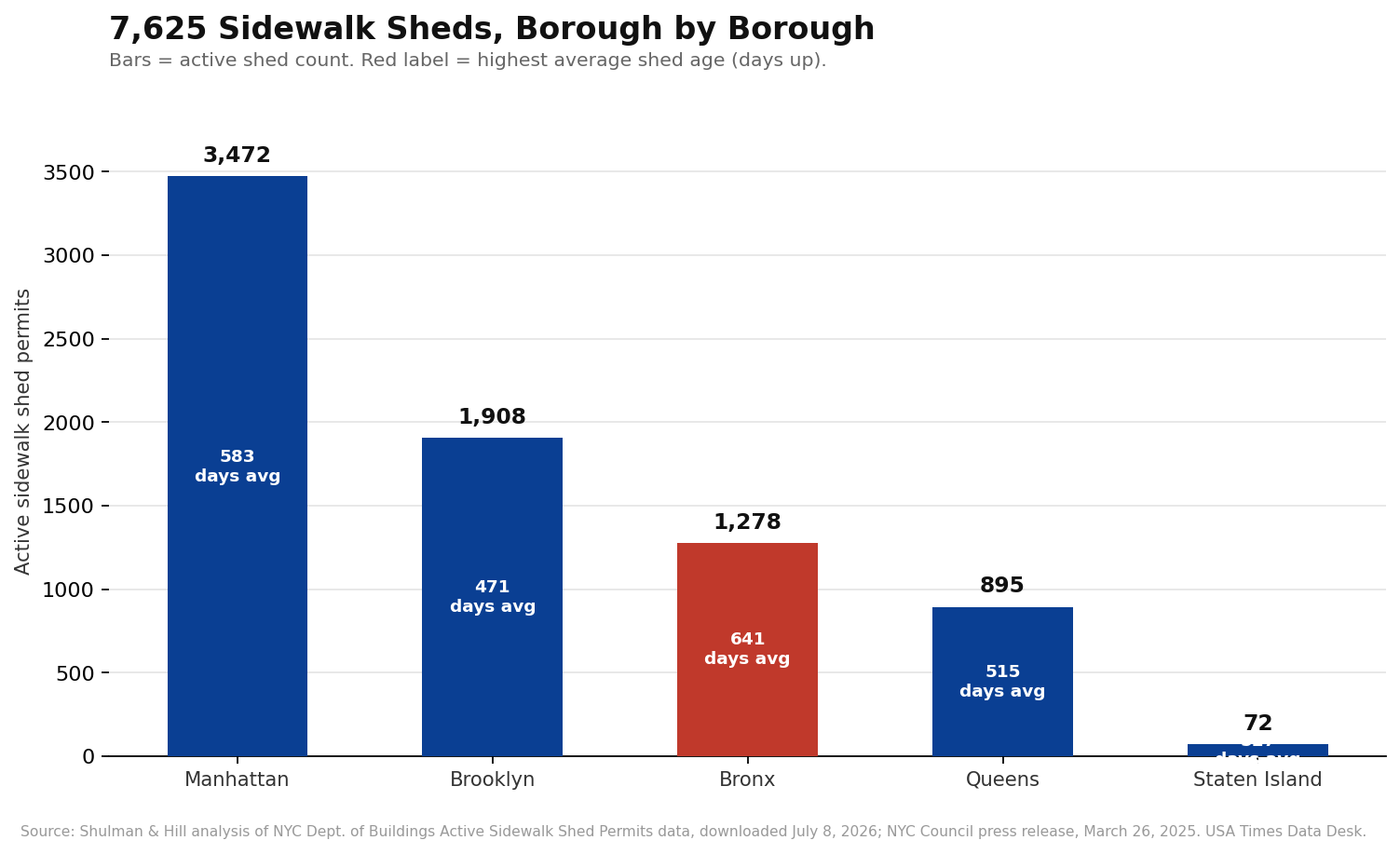
Active Sidewalk Sheds by Borough, July 8, 2026
Hover any bar for average shed age — the Bronx has fewer sheds than Manhattan, but they sit up longest.
Batmandir · The Circle Full access to theatres, museums & exhibitions. S2 · ongoing membership, without a Founder’s seat. Explore membership →Two counts, fourteen months apart
The New York City Council put a number on the problem in a March 26, 2025 press release announcing a package of scaffolding reform bills: “over 8,400 scaffolding structures across New York City,” with an average age of “over 500 days,” and — the figure worth holding onto — “334 scaffolding structures have been in place for more than five years.” Council Member Keith Powers, the bills’ lead sponsor, put the total shed length at “over 400 miles.”
Fourteen months later, on July 8, 2026, personal-injury law firm Shulman & Hill pulled the Department of Buildings’ own live active-permit data — the same public dataset DOB maintains on its “Active Sidewalk Shed Permits” map — and found 7,625 active sheds, covering 333.7 miles. On the numbers the city likes to cite, that is real progress: roughly 800 fewer sheds and about 66 fewer miles of scaffolding than the Council counted at its March 2025 baseline.
The number that went the wrong way
The July 2026 data also counted how many of those active sheds had been standing for at least five years — the threshold the city itself uses to define a “long-standing shed” and the category its “Get Sheds Down” initiative was specifically built to target. That count was 356. In March 2025, it was 334. Despite an overall decline of roughly 800 sheds citywide, the specific subset of sheds that have outlived their purpose the longest actually grew by 22 over the same period. The city can genuinely be taking sheds down — newer, shorter-duration ones, tied to routine façade repairs that get finished on schedule — while the oldest, most stubborn sheds keep aging past the five-year mark faster than they get resolved.
The oldest single shed in the July 2026 dataset was outside 605 East 9th Street in Manhattan, first permitted on September 29, 2010 — 5,760 days, or just under 16 years, before this snapshot was taken. Nine more sheds elsewhere in the city had been up for at least 11 years apiece. Twenty-one sheds citywide had crossed the decade mark.
Where the burden actually falls
Manhattan carries the bulk of the citywide total by a wide margin: 3,472 active sheds as of July 2026, or about 46% of the city’s count, covering roughly 137 miles. Brooklyn was second with 1,908 sheds; the Bronx third with 1,278. But raw counts obscure a second pattern in the same data: the Bronx’s sheds, while fewer in number, sit up the longest. The average active shed in the Bronx had been standing 641 days as of the July snapshot — the highest average age of any borough, ahead of Manhattan’s 583 days, Staten Island’s 527, Queens’s 515, and Brooklyn’s 471. Several individual Bronx community districts — Riverdale/Kingsbridge, Mott Haven/Port Morris, Highbridge/Concourse — ranked among the ten neighborhoods citywide where sheds sit the longest on average, a pattern distinct from the Manhattan neighborhoods (Upper East Side, Midtown, Upper West Side) that simply have the most sheds in absolute terms.
Why the fixes are supposed to work — eventually
The city’s newest round of reforms, announced by Mayor Zohran Mamdani in March 2026, targets the structural reasons sheds linger rather than the sheds themselves. DOB is extending the interval between mandatory façade inspections under Local Law 11 from five years to six, with a reduced 12-year cycle for lower-risk, well-maintained buildings — reasoning that less frequent inspection triggers mean fewer buildings get flagged into a shed cycle in the first place. Separately, under Local Law 47 (passed by the Council in 2025), DOB is capping how far a shed tied to an unsafe façade can extend from the building itself, at 40 feet, down from a standard that could previously require covering sidewalk up to half a building’s height away. And under Local Law 48, DOB is rolling out penalties this summer for sheds kept up longer than 180 days, plus a requirement that owners report shed status to DOB and the public every 90 days. NYCHA, separately, is spending $650 million across 40 developments citywide on the façade repairs that are the actual precondition for taking its own long-standing sheds down — about $400 million of that had been spent and sheds removed at more than 200 buildings as of the March 2026 announcement.
None of those reforms had fully worked their way through the pipeline as of the July 2026 snapshot used in this analysis — the 180-day penalty enforcement under Local Law 48 wasn’t scheduled to take effect until this past summer, and inspection-cycle changes affect which buildings enter the shed system going forward, not sheds already up. The 356-versus-334 comparison captures the system before those specific levers were fully live, which is itself part of why it’s worth tracking going forward: it’s the baseline the newer rules will actually have to move.
What we did
We verified the March 2025 baseline figures — “over 8,400” sheds, average age over 500 days, 334 sheds standing five-plus years, “over 400 miles” of total shed length — directly against the New York City Council’s own March 26, 2025 press release announcing its scaffolding reform legislation, rather than a secondary summary of it. We verified the March 2026 “17% decline” figure directly against the NYC Mayor’s Office’s own press release quoting Buildings Commissioner Ahmed Tigani, along with the NYCHA repair-spending figures cited in the same release. For the current, more granular snapshot — the 7,625 total, the 356 long-standing sheds, and the borough- and community-district-level breakdowns — we relied on Shulman & Hill’s published analysis of the Department of Buildings’ own live “Active Sidewalk Shed Permits” dataset, downloaded July 8, 2026, since DOB’s underlying Open Data feed for this dataset was returning a server-side query error at the time of our research and could not be queried directly. We note as a limitation that the 8,400-to-7,625 and 334-to-356 comparisons come from two different organizations measuring at two different points roughly fourteen months apart, using DOB’s live data each time — not a single continuous tracking series — so the exact percentage change should be read as directionally reliable rather than to the decimal point.