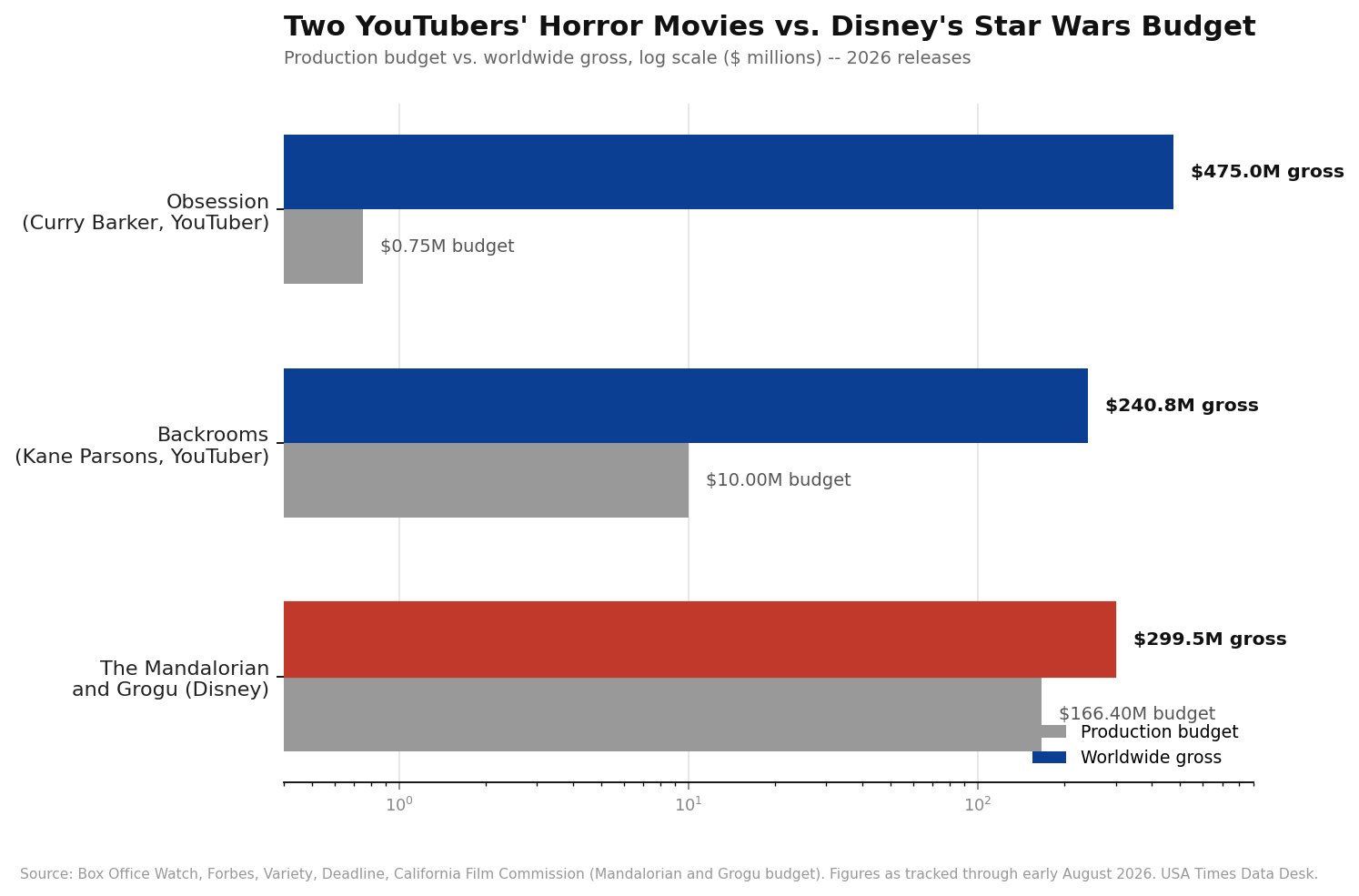
In May 2026, Disney released “The Mandalorian and Grogu,” the first new “Star Wars” theatrical film in seven years, on a reported production budget of $166.4 million. It has since been out-earned by two horror movies directed by YouTubers with no prior studio filmmaking credits. “Obsession,” directed by Curry Barker on a budget of $750,000, has grossed $475.0 million worldwide. “Backrooms,” directed by 20-year-old Kane Parsons on a reported $10 million budget, has grossed $240.81 million. Combined, the two YouTuber films cost $10.75 million to make and have earned $715.81 million worldwide — more than double what Disney’s Star Wars film has made on a budget more than 15 times larger.
Budget vs. Worldwide Gross, by Film
Click or hover each card for the full breakdown.
Batmandir · Guest Passes Step inside for a day. Guest passes from $161/day — brought in by a member. See guest passes →The film that actually won the summer
“Obsession” premiered at the 2025 Toronto International Film Festival, where Focus Features acquired distribution rights for $14 million — a huge multiple of its production cost, but still a fraction of what a studio tentpole spends on marketing alone. According to Forbes, the film went on to become Focus Features’ highest-grossing release ever and the highest-grossing film-festival acquisition of all time, surpassing “The Blair Witch Project,” long the reigning example of a microbudget horror film turning into a runaway hit. What made “Obsession” unusual wasn’t just its opening — it was its trajectory. Forbes contributor Paul Tassi reported that the film’s revenue actually increased 39% in its second weekend as word-of-mouth spread, an extremely rare pattern for a wide theatrical release, where box office normally declines every weekend after opening. By its third weekend, “Obsession” was outgrossing “The Mandalorian and Grogu” on a daily basis — $5.6 million to $4.1 million on one midweek day in early June, despite being three weeks into its run against Mando’s first week.
Then a second YouTuber-directed horror film beat them both
“Backrooms,” based on Kane Parsons’ viral internet horror concept of the same name, opened even bigger than “Obsession” had. Variety reported an $81.5 million domestic opening weekend and $118 million worldwide — a debut large enough to make it A24’s biggest domestic opener ever, on a reported budget of roughly $10 million. It went on to become A24’s highest-grossing worldwide release in the studio’s history, the first A24 film to cross $200 million globally, finishing with $152.38 million domestic and $88.43 million international for a $240.81 million worldwide total. For one weekend in late May, “Backrooms,” “Obsession” and “The Mandalorian and Grogu” were all in theaters at once — two films made by YouTubers with a combined budget under $11 million, going head-to-head with a $166.4 million Star Wars movie, and the Star Wars movie finished third.
What actually happened to Mando
“The Mandalorian and Grogu” did not open badly — Deadline reported a $98 million four-day domestic opening over Memorial Day weekend, comfortably winning the frame. The problem was what came after. By its third weekend, the film’s takings had dropped roughly 69%, falling behind both “Obsession” and “Backrooms” at the box office in the same frame. Box office trackers show the film’s worldwide total sitting at $299.47 million domestic-plus-international combined as of this writing — meaning it has not yet reached twice its own production budget, well short of the roughly 2 to 2.5 times budget that industry rule-of-thumb holds a studio film typically needs just to break even once marketing and distribution costs are included. Forbes noted the film is tracking below “Solo: A Star Wars Story,” the 2018 spinoff whose underperformance was widely credited with helping push Disney away from theatrical “Star Wars” films for years afterward. The California Film Commission’s own figures put the production budget at $166.4 million, before an estimated $21.75 million in tax credits — making it, by that measure, the least expensive Star Wars film Disney has produced, and still on pace to lose money.
Why microbudget horror keeps doing this
Neither “Obsession” nor “Backrooms” is the first ultra-low-budget horror film to massively outperform its cost — “Paranormal Activity” ($15,000 budget, nearly $200 million worldwide) and “The Blair Witch Project” (roughly $60,000, nearly $250 million worldwide) are the genre’s most famous prior examples. What’s different this time is the pipeline: both filmmakers built their followings directly on YouTube before making a theatrical feature, meaning both “Obsession” and “Backrooms” arrived with a built-in, highly online fan base primed to show up opening weekend and to promote the film for free across the same platforms where the directors had already spent years building an audience. Studio horror films still spend meaningfully on marketing; a YouTuber-director with millions of existing subscribers effectively gets a large chunk of that marketing for free, which is part of why a $750,000 production can compete directly with a $166.4 million one without needing anywhere close to comparable per-dollar promotional spending.
Why this matters beyond one weekend
For Disney, the underperformance lands at an awkward moment. Forbes noted the next “Star Wars” theatrical release, “Star Wars: Starfighter,” is due out in 2026 and represents its own risk — reportedly the first Disney-era “Star Wars” film built with no previously established characters from past films or shows. Meanwhile, on the television side, there are almost no new or returning “Star Wars” shows publicly confirmed beyond a long-delayed second season of “Ahsoka.” For the horror genre, the pattern of “Obsession” and “Backrooms” is likely to accelerate a trend already underway: studios and distributors chasing YouTube and social-media-native directors specifically because the audience-acquisition cost that normally eats into a horror film’s profit margin has already been paid, by the creator, over years of building a following — long before a studio ever puts up production money.
What we did
Box office and budget figures came from multiple named trade and box-office-tracking sources rather than a single aggregator: Obsession’s $750,000 budget and $475.0 million worldwide gross from Forbes (Tim Lammers, July 5, 2026) and Box Office Watch; its TIFF acquisition price and festival-record status from Forbes (Paul Tassi, May 29, 2026); Backrooms’ opening-weekend and total-gross figures from Variety and Box Office Watch/boxofficehype.com; and The Mandalorian and Grogu’s $166.4 million production budget from the California Film Commission’s own public filing, as reported by Star Wars Holocron and Star Wars News Net, with its opening-weekend and third-weekend decline figures from Deadline and Forbes. We flag one limitation directly: box office trackers do not fully agree on The Mandalorian and Grogu’s exact running worldwide total — we saw figures ranging from roughly $247 million to $299 million depending on the tracker and date — so we used the boxofficehype.com figure ($299.47 million) as the most complete and recently updated breakdown we found, and note that even the higher of the two figures does not change the article’s core comparison. The “2 to 2.5 times budget to break even” industry benchmark is a widely cited rule of thumb in trade press, not a figure specific to this film, and we’ve presented it as context rather than a precise claim about this film’s profitability.