Read in: English · Español · Русский · 中文 · Português
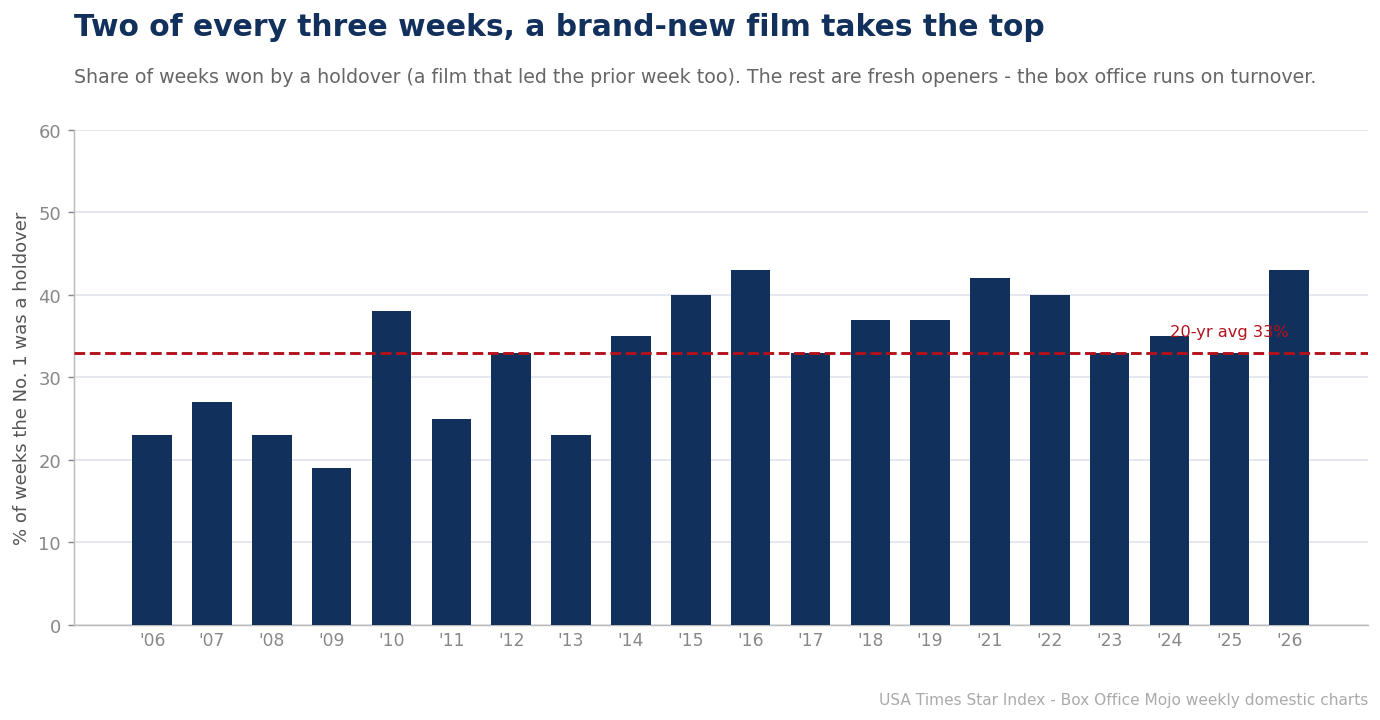
The U.S. box office runs on turnover. Across twenty years and more than a thousand weeks, two out of every three weekly No. 1 films were brand-new openers — movies that had not led the previous week. Only about a third of weeks were won by a holdover, a film defending the top from the week before. For all the talk of staying power and word of mouth, the dominant reality of the box office is constant replacement: most weeks, a new film walks in and takes the crown.
A market built on the new
The 67/33 split is remarkably stable, and it reflects the fundamental physics of the modern release calendar. Studios open wide films nearly every weekend, and because the box office is so front-loaded — a film almost always does its best business on opening — the newcomer usually arrives at the top and the incumbent falls back. The exceptions, the holdover weeks, are the ones where no new release was big enough to dislodge the reigning film, or where the reigning film was a genuine giant with enough altitude to survive the challenge.
Batmandir · The Circle Full access to theatres, museums & exhibitions. S2 · ongoing membership, without a Founder’s seat. Explore membership →The holdover rate is a hidden competitiveness gauge
Reading the holdover rate year by year tells you how contested the calendar was. When holdovers are rare, it means fresh films are constantly strong enough to seize the top — a busy, competitive market. When holdovers rise, it signals either an unusually dominant incumbent that refuses to fall or a soft stretch with no challenger large enough to matter. The metric is a useful complement to the winner-take-all gap: the gap measures how lopsided a given week is, while the holdover rate measures how often the same film keeps winning.
Notably, the holdover rate has ticked up in recent years, consistent with the falling one-week-wonder rate and the lengthening reigns of the biggest films. As the market concentrates around fewer, larger releases, those releases hold the top more often — nudging the holdover share above its long-run third. It is the same consolidation story, seen from the angle of turnover rather than dominance.
Why openers still rule
Even with that recent uptick, the headline holds: the box office remains, at its core, an opener’s game. Two-thirds of the time, the most important film in America this week is one that wasn’t last week. That churn is what makes the weekly box office such a live, restless indicator of the culture — and it is why opening weekend, not cumulative gross, is where studios pour their attention. In a market where a new film takes the top two weeks out of three, the entrance is very nearly everything.
| Weekly No. 1 is… | Share of weeks |
|---|---|
| A brand-new opener | 67% |
| A holdover (led prior week too) | 33% |
What actually makes a holdover
A holdover week — when the same film leads two weeks running — happens for one of two reasons, and they are opposites. The first is dominance: a giant opens so large that even after the standard second-weekend drop it still outgrosses everything new, holding the top on sheer altitude. The second is a vacuum: no new wide release that weekend is strong enough to unseat even a fading incumbent. The first kind of holdover is a sign of strength; the second is a sign of a soft calendar. Distinguishing them is the key to reading the holdover rate correctly — a year can post the same 35% holdover figure for completely different reasons.
The great holdovers
The longest holdover streaks belong, unsurprisingly, to the biggest films: Avatar: The Way of Water held the top across the 2022 holiday corridor; Top Gun: Maverick defended it deep into the summer of 2022; the top Star Wars and Avengers titles routinely strung together multiple weeks. These are dominance holdovers — films that kept winning because nothing could match them. At the other extreme, the quiet holdovers of January and late summer are vacuum holdovers, modest films left on top simply because the calendar around them was empty.
Why turnover makes the box office a live wire
The two-thirds opener rate is what gives the weekly box office its restless, newsy quality. Unlike an album chart, where a hit can sit at No. 1 for months, the movie box office resets constantly: most weeks there is a new king, a new story, a new opening number to parse. That churn is a feature, not a bug — it is what makes “number one at the box office” a headline worth chasing every single weekend, and why studios spend so heavily to win the specific weekend they open on. In a market where a new film takes the top two times out of three, the opening is the whole battlefield.
The recent tilt toward holdovers
The long-run 33% holdover rate has edged upward in the current decade, and the reason is the same consolidation visible everywhere in the Star Index. As the biggest films open larger and the mid-budget challenger disappears, incumbents hold the top slightly more often than they used to. It is a modest shift — the box office is still fundamentally an opener’s market — but it points the same way as every other metric here: toward fewer films, holding longer, with less fresh competition arriving to dislodge them. The turnover that defines the box office is slowing, just a little, year by year.
The opener economy
The two-thirds opener rate is the economic reason the movie business spends the way it does. Because a new film almost always arrives at the top and begins declining immediately, the entire marketing apparatus is engineered to maximize a single weekend’s awareness — the television blitz, the press tour, the premiere, all timed to peak on opening Friday. There is little point spending to sustain a film into week three when the data says week three will be a fraction of week one and the top will likely have changed hands. The opener economy concentrates spending into a narrow window, which in turn reinforces the front-loading that makes openers dominate in the first place. It is a self-perpetuating loop, and the 67% figure is its fingerprint.
For audiences, the churn has an underappreciated upside: the theatrical box office remains one of the few cultural charts that resets weekly, delivering a genuinely new headline nearly every Monday. In an era when a streaming hit can sit unchallenged for months and a song can hold No. 1 for a season, the movies still stage a fresh contest every weekend. Two of every three of those contests are won by a newcomer — which is exactly why the weekend box office endures as a live, weekly barometer of what America actually showed up for.
What we did: We walked the weekly chart in date order and flagged each week’s No. 1 as a holdover if the same film led the immediately prior week, and an opener otherwise. Weekly share is each film’s gross as a percentage of that week’s total U.S. domestic box office, from Box Office Mojo’s weekly charts, 2006–2026. We exclude 2020 as a pandemic anomaly.
Related from the USA Times Data Desk
- The Box Office Almost Never Slow-Burns
- The Perpetual Runner-Up: Twenty Years of No. 2
- Box-office coverage index
Sources
- Box Office Mojo — weekly and weekend box office grosses
- The Numbers — historical domestic box office records
- USA Times — Star Index methodology (how our tiers and box-office share are computed)