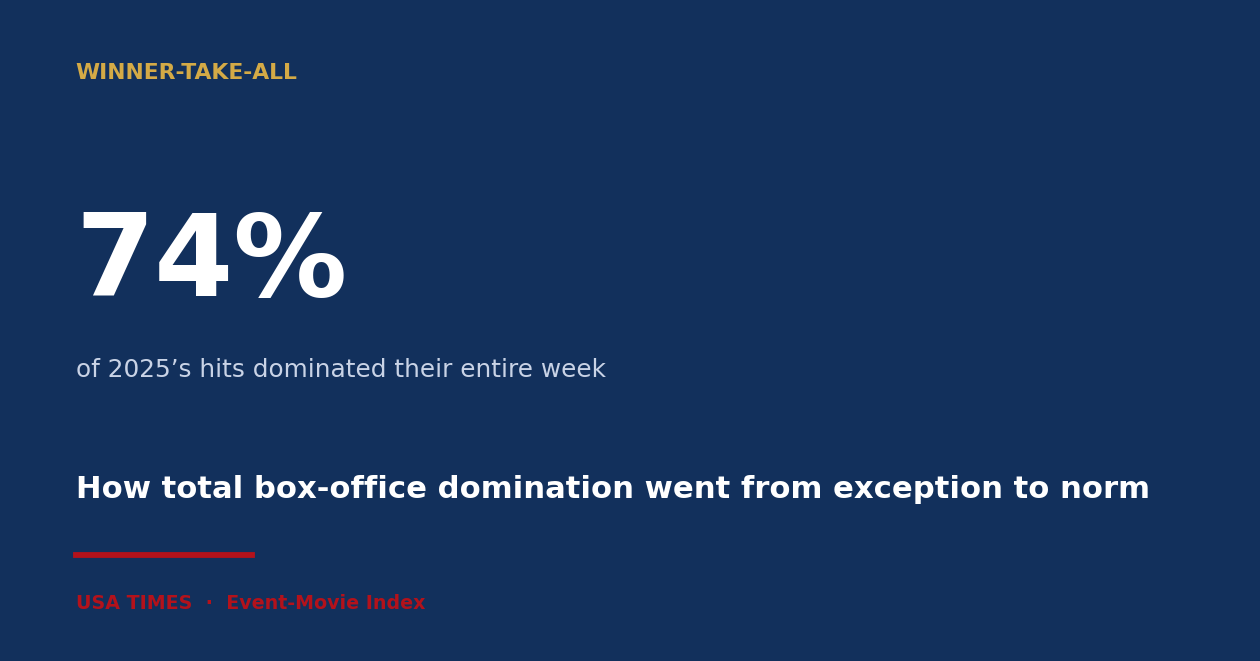
There is a difference between topping the box office and owning it. Plenty of films reach #1 in a crowded week with a modest slice of the take. A smaller club does something else: it swallows the week whole. Combine the USA Times Star Index’s two top tiers — Betelgeuses and Geuses, every film that captured 38.2% or more of an entire week’s U.S. box office — into a single category, call it a Dominant film, and a twenty-year pattern snaps into focus: domination is no longer the exception. It is becoming the norm.
Domination roughly doubled
In the first decade of the index (2006–2015), an average of 7.7 films a year reached the Dominant tier. In the second (2016–2025), that jumped to 13.4 — nearly double. As a share of all star movies, domination climbed from a 40% average to 55%, and in 2025 it hit 74%: of the 27 films that topped a week last year, twenty took 38.2%+ of it.
Batmandir · Guest Passes Step inside for a day. Guest passes from $161/day — brought in by a member. See guest passes →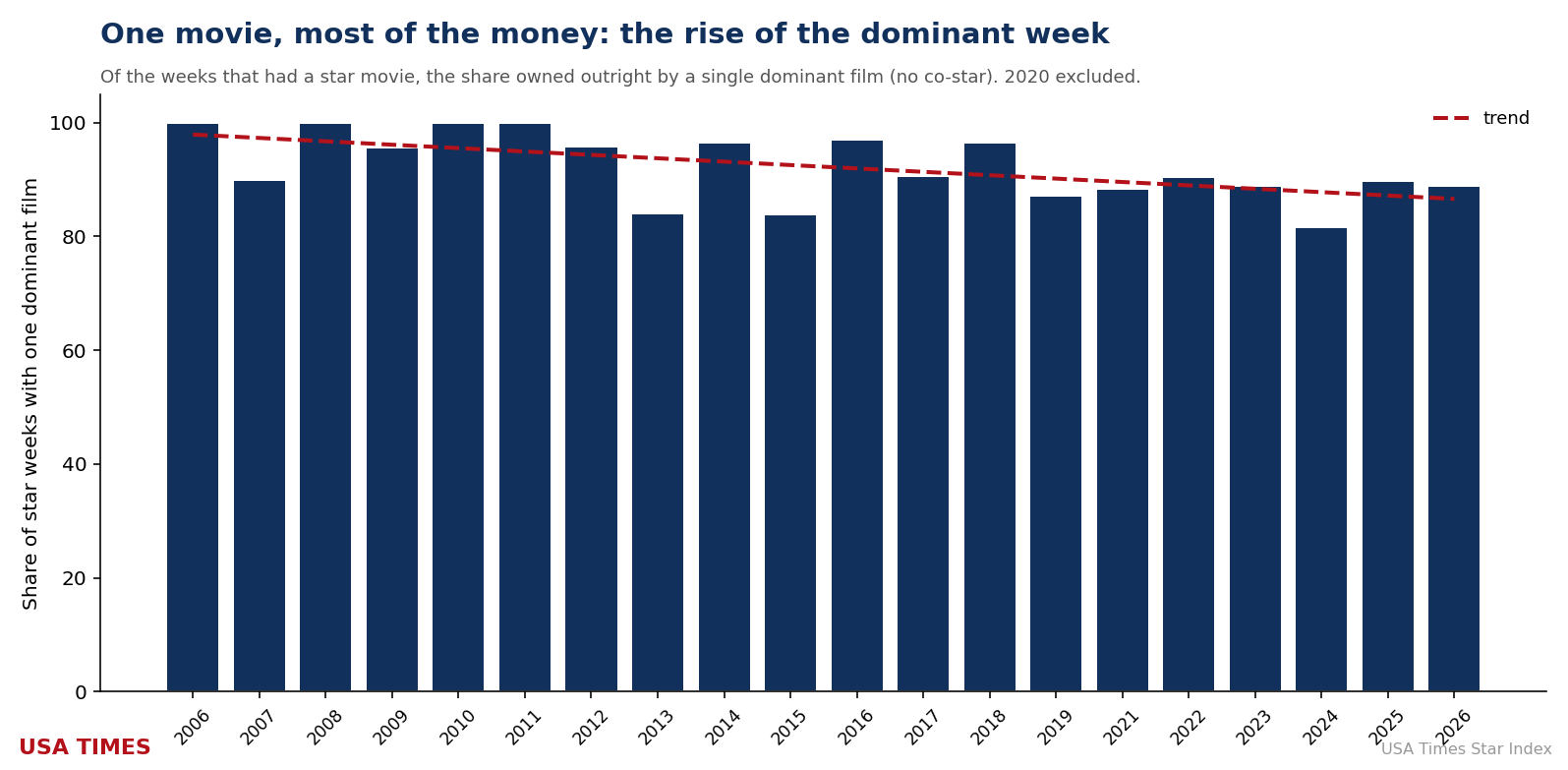
 USA Times Billion-Dollar Club: one S2 star per $1 billion in worldwide gross (floor). Two stars = crossed $2B.
The mix has flipped
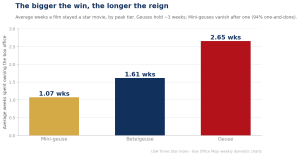
Early in the era, most weeks were shared — a #1 film out front but a crowded field behind it, so the leader’s share stayed in Mini-geuse territory. Now the opposite is true: in most recent years, the majority of the films that top a week do so by domination, not by plurality. The gold is shrinking; the navy is taking over.
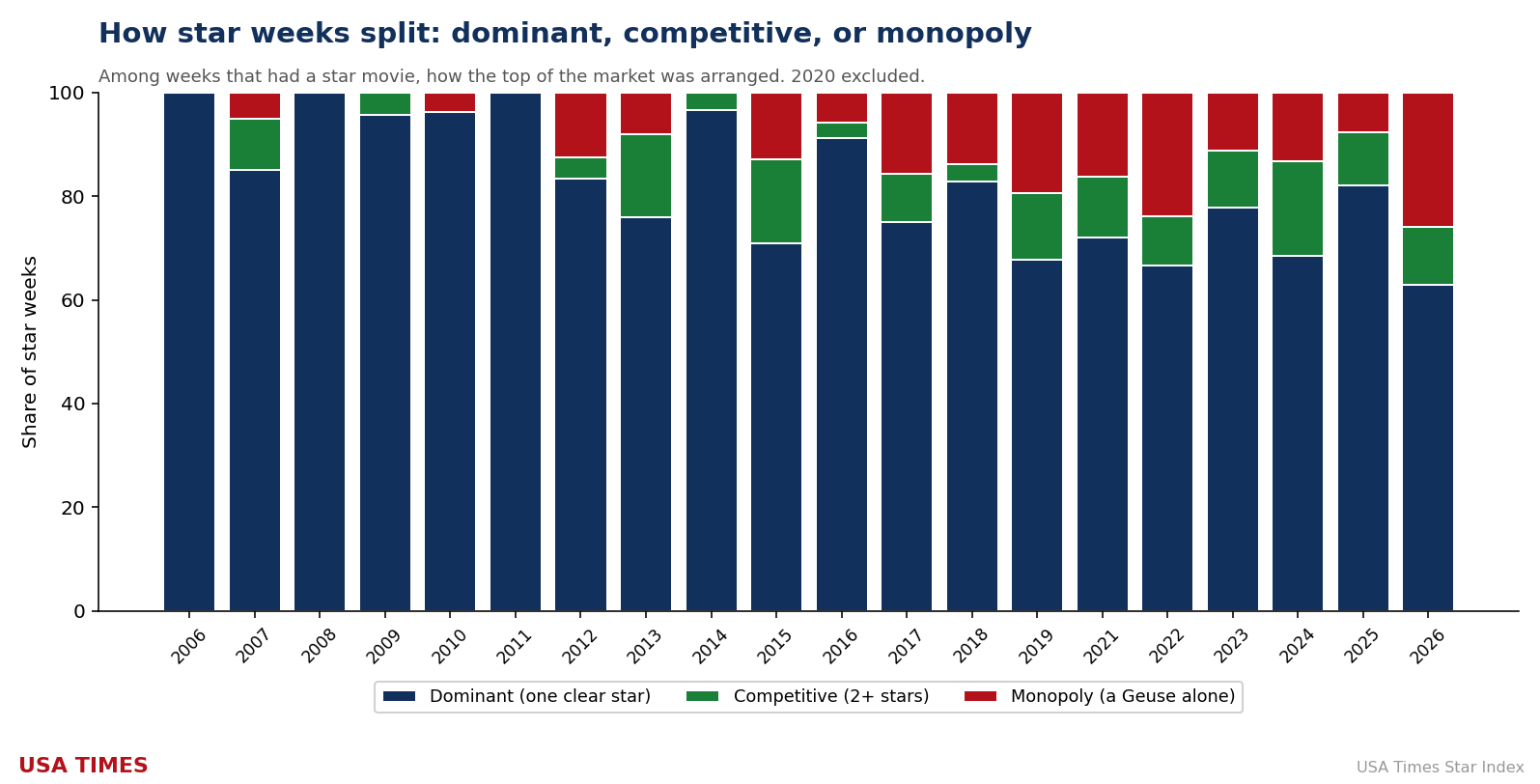
One clean exception proves the mechanism: 2020 collapses to 24%. With theaters shuttered, the films that reached #1 were small ones limping over a low bar — plenty of Mini-geuses, almost no domination. Take a real market away and the Dominant tier vanishes; hand the market to a few mega-releases and it swells.
The films doing the dominating
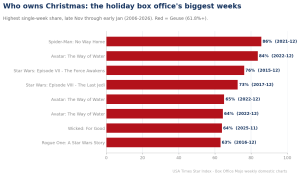
At the extreme sit the Geuses — Marvel, Avatar, Star Wars, Jurassic World, Top Gun. But the Dominant tier is broader than the giants; it is the whole top half of the market, and it is where the modern box office increasingly lives.
| Most dominant weeks, 2006–2025 | Year | Tier | Peak share |
|---|---|---|---|
| Avengers: Endgame | 2019 | Geuse | 88.3% |
| Black Panther: Wakanda Forever | 2022 | Geuse | 86.1% |
| Spider-Man: No Way Home | 2021 | Geuse | 85.6% |
| Avatar: The Way of Water | 2022 | Geuse | 83.7% |
| Doctor Strange in the Multiverse of Madness | 2022 | Geuse | 83.3% |
| Avengers: Infinity War | 2018 | Geuse | 81.3% |
| Avengers: Age of Ultron | 2015 | Geuse | 80.4% |
| The Batman | 2022 | Geuse | 79.8% |
| The Avengers | 2012 | Geuse | 79.7% |
| A Minecraft Movie | 2025 | Geuse | 78.7% |
| Iron Man 3 | 2013 | Geuse | 78.3% |
| Spider-Man 3 | 2007 | Geuse | 78.1% |
| Star Wars: Episode VII – The Force Awakens | 2015 | Geuse | 76.2% |
| Jurassic World | 2015 | Geuse | 75.2% |
| Top Gun: Maverick | 2022 | Geuse | 74.4% |
What it means
The theatrical market is consolidating into fewer, bigger events that don’t share the calendar — they command it. For studios with tentpole IP and for premium-format exhibition, that concentration is the whole business model. For everything in the middle — the mid-budget drama, the counter-programmer, the modest comedy — the squeeze is the story: a shrinking share of weeks where anyone else can breathe.
Method: each film’s peak weekly share is its highest single-week take of total U.S. box office as the #1 film, from Box Office Mojo (The Numbers as fallback). “Dominant” = peak tier of Betelgeuse or Geuse (38.2%+). Complete for 2006–2025; 2026 in progress.
- The IMAX PassportOf every box-office Geuse in 20 years, how many opened on a giant screen?
- Holding the ThroneThe rarest event in modern cinema: one film owning the U.S. box office two weeks running.
- The 20-Year Star IndexThe complete USA Times index of every star movie since 2006.
- The Star Movies of 2026, So FarUpdated weekly: which films are taking the whole market this year.
The mechanism behind the shift
The rise of total domination from exception to norm is not, at its root, a story about films getting better or audiences getting more enthusiastic. It is a story about the thinning of everything around the giants. In the mid-2000s, a blockbuster opened into a marketplace thick with alternatives — mid-budget dramas, star-driven comedies, genre pictures — all pulling real audiences and capping how large any single film’s share could grow. As that middle layer of theatrical filmmaking migrated to streaming and studios concentrated their bets on fewer, bigger titles, the marketplace hollowed out. The same-sized blockbuster now opens into a near-empty field, and so commands a far larger slice of a smaller pie. Total domination became normal not because the winners grew, but because the competition vanished.
This reframes what a record-breaking share actually signifies. When a film takes 80% of a week, the instinct is to read it as a triumph of that film’s popularity. But the more accurate reading is that it reflects the absence of anything else worth seeing that week — a symptom of a narrowed market as much as a monument to a single film’s pull. The two readings are not mutually exclusive; a genuine juggernaut and an empty field usually arrive together, each amplifying the other. But it is the emptiness, more than the juggernaut, that has changed most over twenty years.
The honest caveat, as always, is that domination measures share within a week, not total gross or quality, and a shrinking, more concentrated theatrical market is not necessarily a smaller one in dollars — ticket-price inflation and premium formats have kept revenues up even as the number of viable wide releases has fallen. But by every measure of distribution — how the available box office is spread across films — the trend is unmistakable and one-directional. The exception has become the norm, and the norm keeps getting more extreme.
Related from the USA Times Data Desk
- The Betelgeuse-Betelgeuse Week Has Happened Once in Twenty Years. Our Editor-in-Chief Bets December 18 Won't Be the Second.
- The Secret in Our Stars: The Golden-Ratio Math Hidden in the USA Times Logo
- The 38.2% Club: The ‘Betelgeuses’ That Run the Box Office
- Holding the Throne: The Films That Stayed a Box-Office Geuse Two Weeks Running (2006–2026)
- Box-office coverage index · the Star Index methodology
Sources
- Box Office Mojo — Weekend Domestic Box Office
- Box Office Mojo — Yearly Domestic Box Office
- The Numbers — Weekly Box Office Chart
- USA Times — Star Index methodology & data sources