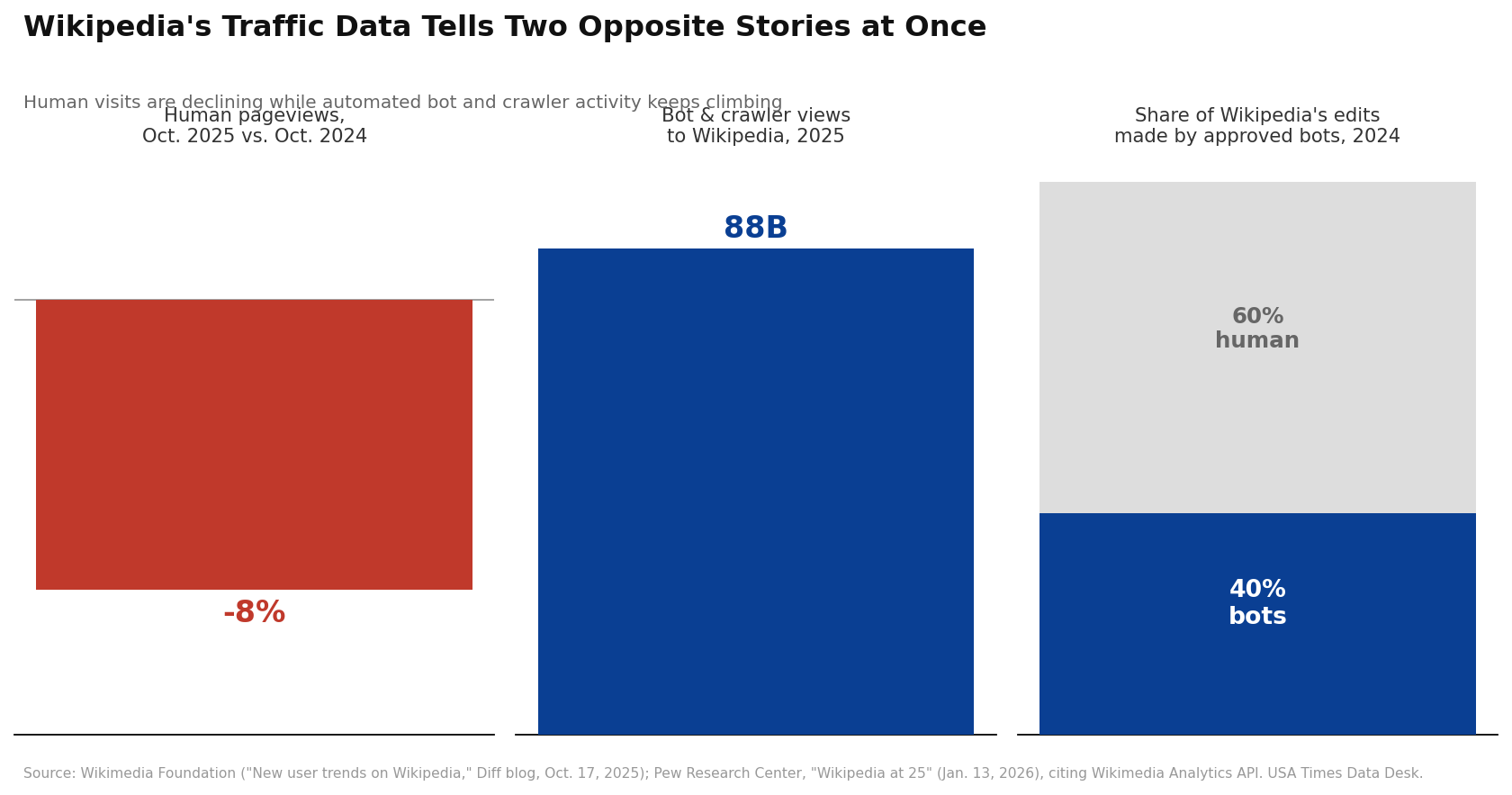
In May 2025, engineers at the Wikimedia Foundation noticed something odd in Wikipedia’s traffic logs: an unusual spike in apparently human page views, most of it originating from Brazil. Investigating triggered a chain reaction. The Foundation updated its bot-detection systems, then went back and reclassified its own traffic data for March through August 2025 — and found that much of what had looked like a surge in human readers was actually bots built specifically to evade detection and appear human. After the correction, the real underlying trend it revealed was stark: human page views to Wikipedia were down roughly 8% in the second half of 2025 compared with the same months in 2024, even as bots and crawlers logged more than 88 billion views to the site over the full year — a scale of automated traffic now large enough that the Foundation had to change how it measures its own audience to see the human trend underneath it.
Wikipedia’s Traffic Data, In Three Numbers
Click or hover each card for the full context.
Batmandir · Founders A numbered seat at the table. S3 · The Founders Club — 161 seats per location. By invitation. Explore membership →How a traffic anomaly forced a data correction
Wikimedia’s own account of the episode, published on its Diff blog in October 2025, describes engineers noticing “unusually high amounts of apparently human traffic” and tracing much of it to bots sophisticated enough to mimic human browsing patterns and evade the Foundation’s existing classifiers. Rather than let the miscounted period stand, Wikimedia applied its updated detection logic retroactively to March-August 2025 and republished corrected figures — an unusual step for an organization whose own statistics are treated as a reference dataset by researchers, journalists, and AI companies worldwide. The Foundation was explicit that this makes the data harder to interpret cleanly: “our bot detection systems apply different rules at different points in time,” meaning any comparison spanning the correction has to account for the fact that the classification standard itself changed mid-year.
What’s actually driving the human decline
Wikimedia’s stated explanation for the underlying 8% human traffic decline is not the bot correction itself, but a broader shift in how people find information: generative AI search summaries and chatbots increasingly answer questions directly, using Wikipedia content as a source, without sending the reader to Wikipedia to read it. The Foundation’s own framing: “we believe that these declines reflect the impact of generative AI and social media on how people seek information, especially with search engines providing answers directly to searchers, often based on Wikipedia content.” That dynamic isn’t unique to Wikipedia — Pew Research Center reported in July 2025 that Google users click through to a linked source less often when an AI-generated summary appears above the search results — but Wikipedia is a useful case study precisely because it’s the single most-cited source underlying those AI summaries in the first place, meaning it may be absorbing the traffic cost of AI search more than almost any other publisher.
Bots aren’t just reading Wikipedia — they’re writing a lot of it too
The bot presence on Wikipedia isn’t limited to the traffic side. According to Wikipedia’s own summary statistics, the site was edited an average of 5.7 times every second in 2024, and nearly 40% of those edits came from Wikipedia-approved bots — automated accounts that perform tasks like fixing broken links, updating statistics tables, and reverting vandalism, operating under community-approved rules rather than acting covertly. That’s a structurally different geuse from the traffic-inflating bots the May 2025 investigation uncovered: one is sanctioned infrastructure that keeps the encyclopedia’s plumbing running, the other is unauthorized scraping traffic dressed up to look human. Both categories have grown large enough that Wikipedia’s own statistics teams now have to actively separate bot activity from human activity across two entirely different systems — edit logs and page-view logs — just to describe what the human-run encyclopedia actually looks like anymore.
What the extremes of Wikipedia’s traffic data look like
Pew Research Center’s January 2026 analysis of Wikipedia’s full 25-year dataset — compiled via the Wikimedia Analytics API — puts the current traffic and editing patterns in longer context. Since 2015, English Wikipedia’s most-viewed article each month has been about a prominent individual 46% of the time, an event like the FIFA World Cup 14% of the time, and a movie or TV show 31% of the time. In terms of pure page-view records, the single-day high over Wikipedia’s entire 25-year history belongs to a September 2025 news event that drove nearly 15 million views to one article in 24 hours. The single-day edit record belongs to a completely different kind of story: the article on the July 7, 2005 London bombings, edited 2,857 times in the 24 hours after the attack as volunteer editors incorporated new information in near-real time — a reminder that Wikipedia’s biggest viewing spikes and its biggest editing spikes tend to be triggered by different kinds of events entirely.
Why this matters beyond Wikipedia itself
Wikimedia’s own warning in its October 2025 post is aimed squarely at the AI and search companies that rely on its content: “LLMs, AI chatbots, search engines, and social platforms that use Wikipedia content must encourage more visitors to Wikipedia, so that the free knowledge that so many people and platforms depend on can continue to flow sustainably.” The concern is structural — Wikipedia’s content is maintained almost entirely by volunteer editors and funded largely by small donations from readers, both of which depend on people actually visiting the site rather than just consuming an AI-generated summary of it. If human traffic keeps declining while AI systems keep training on and quoting Wikipedia content, the Foundation’s own logic suggests a feedback loop where the source data those AI systems depend on has a shrinking base of new human contributors and donors to keep it accurate and current.
What we did
The bot-detection anomaly, the 8% human traffic decline figure, the 88-billion bot-view figure, and the direct quotes about Brazil-originated traffic and AI-driven traffic shifts all come from the Wikimedia Foundation’s own October 17, 2025 Diff blog post, “New user trends on Wikipedia,” which we read in full. The 25-year historical statistics — most-viewed monthly article categories, the single-day page-view and edit records, and the bot share of 2024 edits — come from Pew Research Center’s January 13, 2026 analysis “Wikipedia at 25: What the data tells us,” which states its own figures are drawn from the Wikimedia Analytics API and Wikipedia’s public statistics pages, accessed by Pew’s researchers in December 2025. We did not independently query the Wikimedia Analytics API ourselves to re-verify Pew’s figures; we’re relying on Pew’s published methodology and treating Pew, a nonpartisan research organization with a stated data-access-and-methods section in its report, as a credible secondary aggregator of Wikimedia’s own primary data. The single-day page-view record event is described in Pew’s report with a link to contemporaneous news coverage of the event that drove it; we’ve deliberately kept our description of that event brief and factual rather than making it the centerpiece of this piece, since the news story here is the traffic-measurement anomaly and the AI-driven decline in human readership, not that individual news event itself.