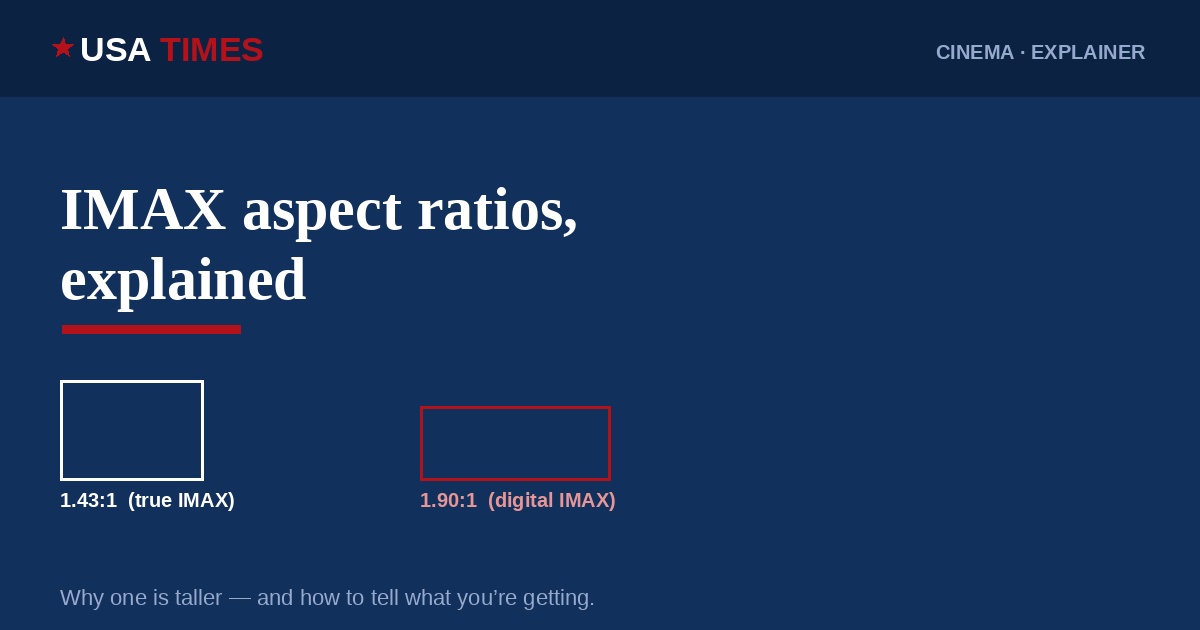
You bought a ticket that said “IMAX.” But IMAX comes in two very different shapes, and on the screen the difference is dramatic. One is tall; the other is wide. Knowing which one you’re walking into is the difference between seeing a film the way its director framed it — and seeing a cropped version of it.
The two IMAX shapes
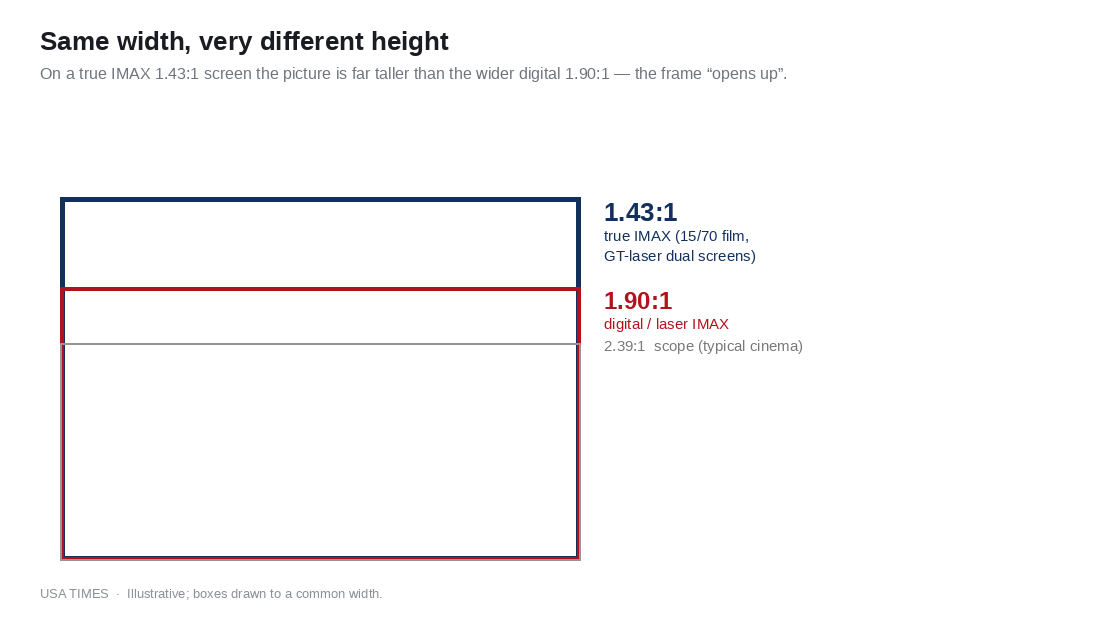
There are two aspect ratios sold under the IMAX name. The taller 1.43:1 is “true IMAX,” produced either by 15/70mm IMAX film or by a handful of premium digital houses running IMAX’s GT Laser dual-projector system. The wider 1.90:1 is “full IMAX digital,” used by most IMAX with Laser and older Xenon (digital) auditoriums. The 1.43:1 image is the one that fills more of your vertical vision — which is the entire point of the format. (Sources: CinemaView; Britannica.)
Why 1.43:1 matters: the picture “opens up”
In films shot partly with IMAX cameras, the image switches between an ordinary widescreen shape and the tall IMAX ratio. On a true 1.43:1 screen, when an IMAX sequence arrives the frame literally opens up — the black bars at the top and bottom vanish and the picture grows by up to about 40%, from floor to ceiling. On a 1.90:1 digital-IMAX screen you still get a big, bright image, but those tall sequences stay letter-boxed; you’re seeing less of the frame the filmmaker exposed. (Source: Engadget.)
Batmandir · Guest Passes Step inside for a day. Guest passes from $161/day — brought in by a member. See guest passes →Where the true 1.43:1 actually is
It’s rare. The tall GT-laser 1.43:1 dual-projector system exists in only about a dozen theaters in North America, alongside the shrinking number of houses still able to run 15/70mm film. Everything else marketed as “IMAX” is the wider 1.90:1. We keep a running list of the true 1.43:1 rooms in every true IMAX 1.43:1 theatre in the world, and a deeper explainer on what the GT dual-laser system actually buys you. (Source: DFI Rentals.)
“What aspect ratio is AMC Empire 25’s IMAX?”
It’s the question New York moviegoers ask most, so here’s the plain answer: a digital-IMAX auditorium such as AMC Empire 25 in Times Square presents the wider 1.90:1 image — not the tall 1.43:1. For New York’s true large-format IMAX, the screen to seek out is AMC Lincoln Square. Formats can vary by showtime and can change, so confirm the specific auditorium before you buy — and see our guide to Manhattan’s biggest movie screens for the theater-by-theater breakdown.
How to tell before you pay
Three quick checks. First, look at the format label: “IMAX 70mm” or a stated “1.43:1” means the tall frame; “IMAX with Laser” alone usually means 1.90:1. Second, match it to the movie — if a film advertises “filmed for IMAX,” a 1.43:1 screen is the only place you’ll see its full height. Third, when in doubt, ask the theater which aspect ratio the auditorium runs. The ticket price is often the same; the amount of picture is not.
Sources: CinemaView — Understanding IMAX aspect ratios; Engadget — IMAX vs IMAX 70mm; Encyclopædia Britannica — IMAX film format; DFI Rentals — how many 70mm IMAX theaters. Theater-specific formats change; confirm with the venue before buying.
Why two IMAX ratios exist at all
The reason IMAX presentations come in two fundamentally different shapes — the tall 1.43:1 and the wider 1.90:1 — comes down to a split in the underlying technology. The original, purest IMAX format is 70mm film, projected from those enormous horizontal reels onto a screen tall enough to fill your peripheral vision; that format’s native shape is the nearly-square 1.43:1, and it exists today on only a small number of surviving film-capable screens. The far more common modern IMAX auditorium uses digital laser projectors, whose native shape is the wider 1.90:1. So when a film advertises “IMAX,” the experience you actually get depends entirely on which kind of house you walk into — and the difference in how much image fills the screen is dramatic.
This matters most for films that were photographed with IMAX cameras in the tall format. In a true 1.43:1 film house, those sequences open up to their full, towering height, and the effect is genuinely enveloping. In a 1.90:1 digital house, the same sequences are cropped down to the wider shape — you still get a bigger, brighter image than a standard screen, but you are missing a substantial slice of the picture the filmmaker composed at the top and bottom of the frame. Two audiences buying tickets to the same “IMAX” screening of the same film, in two different theaters, can therefore see meaningfully different images.
How to know what you’re buying
Because the marketing rarely spells this out, discerning moviegoers have learned to do their own homework before buying a premium ticket. The surest tell is the theater itself: only a handful of venues worldwide still run true 1.43:1 film, and enthusiast communities maintain running lists of exactly which ones. For a digital IMAX house, the presentation will be 1.90:1 at best. Some chains now disclose the specific format on the ticketing page, and the film’s own marketing will sometimes note whether it was “filmed for IMAX” in the expanded ratio. The premium price is the same either way, which is precisely why it pays to know whether you are getting the full giant-screen image or a cropped approximation of it.
None of this is to disparage the 1.90:1 experience, which remains a genuine step up from a conventional screen in brightness, scale, and sound. But the gap between the two IMAX ratios is real and widening as more films are shot in the tall format specifically to exploit it — and understanding which shape you are actually paying for is the difference between seeing a film as its makers intended and seeing a competent, cropped facsimile of it.
Related from the USA Times Data Desk
- The 630-Pound Movie: The Absurd Logistics of Showing ‘The Odyssey’ in 70mm IMAX
- The National Average Movie Ticket Is $10.75. IMAX Routinely Charges Double That in New York and LA.
- Every Screen on Earth That Can Show The Odyssey in True IMAX 70mm — All 41 of Them
- 39 Films in 1.43
- Box-office coverage index · the Star Index methodology
Sources
- Box Office Mojo — Weekend Domestic Box Office
- IMAX — format & venue background (Wikipedia)
- USA Times — Star Index methodology & data sources